
Newsletter
About
New arrivals
Sell your books
Cart
Contact us
Blog
Categories
Categories
Science
Astronomy
Chemistry
Mathematics
Physics
Natural History
Engineering
History of science
Medicine
Medicine
Pharmacy
Occult
Astrology
Alchemy
Occult
Social Sciences
Economy
History
Philosophy
Law
Theology
Arts & Architecture
Art & Artist's Books
Architecture
Litterature
Miscellany
Manuscripts
Fine bindings
Early printings
FREE SHIPPING WORLWIDE
WE ACCEPT
Art, Artist's Books, Architecture, Gardening
Results (91 - 120) of
134
<
2
3
4
5
>
New
Price ↓
Price ↑
Author A-Z
Author Z-A
Title A-Z
Title Z-A
Date ↑
Date ↓
DUFOUR, Henri.
Le Bayon d'Angkor Thom. Bas-Reliefs.
Publiés par les soins de la Commission Archéologique de l'Indochine, d'après les documents recueillis par la Mission Henri Dufour avec la collaboration de Charles Carpeaux.
Paris, Ernest Leroux, 1910-1913.
More Details >
2500 €
The first monograph to reproduce in its entirety the decorative bas-reliefs of the most important Khmer building, the Bayon of Angkor Thom.
The documents it contains were gathered during two archaeological missions entrusted to Henri Dufour.
This rare work is complete in both parts (bas-reliefs of the outer galleries and bas-reliefs of the inner galleries) and includes all the required plates, for a total of 1 general plan, 16 plans (1 per booklet of plates), and 252 plates.
DUCHENNE, Guillaume-Benjamin.
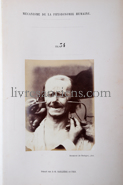
Mécanisme de la physionomie humaine ou analyse électro-physiologique de l’expression des passions.
Paris, Baillière, 1876.
More Details >
18000 €
Rare copy of the deluxe edition of the second edition with the atlas.
It's the first medical book illustrated with photographs of living subjects.
The celebrated work by Duchenne de Boulogne on facial expressions induced by electrification.
Duchenne de Boulogne’s research was intended both for anatomists and scientists (Darwin would later use Duchenne’s findings in his The Expression of the Emotions in Man and Animals) and for artists, who, as he said, “have not always been able to find the fundamental lines” of an expressive face.
Using his electrodes and induction coil, Duchenne assigned the precise role of each facial muscle in animating the human face.
He thus aimed to “make known, through electro-physiological analysis and with the help of photography, the art of accurately painting the expressive lines of the human face—a kind of orthography of physiognomy in motion” (from the preface).
A copy from the deluxe edition, issued by the publisher, accompanied by its atlas; the regular edition contained only the frontispiece and the nine plates in the text volume.
Our copy is complete with its atlas of 82 additional plates (the last eleven "aesthetic" plates are often missing).
The atlas reproduces the original photographs, whose portraits had been extracted to create the nine synoptic plates, now printed in large format on albumen paper and mounted.
The electrically induced emotions of the six models literally leap off the page.
The first series of experimental photographs (plates 3–73), featuring an old cobbler with a wrinkled face, was deemed too coarse when Duchenne first presented it. He was persuaded to create a second series (plates 74–84) showing young women in various poses—ecstatic to imitate Saint Teresa or cruel to mimic Lady Macbeth.
“Striving to satisfy those with a sense of beauty, and wishing to please while instructing, I have undertaken some new electrophysiological studies in which, as far as possible, I hope to meet the principal requirements of aesthetics: beauty of form, combined with the truth of facial expression, attitude, and gesture.” (p. 133)
He called this part of his work the aesthetic section.
Perhaps unconvinced of its scientific value, he did not always distribute these 11 “aesthetic” photographs with the atlas; for example, the copies sent to Darwin and Charcot stop at plate 73.
The publisher himself only anounced on the title page 74 plates. Copies with plates 74 to 84 are rare.
Duchenne stands at the crossroads of three recent scientific revolutions (electrical induction, physiology, and photography), yet here he has composed one of the true photographic masterpieces of the 19th century.
[DOUCET, Jérôme] DICKENS, Charles.
Monsieur Minns, Horace Sparkins.
Paris, Le Livre et L'Estampe, 1903.
More Details >
350 €
Adaptation of the work of Dickens by Jérôme Doucet under the pseudonym of F. de Montfrileux.
Stencil illustrated by Harry Elliot.
One of the 240 copies on Arches paper, ours n°277.
DORGELES, Roland.
Le Réveil des morts.
Paris, Editions Mornay, 1924.
More Details >
250 €
Edition illustrated by Carlègle.
Le Réveil des morts takes place in the immediate post-war years 14-18 on the Chemin des Dames. The refugees return to their flattened country, completely destitute, and begin to live again in this territory disfigured by the war, where the dead rub shoulders with the living. Story of a disaster, of the establishment of war damages, it is the period of reconstruction and mourning.
One of 30 copies on Japon, ours n°14.
Editions Mornay was a French publishing house founded in 1919 by Georges and Antoinette Mornay. The company was particularly known for its exquisitely designed and illustrated books, which featured the work of some of the leading illustrators of the time.
DICKENS, Charles || DORE, Gustave.
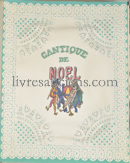
Cantiques de Noël.
Paris, Editions Textes Prétextes, 1946.
More Details >
100 €
Very beautiful illustration of this classic of ancient literature by Gustave Doré
Copy n°1 printed on pure Auvergne rag by hand, accompanied by a suite in black of illustrations on pure vellum and an original watercolor, first paper printed in 21 copies.
DESGODETZ, Antoine.
Les Édifices antiques de Rome, mesurés et dessinés très exactement sur les lieux.
Paris, Claude Antoine Jombert, 1779.
More Details >
3000 €
Second edition.
A new edition by Claude Antoine Jombert, who had just acquired the original copperplates from the descendants of the architect.
Antoine Desgodetz was sent to Rome, where he stayed for sixteen months in 1676–1677, to survey and measure ancient monuments with great precision. The purpose was well conceived, as he had already observed discrepancies in the dimensions—and thus the proportions—given in classical works on the subject.
The result was a work of obvious utility and great beauty: Desgodetz’s drawings were engraved by excellent artists, including Louis de Chastillon, Nicolas Guérard, and Jean and Pierre Lepautre. Each plate is accompanied by a facing descriptive notice specifying the measurements of the various elements and pointing out the errors in earlier treatises.
The work was justly admired and underwent several reissues. It is all the more surprising to learn that, unlike most ancient treatises, it has not lost its value: even today’s archaeologists—far more demanding than the amateurs of the past—still recognize its accuracy and usefulness.
A complete copy, with all 137 required plates.
DE LA FAILLE, Jacob-Baart || VAN GOGH, Vincent.
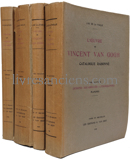
L'oeuvre de Vincent van Gogh. Catalogue raisonné.
Paris, G.Van Oest, 1928.
More Details >
1000 €
First edition.
The catalog raisonné of paintings and drawings of Van Gogh . Complete.
With :
- Lettres de vincent van gogh à Emile bernard publiées par Ambroise Vollard. 1911. Disbound. Spine damaged. To be repaired
- Francis Gobain (i.e. Gobin). Vincent Van Gogh. 1947.
DAUMIER, Honoré || (GOBIN, DELTEIL, MAISON, ...).
Lot de 28 ouvrages relatifs à Daumier provenant de la bibliothèque de documentation de Maurice Gobin.
s.l., s.n., s.d.>
More Details >
1500 €
Twenty-eight books and exhibition catalogs relating to the work of Honoré Daumier.
This collection comes from the documentation library of the art dealer Maurice Gobin (later his son Francis).
Maurice Gobin wrote a book with a catalogue raisonné of the Daumier's Sculpture (see 5).
1. DELTEIL, Loys. Oeuvre lithographié de Honoré Daumier. 1925- Paris. Complete run of 11 volumes of the lithographs of Daumier. Published in the series 'Le peintre-graveur illustré"+ volume 20 up to 29 bis (Tables).
Quarter clothes, original printed wrappers bound in.
Copy printed for Maurice Gobin, as a member of the patronage committee formed specifically by Loys Delteil for this publication on Daumier.
Copy filled with two letters from Loys Delteil to Maurice Gobin. The first thanking him for joining the patronage committee and the second requesting information on the prices achieved at auctions in Germany for Daumier's lithographs.
Also filled with four leaves from the manuscript of the book. Some annotations by Gobin and two photos of unpublished Daumier lithographs that Maurice Gobin transferred or donated to the BNF, based on his annotations.
2. MAISON, Karl Eric. Honoré Daumier: Catalogue Raisonné of Paintings, Watercolours & Drawings. 1968. Paris.
Set of two books in original slipcase
3. MAISON, Karl Eric. Daumier studies. 1954. Offprint from "The Burlington Magazine - january, march and Aprill 1954". Presentation copy.
4. CHAMPFLEURY. Catalogue de l'oeuvre lithographié et gravé de H. Daumier : avec une eau-forte inédite. 1878. (4)-52 pages and 1 etching. Poor copy, disbound without the upper cover. Only 100 copies printed. This one for A.Bareaux
5. GOBIN, Maurice. Daumier Sculpteur 1808-1879, avec un catalogue raisonné et illustré de l'oeuvre sculpté. 1952, Cailler, Genève.
6. Galerie Sagot-Le-Garrec. Daumier sculpteur, lithographe et dessinateur. 1957. Exposition catalogue. With an introduction written by Maurice Gobin.
7. Bibliothèque Nationale. DAUMIER. Lithographies, Gravures sur bois, Sculptures. 1934. Exposition catalogue.
Poor copy. Spine broken with lacks. With add in a manuscript sheet from Maurice Gobin to Marcel Lecomte (see n. 23) dated 19533 in which is discuss the date of the lithigraphy n°142 of this book.
8. DAUMIER, Jean Baptiste. Un matin de printemps. 1815. 27 pages. Stain p. 23/24.
First edition of this poem by Daumier's father. Copy that belonged to Léo Larguier (author of works on Corot, Cézanne, etc.) who then gave it to Maurice Gobin.
9. ALEXANDRE, Arsène. Honoré Daumier, l'homme et l'eouvre. Ouvrage orné d'un portrait à l'eau-forte, de deux héliogravures et de 47 illustrations. Paris, Renouard - H. Laurens, 1888.
8vo, (8)-383-(1) pages and 6 plates. Foxings.
Fine contemporary half morocco bindong signed Canapa. Originals wrappers bound in.
10. FUCHS, Edouard. Der Maler Daumier. 1927 + Supplement. 1930.
First volume in the original printed cloth and the supplement with original printed paper hardcover.
11. LE GARREC, Maurice . Trente-Six Bustes de H. Daumier, reproduits en phototypie grandeur nature. 1932. Spine chipped. 325 copies. Plates are captioned in pencil.
12. ESCHOLIER, Raymond. Daumier Peintre et Lithographe. Paris, Floury, 1923.
8vo, frontispiece, 202-(2) pages and 63 plates. Few pencil annotations.
Contemporary quarter morocco. Original wrappers bound in.
13. ESCHOLIER, Raymond. Daumier et son Monde. 1965.
14. ROGER- MARX, Claude, Daumier. 1938. Spine broken with lacks. Presentation copy to Maurice Gaubin : "Pour Maurice Gobin qui lutte pour l'art vrai avec l'amitié de CRM".
15. Burlington Magazine n°613. Avril 1954. Contain : Daumier Studies III par K.E. Maison
16. ROSENTHAL, Leon. Daumier (L' Art De Notre Temps). 1911.
17. The Journal Walter Art Gallery. Vol. XI.1948. With a paper from Marceau and Rosen : "A Terracotta by Daumier". With a manuscript paper from Gobin who give is advise on this Terracotta (par et truffé d'un page manuscrite de commentaire de Gobin sur cette terre cuite (Le Fardeau).
18. Arts et Livres de Provence. Premier Bulletin Daumier. 1949.
19. BALZER, Wolfgang. Der junge Daumier und seine Kampfgefährten. Politische Karikatur in Frankreich 1830 bis 1835. Dresden. 1965.
20. REY, Robert. Daumier. 1968.
21. FOGG ART MUSEUM. Daumier Sculpture - a Critical and Comparative Study. 1969. With ballpoint annotations on the book and on some loose sheets.
22. Catalogue vente Maurice Loncle. 22 novembre 1977. With in particular important sculptures by Daumier, with the auction prices noted in ballpoint pen.
23. SAGOT-LE GARREC. Daumier Sculpteur. * Les bustes des Parlementaire et LECOMTE, Marcel. ** Les figurines et autres sculptures. 1979. Joint exhibition of these two galleries opened on October 10, 1979
24. PASSERON, Roger. Daumier: Témoin de son temps. 1979
25. CHERPIN, Jean. Daumier et la sculpture. 1979. Presentation copy : "A Francis Gobin en témoignage de gratitude pour les conseils amicaux reçus de Maurice Gobin et l'admiration pour son oeuvre. En cordial hommage".
26. The Metropolitan Art Museum. Daumier Drawings. 1992.
27. Colta Ives. Honoré Daumier : Zeichnungen (German). 1992. German version of the catalogue of this joint exhibition (see no. 26) between the Städtische Galerie im Städelschen Kunstinstitut in Frankfurt and the Metropolitan Art Museum.
28. LOYRETTE, Henri [ under the direction ]. Daumier, 1808 -1879 - Album de l'exposition [ Musée des Beaux-Arts du Canada, Ottawa, 11 juin-6 septembre 1999 ; Galeries nationales du Grand Palais, Paris, 5 octobre 1999-3 . Washington, 19 février-14 mai 2000 ]
Due to the important weight of this set (arround 60 kg) , no shipping out France or with important shipping extra cost.
DARAGNES, Jean Gabriel || FARGUE, Léon Paul || COLETTE.
Rencontres.
Paris, Presses de Madame Daragnès, 1954.
More Details >
600 €
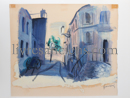
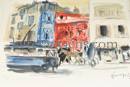
First edition illustrated with a double-page black and white drawing on the title page and 28 color woodcuts in the text and with an original gouache hand-signed by Daragnès (258x220 mm).
Book in the form of a tribute published by his friends after the death of Jean Gabriel Daragnès. Woodwinds from the artist accompanied by texts by Colette, Fargue, Segonzac...
One of the 130 copies printed on Vélin blanc with an original painting, ours n°41.
DARAGNES, Jean Gabriel || FARGUE, Léon Paul || COLETTE.
Rencontres.
Paris, Presses de Madame Daragnès, 1954.
More Details >
600 €
First edition illustrated with a double-page black and white drawing on the title page and 28 color woodcuts in the text and with an original gouache hand-signed by Daragnès (258x220 mm).
Book in the form of a tribute published by his friends after the death of Jean Gabriel Daragnès. Woodwinds from the artist accompanied by texts by Colette, Fargue, Segonzac...
One of the 130 copies printed on Vélin blanc with an original painting, ours n°21.
DACIER, Emile || SAINT-AUBIN, Gabriel de.
Gabriel de Saint-Aubin, peintre, dessinateur et graveur (1724-1780).
Paris, Van Oest, 1929-1931.
More Details >
120 €
First edition.
Volume 1 : L'Homme Et L'Oeuvre
Volume 2 : Catalogue Raisonné.
CUYP, Aelbert.
VI Stüks koitjer Geetst door A. Cuyp.
s.l, s.n, [v. 1660].
More Details >
1000 €
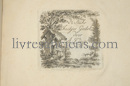
Complete series of 6 engravings by Aelbert Cuyp (1620-1691) Dutch painter, preceded by a title vignette.
Dimensions of the etchings: 67x75 mm
Dimensions of the paper: 170x135 mm
This complete set is rarely found with its margins preserved.
CURWOOD, James Oliver.
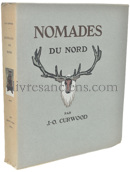
Nomades du Nord.
Paris, Editions Mornay, 1932.
More Details >
180 €
Edition illustrated by Henri Deluermoz.
One of the 57 copies on Japan paper, ours n°20.
Editions Mornay was a French publishing house founded in 1919 by Georges and Antoinette Mornay. The company was particularly known for its exquisitely designed and illustrated books, which featured the work of some of the leading illustrators of the time.
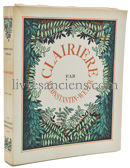
CONSTANTIN-WEYER, Maurice || FALKE, Pierre.
Clairière.
Paris, Editions Mornay, 1929.
More Details >
250 €
Edition illustrated by George Barbier.
One of the 35 copies on Japan paper, ours n°10.
Editions Mornay was a French publishing house founded in 1919 by Georges and Antoinette Mornay. The company was particularly known for its exquisitely designed and illustrated books, which featured the work of some of the leading illustrators of the time.
COLERIDGE, Samuel Taylor || LHOTE, André.
Le dit de l'ancien marinier en sept parties.
Paris, Emile-Paul frères, 1920.
More Details >
180 €
766 copies, this one number xv, one of the 27 on "papier bis du Mittineague-mill" with a suite of the illustrations.
COLERIDGE, Samuel Taylor || DARAGNES, Jean-Gabriel.
La Chanson du Vieux marin.
Paris, Société des francs-bibliophiles, 1951.
More Details >
250 €
First edition of the illustrations.
Jean Gabriel Daragnès (1886-1950) is undoubtedly one of the most famous illustrator of the middle of the XXth century, he signs here one of his last creations with sixteen original compositions. He died during the publication and did not have time to engrave them himself
One of the 160 copies on pur fil by Vidalon, ours n°155.
COCTEAU, Jean || LHOTE, André.
Escales.
Paris, Éditions de la Sirène, 1920.
More Details >
3000 €
440 copies.
This (n° xviii) one of the 25 on Hollande paper, with an additionnal text 'Musée Secret' containing 5 erotical drawing in black from Lhote that is not in the normal paper.
CHEVREUL, Michel Eugène.
Mémoire sur la vision des couleurs matérielles en mouvement de rotation et des vitesses numériques de cercles.
Paris, Firmin-Didot, 1882 [1881].
More Details >
3000 €
First edition of Chevreul's last works on color.
A rare offprint with its own title page published by Firmin-Didot in 1882, of an article presented to the Academy of Sciences in December 1880 and January 1881 (one generally only finds the article extracted from the Mémoires de l'institut published in 1883). Chevreul is interested here in physiological optics, trying to analyze how the contrast between complementary colors is affected by movement.
In his conclusion, in which he calls himself "the dean of students in France" (he was then 95 years old), he sees a direct application of his work to signaling for train drivers.
CHEVREUL, Michel Eugène.
Des couleurs et de leurs applications aux arts industriels à l’aide des cercles chromatiques. Avec XXVII planches gravées sur acier et imprimées en couleurs par René Digeon.
Paris, J.B. Baillière et Fils, 1864.
More Details >
5500 €
First edition of the rarest of Chevreul's publications on color.
Michel-Eugène Chevreul (1786-1889) is known to chemists for his research on fatty acids, saponification, and the discovery of stearin, but it is as a color theorist that his name will go down in history. Chevreul was appointed director of the Manufacture des Gobelins in 1824. Responsible for overseeing the production of dyes, he supported the work of dyers with his research on color perception. Thus, in 1839, he proposed a scientific approach to color complementarity and subsequently developed "color circles." A true "Pantone" color chart, a hundred years ahead of its time, Chevreul's color circles had the dual benefit of systematizing the production of hues (each with its own name) and making it easier to understand the concept of color complementarity. Thus, complementary colors are found on the same diameter of the color wheel, Red No. 2 corresponds to Green No. 2. "I believe I can affirm that it is possible to subject colors to a reasoned nomenclature, by relating them to types classified according to a simple method, accessible to the intelligence of all those who deal with colors" (extract from the preface). The standardization of color production was to interest first and foremost the industry then in full development, but it is undoubtedly in the Impressionist movement that Chevreul's theories found their finest accomplishment. Very early on, painters were inspired by Chevreul's work in their paintings, starting with Delacroix and then Monet. We will thus remember the fields of poppies dear to the Impressionists (Van Gogh, Monet, Pissaro...) where the red dots of the flowers burst out on complementary green backgrounds. The 27 spectacular plates were printed by René-Henri Digeon using chromochalcography, the process and difficulties of which are discussed in a paragraph in the book. Digeon appears to have presented a first edition of these plates at the 1855 World's Fair, for which he received a patent from the Empress. Several of the plates in our copy appear to be from this first edition and contain errors that have been corrected in other later copies that we have been able to consult.
CHEVREUL, Michel Eugène.
De la Loi du Contraste simultané des Couleurs et de l’Assortiment des Objets colorés, considéré d’après cette Loi dans ses Rapports avec la Peinture, les Tapisseries des Gobelins, les Tapisseries de Beauvais pour Meubles, les Tapis, la Mosaïque, les Vitraux colorés, l’Impression des Étoffes, l’Imprimerie, l’Enluminure, la Décoration des Édifices, l’Habillement et l’Horticulture.
Paris, Pitois-Levrault, 1839.
More Details >
9000 €
First edition.
One of the most influential books on art in the 19th century.
Michel-Eugène Chevreul (1786–1889) is known to chemists for his research on fatty substances (1810–1823) and on immediate organic analysis (1824), but it is as a color theorist that his name achieved lasting fame.
De la loi du contraste simultané des couleurs introduced a scientific understanding of color that had a profound and lasting impact on the painters of his time.
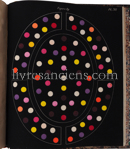
His “law” describes how the perception of a hue is altered by the surrounding colors, each color projecting its complementary onto its immediate environment (thus, a red object tends to cast a greenish glow on nearby surfaces, a yellow one a purplish tint, and so on). This principle is clearly illustrated in plate 7 of the Atlas, where colored dots on a white background seem to emit halos of their complementary hues.
Eugène Delacroix (1798–1863), a central figure of Romanticism, paid close attention to Chevreul’s research. According to the painter Paul Signac, Delacroix even sought to meet the chemist and acquired notes from his lectures in order to better grasp the law of simultaneous contrast. Several of his paintings feature harmonies built around complementary color pairs. For instance, The Entry of the Crusaders into Constantinople (1840) deliberately juxtaposes yellow/purple, blue/orange, and red/green to dramatize the scene—so effectively that art historian Lee Johnson called it an ideal “illustration” of Chevreul’s treatise.
But it was arguably within the Impressionist movement that Chevreul’s theories reached their highest artistic fulfillment. Claude Monet (1840–1926), in particular, used simultaneous contrast to heighten luminosity in his landscapes. He avoided black and earth tones, preferring instead to render shadows in color: purples and blues for shaded areas at sunset, accented with yellow-orange highlights in full light. This technique appears as early as Impression, Sunrise, the foundational work of the movement. One might also recall the poppy fields, a favorite motif of the Impressionists (Van Gogh, Monet, Pissarro…), where red flowers vibrantly stand out against green backgrounds.
A book heralding one of the greatest revolutions in painting.
Our copy is complete with all the color plates, most of them signed by Chevreul himself.
CHARLET, Nicolas-Toussaint.
Lettre autographe signée adressé à Regnier.
Viroflay, s.n., 23 juillet 1844.
More Details >
150 €
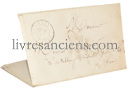
Handwritten autograph letter from Nicolas-Toussaint Charlet (1792-1845) French painter and lithographer to Mr. Regnier Maison de Tableaux at 20 Boulevard des Italians.
Written in July 1844, Charlet says she is weakened but on the road to recovery. There he concluded an agreement on honor with Regnier, a gallery owner, for the distribution of his paintings and drawings but did not want to commit himself to a contract.
This letter does not appear in the correspondence published by La Combe.
CAUËT, Christiane et Louis-Frédéric.
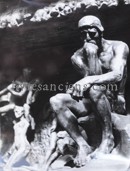
Rodin.
Photographies de Louis-Frédéric,
Poèmes de Christiane Cauët.
Paris, Collection "Argiles", [1952].
More Details >
100 €
Edition limited to 109 copies.
Copy 27.
With 11 pictures from Louis-Frédéric.
CASSOU, Jean || MARQUET, Albert.
Rhapsodie Parisienne.
Paris, Édition de la galerie Charpentier, 1950.
More Details >
2500 €
Edition illustrated by Henri Deluermoz with 142 woodcuts printed in color in Théo Schmied's studio.
Limited edition (150 copies), our, n° 10, one of the 20 first copies with an additional suite on Malacca paper and an an original drawing from A.Marquet.
Presentation copy. Incribed by the author, Jean Cassou to Lucien Muguet.
CARTON, Jean || MONTHERLANT, Henry de.
Encore un instant de bonheur.
Paris, Société du Livre d'Art, 1955.
More Details >
500 €
Limited edition (150 copies).
Our one the only 20 with the additionnal two suite of the engravings.
With an original drawing from Jean Carton.
CARCO, Francis || DIGNIMONT, André.
Dignimont.
Monte Carlo, André Sauret, 1946.
More Details >
250 €
First edition.
Monograph devoted by Francis Carco to the work of his friend André Dignimont.
One of the 385 numbered copies on Vélin de Rives, ours n° 331 containing in frontispiece a lithograph signed and numbered by the artist and theset of the 41 reproductions drawing from the work of Dignimont.
CARCO, Francis || DARAGNES, Jean Gabriel.
Les Jours & les Nuits.
Paris, Textes et Prétextes, 1946.
More Details >
100 €
First edition of illustrations.
21 color lithographs by Daragnès including 10 full-page.
One of the 200 copies on Lana paper, ours n°184.
CARCO, Francis || ASSELIN, Maurice.
Rien qu'une femme.
Paris, G.Crès et Cie, 1923.
More Details >
450 €
1228 copies, this one of the 36 on "japon impérial" paper.
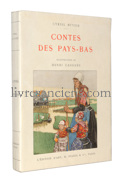
BUYSSE, Cyriel || CASSIERS, Henri.
Contes des Pays-Bas.
Paris, H. Piazza, 1910.
More Details >
400 €
First edition.
Very beautiful illustrations by Henri Cassiers (1858-1944), belgian painter.
Presentation copy.
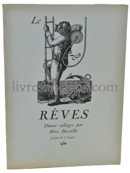
BUCAILLE, Max.
Le Scaphandrier des Rêves.
Paris, GLM, 1950.
More Details >
200 €
First edition.
Twelve collages by Max Bucaille with a preface by J. Laude
One of 465 copies on vellum paper (No. 228).
BRINK, Louise.
Women Characters in Richard Wagner - A Study in "The Ring of the Nibelung".
New York, Nervous and Mental Disease Publishing Company, 1924.
More Details >
30 €
First edition.
Presentation copy.
Results (91 - 120) of
134
<
2
3
4
5
>
New
Price ↓
Price ↑
Author A-Z
Author Z-A
Title A-Z
Title Z-A
Date ↑
Date ↓
About
Sell your books
Contact
Newsletter
Blog
52 rue des Ecoles 75005 Paris
tel. +33 (0)1 43 54 22 23
contact@livresanciens.com
Terms and conditions
European VAT number: FR87515091171
© Eric Zink, Antiquarian Bookseller