
Categories

All our Scientific books

Are you passionate about the history of science?
You will certainly find a book for you among our rare books and manuscripts of Mathematics, Physics, Chemistry or Natural Sciences.
The famous names in science are present on our shelves: Euclid, Newton, Darwin, Pascal, Lavoisier and also those who have participated in scientific progress.

Results (361 - 390) of 795
TilesList
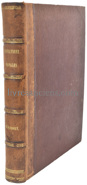
Photo GALOIS, Évariste. 

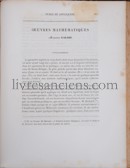
First edition of collected mathematical works of Evariste Galois given by Liouville in this volume of the Journal de Mathématiques pures et appliquées .

A brilliant mathematician, misunderstood in his day and with a tragic fate (he died at the age of 20 in a gallant duel), Galois created the notion of group, and his work has inspired generations of mathematicians.
A brilliant student, he was misunderstood by his contemporaries. Poisson rejected the work he wanted to present to the Paris Academy of Sciences.
In 1832, on the eve of his fatal duel, Galois wrote his mathematical will, which he entrusted to a friend.
It was not until 1846 that Liouville published them in this volume of the Journal des mathématiques, and not until 1870 that Jordan recognized their importance.

"When, yielding to the wish of Evariste's friends, I gave myself up, as it were under the eyes of his brother, to the attentive study of all the printed or manuscript pieces he left behind, I therefore thought I had to propose as my sole aim to seek out, to unravel, to then bring out as best I could, what was new in these productions.

My zeal was soon rewarded, and I was delighted when, after filling in a few small gaps, I recognized the complete accuracy of the method by which Galois proves, in particular, this beautiful theorem: For an irreducible equation of prime degree to be solvable by radicals, it is necessary and sufficient that all the roots be rational functions of any two of them.
This method, truly worthy of the attention of geometers, would alone suffice to secure our compatriot a place among the small number of scientists who have earned the title of inventor." (Liouville p.382).

Photo FUSTER, Joseph-Jean Nicolas. 
Photo CAUCHY, Augustin Louis || ACADÉMIE ROYALE DES SCIENCES. 
Photo CHEVREUL, Michel Eugène. 

First edition.
One of the most influential books on art in the 19th century.
Michel-Eugène Chevreul (1786–1889) is known to chemists for his research on fatty substances (1810–1823) and on immediate organic analysis (1824), but it is as a color theorist that his name achieved lasting fame.
De la loi du contraste simultané des couleurs introduced a scientific understanding of color that had a profound and lasting impact on the painters of his time.
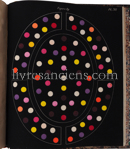
His “law” describes how the perception of a hue is altered by the surrounding colors, each color projecting its complementary onto its immediate environment (thus, a red object tends to cast a greenish glow on nearby surfaces, a yellow one a purplish tint, and so on). This principle is clearly illustrated in plate 7 of the Atlas, where colored dots on a white background seem to emit halos of their complementary hues.

Eugène Delacroix (1798–1863), a central figure of Romanticism, paid close attention to Chevreul’s research. According to the painter Paul Signac, Delacroix even sought to meet the chemist and acquired notes from his lectures in order to better grasp the law of simultaneous contrast. Several of his paintings feature harmonies built around complementary color pairs. For instance, The Entry of the Crusaders into Constantinople (1840) deliberately juxtaposes yellow/purple, blue/orange, and red/green to dramatize the scene—so effectively that art historian Lee Johnson called it an ideal “illustration” of Chevreul’s treatise.

But it was arguably within the Impressionist movement that Chevreul’s theories reached their highest artistic fulfillment. Claude Monet (1840–1926), in particular, used simultaneous contrast to heighten luminosity in his landscapes. He avoided black and earth tones, preferring instead to render shadows in color: purples and blues for shaded areas at sunset, accented with yellow-orange highlights in full light. This technique appears as early as Impression, Sunrise, the foundational work of the movement. One might also recall the poppy fields, a favorite motif of the Impressionists (Van Gogh, Monet, Pissarro…), where red flowers vibrantly stand out against green backgrounds.

A book heralding one of the greatest revolutions in painting.

Our copy is complete with all the color plates, most of them signed by Chevreul himself.

Results (361 - 390) of 795
TilesList
52 rue des Ecoles   75005 Paris
tel. +33 (0)1 43 54 22 23
European VAT number: FR87515091171
© Eric Zink, Antiquarian Bookseller