
Categories

Art & Artist's Books

Results (1 - 30) of 128
TilesList
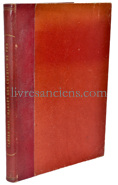
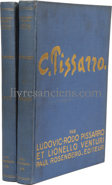
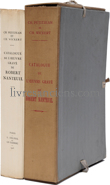
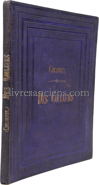
Photo CHEVREUL, Michel Eugène. 

First edition.
One of the most influential books on art in the 19th century.
Michel-Eugène Chevreul (1786–1889) is known to chemists for his research on fatty substances (1810–1823) and on immediate organic analysis (1824), but it is as a color theorist that his name achieved lasting fame.
De la loi du contraste simultané des couleurs introduced a scientific understanding of color that had a profound and lasting impact on the painters of his time.
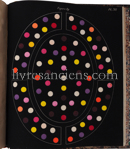
His “law” describes how the perception of a hue is altered by the surrounding colors, each color projecting its complementary onto its immediate environment (thus, a red object tends to cast a greenish glow on nearby surfaces, a yellow one a purplish tint, and so on). This principle is clearly illustrated in plate 7 of the Atlas, where colored dots on a white background seem to emit halos of their complementary hues.

Eugène Delacroix (1798–1863), a central figure of Romanticism, paid close attention to Chevreul’s research. According to the painter Paul Signac, Delacroix even sought to meet the chemist and acquired notes from his lectures in order to better grasp the law of simultaneous contrast. Several of his paintings feature harmonies built around complementary color pairs. For instance, The Entry of the Crusaders into Constantinople (1840) deliberately juxtaposes yellow/purple, blue/orange, and red/green to dramatize the scene—so effectively that art historian Lee Johnson called it an ideal “illustration” of Chevreul’s treatise.

But it was arguably within the Impressionist movement that Chevreul’s theories reached their highest artistic fulfillment. Claude Monet (1840–1926), in particular, used simultaneous contrast to heighten luminosity in his landscapes. He avoided black and earth tones, preferring instead to render shadows in color: purples and blues for shaded areas at sunset, accented with yellow-orange highlights in full light. This technique appears as early as Impression, Sunrise, the foundational work of the movement. One might also recall the poppy fields, a favorite motif of the Impressionists (Van Gogh, Monet, Pissarro…), where red flowers vibrantly stand out against green backgrounds.

A book heralding one of the greatest revolutions in painting.

Our copy is complete with all the color plates, most of them signed by Chevreul himself.

Photo CHEVREUL, Michel Eugène. 

First edition of the rarest of Chevreul's publications on color.

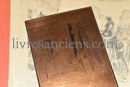
Michel-Eugène Chevreul (1786-1889) is known to chemists for his research on fatty acids, saponification, and the discovery of stearin, but it is as a color theorist that his name will go down in history. Chevreul was appointed director of the Manufacture des Gobelins in 1824. Responsible for overseeing the production of dyes, he supported the work of dyers with his research on color perception. Thus, in 1839, he proposed a scientific approach to color complementarity and subsequently developed "color circles." A true "Pantone" color chart, a hundred years ahead of its time, Chevreul's color circles had the dual benefit of systematizing the production of hues (each with its own name) and making it easier to understand the concept of color complementarity. Thus, complementary colors are found on the same diameter of the color wheel, Red No. 2 corresponds to Green No. 2. "I believe I can affirm that it is possible to subject colors to a reasoned nomenclature, by relating them to types classified according to a simple method, accessible to the intelligence of all those who deal with colors" (extract from the preface). The standardization of color production was to interest first and foremost the industry then in full development, but it is undoubtedly in the Impressionist movement that Chevreul's theories found their finest accomplishment. Very early on, painters were inspired by Chevreul's work in their paintings, starting with Delacroix and then Monet. We will thus remember the fields of poppies dear to the Impressionists (Van Gogh, Monet, Pissaro...) where the red dots of the flowers burst out on complementary green backgrounds. The 27 spectacular plates were printed by René-Henri Digeon using chromochalcography, the process and difficulties of which are discussed in a paragraph in the book. Digeon appears to have presented a first edition of these plates at the 1855 World's Fair, for which he received a patent from the Empress. Several of the plates in our copy appear to be from this first edition and contain errors that have been corrected in other later copies that we have been able to consult.

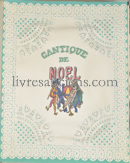
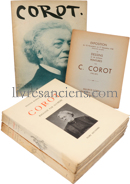
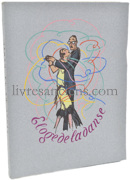
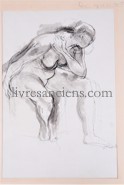
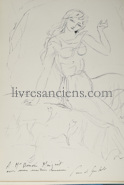
Photo [ÉLOGES et PORTRAITS (Collection Bruker)]. 

Manuel Bruker, was born in 1891 in Radaut, Romania. He was three years old when his family arrived in France and settled in Paris around 1894.

After studying medicine and receiving his doctorate in 1917, he became an ear, nose and throat specialist.

Dr. Manuel Bruker was, in the words of Pierre Mac Orlan, a "book lover" with a real passion for art.

In 1926, at the age of thirty-five, he created his own publishing house on the advice of his friend Dr. Lucien-Graux, "the prince of bibliophiles".

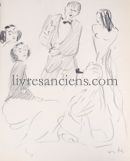
Between 1931 and 1963, Bruker devoted himself to what was to be the most original and personal part of his work as a publisher: the creation of Praise and Portraits of Artists. He chose among his contemporaries those whose work he particularly esteemed; collaborating with them, he commissioned prints to illustrate the texts, which were written by writers or art critics often close to the artist. During these three decades Manuel Bruker publishes forty-six Praises and Portraits.
These works, which testify to the publisher's aspirations in the field of illustrated books - Manuel Bruker considered this field to be "a production in which France has been able to take the lead" - have rarely been brought together. They have been the subject of three exhibitions, the first at the municipal library of Toulouse in 1958, more recently at the Meguro Museum of Tokyo in the fall of 2003, and then at the Museum of Fine Arts of Bordeaux in 2005, from whom we borrow this introduction.

A very rare and complete collection of the 34 "Praises" and 12 "Portraits" published by Manuel Bruker.

If most of these works are easy to find, some are rare, such as the portrait of Hasegawa

Most of them are printed at 200 copies, some at 150 or 250 copies.

The "Eloges" :
Eloge de Raoul Dufy par Fernand Fleuret. Paris, 1932.
Eloge de J.-E Laboureur par le Dr Lucien-Graux. Paris, 1938.
Eloge de H. de Waroquier par A.- H Martinie. Paris, 1945.
Eloge de Pierre Bonnard par Léon Werth. Paris, 1946.
Eloge de Bernard Naudin par Claude Roger-Marx. Paris, 1947.
Eloge de Albert Marquet par Léon Werth. Paris, 1948.
Eloge de Gus Bofa par Pierre Mac Orlan. Paris, 1949.
Eloge de Jean Frélaut par Jacques de Laprade. Paris, 1950.
Eloge de Lucien Mainssieux par Manuel Bruker. Paris, 1950.
Eloge de Marcel Vertès par Georges Huisman. Paris, 1951.
Eloge de Louise Hervieu par Claude Roger-Marx. Paris, 1953.
Eloge de Henri Manguin par Charles Terrasse. Paris, 1954.
Eloge de Jacques Villon par Jacques Lassaigne. Paris, 1955.
Eloge de Maurice Brianchon par Claude Roger-Marx. Paris, 1955.
Eloge de Yves Brayer par Jean Bouret. Paris, 1955.
Eloge de Maurice Utrillo par Renée Willy. Paris, 1956.
Eloge de J.-G. Daragnès par Pierre Mac Orlan. Paris, 1956.
Eloge de Charles Camoin par Charles Vildrac. Paris, 1956.
Eloge de Van Dongen par Paul Guth. Paris, 1957.
Eloge de François Desnoyer par Jean Bouret. Paris, 1958.
Eloge de Clavé par Pierre Osenat. Paris, 1958.
Eloge de Gromaire par Guy Dornand. Paris, 1958.
Eloge de Cavaillès par Jean Cassou. 1958.
Eloge de Derain par Marc Sandoz. 1958.
Eloge de Roland Oudot par Claude Roger-Marx. Paris, 1958.
Eloge de Maurice Asselin par Marc Sandoz. Paris,1959.
Eloge de André Lhote par Guy Dornand. Paris,1960.
Eloge de Louis Neillot par Jean Bouret. Paris, 1962.
Eloge de Jean Lurçat par Robert Mallet. Paris, 1962.
Eloge de Robert Humblot par Claude Roger-Marx. Paris, 1962.
Eloge de Georges Oudot par Guy Dornand. Paris, 1962.
Eloge de Emile Bernard par Louis Hautecoeur. Paris, 1962.
Eloge de Michel Rodde par Gérard Mourgue. Paris, 1963.
Eloge de Dunoyer de Segonzac par Maurice Loncle. Paris, 1963


The "Portraits" :
Portrait de J.-L. Soulas par Jacques de Laprade. Paris, 1950.
Portrait d’A. Jacquemin par Louis Cheronnet. 1951.
Portrait d’Albert Decaris par lui-même. Paris, 1953.
Portrait de D. Galanis par André Beucler. Paris, 1954.
Portrait de Robert Lotiron par Claude Roger-Marx. Paris, 1955.
Portrait d’Abram Krol par Maurice Toesca. Paris, 1957.
Portrait de Jacob Balgley par Claude Roger-Marx. 1959.
Portrait de Monique Jörgensen par elle-même. Paris, 1959.
Portrait de Germaine de Coster par Raymond Cogniat. Paris, 1960.
Portrait de Ilya Bechkov par Bogomil Raino. 1960.
Portrait de Kiyoshi Hasegawa par Robert Rey. Paris, 1963.
Portrait de Hélène Marre par Jean-Luc Michaud. Paris, 1963.

Results (1 - 30) of 128
TilesList
52 rue des Ecoles   75005 Paris
tel. +33 (0)1 43 54 22 23
European VAT number: FR87515091171
© Eric Zink, Antiquarian Bookseller