Newsletter
About
New arrivals
Sell your books
Cart
Contact us
Blog
Categories
Categories
Science
Astronomy
Chemistry
Mathematics
Physics
Natural History
Engineering
History of science
Medicine
Medicine
Pharmacy
Occult
Astrology
Alchemy
Occult
Social Sciences
Economy
History
Philosophy
Law
Theology
Arts & Architecture
Art & Artist's Books
Architecture
Litterature
Miscellany
Manuscripts
Fine bindings
Early printings
FREE SHIPPING WORLWIDE
WE ACCEPT
Art & Artist's Books
Results (121 - 142) of
142
<
3
4
5
New
Price ↓
Price ↑
Author A-Z
Author Z-A
Title A-Z
Title Z-A
Date ↑
Date ↓
FRANCE, Anatole || JOU, Louis.
L'Ile des pingouins. Illustrations de Louis Jou.
Paris, Editions Lapina, 1926.
More Details >
1500 €
Copy 68, one of the 25 on 'Japon impérial' paper with additionnal etchings (two state of the etchings, a state with the copper barred and a complete suite of the woodcuts, all on japon paper.
VOLLARD, Ambroise.
La Vie et l'Oeuvre de Pierre-Auguste Renoir.
Paris, Ambroise Vollard, 1919.
More Details >
Sold
First edition printed at of 1000 copies.
Complete copy with the original engravings ("Femme nue"), from Pierre-Auguste Renoir.
We add :
- ROGER-MAX, Claude. Renoir. 1933. Presentation copy to Maurice Gobin.
DAUMIER, Honoré || (GOBIN, DELTEIL, MAISON, ...).
Lot de 28 ouvrages relatifs à Daumier provenant de la bibliothèque de documentation de Maurice Gobin.
s.l., s.n., s.d.>
More Details >
1500 €
Twenty-eight books and exhibition catalogs relating to the work of Honoré Daumier.
This collection comes from the documentation library of the art dealer Maurice Gobin (later his son Francis).
Maurice Gobin wrote a book with a catalogue raisonné of the Daumier's Sculpture (see 5).
1. DELTEIL, Loys. Oeuvre lithographié de Honoré Daumier. 1925- Paris. Complete run of 11 volumes of the lithographs of Daumier. Published in the series 'Le peintre-graveur illustré"+ volume 20 up to 29 bis (Tables).
Quarter clothes, original printed wrappers bound in.
Copy printed for Maurice Gobin, as a member of the patronage committee formed specifically by Loys Delteil for this publication on Daumier.
Copy filled with two letters from Loys Delteil to Maurice Gobin. The first thanking him for joining the patronage committee and the second requesting information on the prices achieved at auctions in Germany for Daumier's lithographs.
Also filled with four leaves from the manuscript of the book. Some annotations by Gobin and two photos of unpublished Daumier lithographs that Maurice Gobin transferred or donated to the BNF, based on his annotations.
2. MAISON, Karl Eric. Honoré Daumier: Catalogue Raisonné of Paintings, Watercolours & Drawings. 1968. Paris.
Set of two books in original slipcase
3. MAISON, Karl Eric. Daumier studies. 1954. Offprint from "The Burlington Magazine - january, march and Aprill 1954". Presentation copy.
4. CHAMPFLEURY. Catalogue de l'oeuvre lithographié et gravé de H. Daumier : avec une eau-forte inédite. 1878. (4)-52 pages and 1 etching. Poor copy, disbound without the upper cover. Only 100 copies printed. This one for A.Bareaux
5. GOBIN, Maurice. Daumier Sculpteur 1808-1879, avec un catalogue raisonné et illustré de l'oeuvre sculpté. 1952, Cailler, Genève.
6. Galerie Sagot-Le-Garrec. Daumier sculpteur, lithographe et dessinateur. 1957. Exposition catalogue. With an introduction written by Maurice Gobin.
7. Bibliothèque Nationale. DAUMIER. Lithographies, Gravures sur bois, Sculptures. 1934. Exposition catalogue.
Poor copy. Spine broken with lacks. With add in a manuscript sheet from Maurice Gobin to Marcel Lecomte (see n. 23) dated 19533 in which is discuss the date of the lithigraphy n°142 of this book.
8. DAUMIER, Jean Baptiste. Un matin de printemps. 1815. 27 pages. Stain p. 23/24.
First edition of this poem by Daumier's father. Copy that belonged to Léo Larguier (author of works on Corot, Cézanne, etc.) who then gave it to Maurice Gobin.
9. ALEXANDRE, Arsène. Honoré Daumier, l'homme et l'eouvre. Ouvrage orné d'un portrait à l'eau-forte, de deux héliogravures et de 47 illustrations. Paris, Renouard - H. Laurens, 1888.
8vo, (8)-383-(1) pages and 6 plates. Foxings.
Fine contemporary half morocco bindong signed Canapa. Originals wrappers bound in.
10. FUCHS, Edouard. Der Maler Daumier. 1927 + Supplement. 1930.
First volume in the original printed cloth and the supplement with original printed paper hardcover.
11. LE GARREC, Maurice . Trente-Six Bustes de H. Daumier, reproduits en phototypie grandeur nature. 1932. Spine chipped. 325 copies. Plates are captioned in pencil.
12. ESCHOLIER, Raymond. Daumier Peintre et Lithographe. Paris, Floury, 1923.
8vo, frontispiece, 202-(2) pages and 63 plates. Few pencil annotations.
Contemporary quarter morocco. Original wrappers bound in.
13. ESCHOLIER, Raymond. Daumier et son Monde. 1965.
14. ROGER- MARX, Claude, Daumier. 1938. Spine broken with lacks. Presentation copy to Maurice Gaubin : "Pour Maurice Gobin qui lutte pour l'art vrai avec l'amitié de CRM".
15. Burlington Magazine n°613. Avril 1954. Contain : Daumier Studies III par K.E. Maison
16. ROSENTHAL, Leon. Daumier (L' Art De Notre Temps). 1911.
17. The Journal Walter Art Gallery. Vol. XI.1948. With a paper from Marceau and Rosen : "A Terracotta by Daumier". With a manuscript paper from Gobin who give is advise on this Terracotta (par et truffé d'un page manuscrite de commentaire de Gobin sur cette terre cuite (Le Fardeau).
18. Arts et Livres de Provence. Premier Bulletin Daumier. 1949.
19. BALZER, Wolfgang. Der junge Daumier und seine Kampfgefährten. Politische Karikatur in Frankreich 1830 bis 1835. Dresden. 1965.
20. REY, Robert. Daumier. 1968.
21. FOGG ART MUSEUM. Daumier Sculpture - a Critical and Comparative Study. 1969. With ballpoint annotations on the book and on some loose sheets.
22. Catalogue vente Maurice Loncle. 22 novembre 1977. With in particular important sculptures by Daumier, with the auction prices noted in ballpoint pen.
23. SAGOT-LE GARREC. Daumier Sculpteur. * Les bustes des Parlementaire et LECOMTE, Marcel. ** Les figurines et autres sculptures. 1979. Joint exhibition of these two galleries opened on October 10, 1979
24. PASSERON, Roger. Daumier: Témoin de son temps. 1979
25. CHERPIN, Jean. Daumier et la sculpture. 1979. Presentation copy : "A Francis Gobin en témoignage de gratitude pour les conseils amicaux reçus de Maurice Gobin et l'admiration pour son oeuvre. En cordial hommage".
26. The Metropolitan Art Museum. Daumier Drawings. 1992.
27. Colta Ives. Honoré Daumier : Zeichnungen (German). 1992. German version of the catalogue of this joint exhibition (see no. 26) between the Städtische Galerie im Städelschen Kunstinstitut in Frankfurt and the Metropolitan Art Museum.
28. LOYRETTE, Henri [ under the direction ]. Daumier, 1808 -1879 - Album de l'exposition [ Musée des Beaux-Arts du Canada, Ottawa, 11 juin-6 septembre 1999 ; Galeries nationales du Grand Palais, Paris, 5 octobre 1999-3 . Washington, 19 février-14 mai 2000 ]
Due to the important weight of this set (arround 60 kg) , no shipping out France or with important shipping extra cost.
RONSARD, Pierre de || [DUNOYER DE SEGONZAC André].
Quelques sonnets.
Paris, Chez l'artiste, 1955.
More Details >
2000 €
Edition illustrated by par Dunoyer de Segonzac with 51 original etchings.
Limited edition (210 copies), our, n° 8, one of the 35 copies with suite of the etchings on Japon paper and an other suite of 20 etchings.
Presentation copy, offer by the artist with a beautiful dedication to André Muguet and enriched with:
- an original drawing offered to André and Viviane Muguet, with a dedication inviting them to choose the drawing of their choice.
- a postcard addressed to André Muguet and signed by Dunoyer de Segonzac and his wife Thérèse Dormy
- 7 photographs of Dunoyer de Segonzac, including 3 with André Muguet
- a letter of greetings for 1952 signed by Dunoyer de Segonzac and his wife Thérèse Dormy
- an amusing note signed "André" (Dunoyer de Segonzac): "My dear Alexandre, to climb the 5 floors, please use this small folding chair which will allow you to sit on each landing.".
BASTIA, Georges.
Le Zoo des Vedettes.
s.l., s.n., [v. 1950].
More Details >
2000 €
First edition printed at 400 numbered copies (n° 35), with 68 caricatures by Georges BASTIA (1904-1980), on 61 plates, , representing the stars of the show of the time such as Sacha Guitry, Jean Gabin, Gérard Philippe, Madeleine Renaud, Jean-Louis Barrault, Brigitte Bardot, Jean Marais, Simone Signoret, Yves Montand, Yvonne Printemps, Bourvil, Michel Simon, etc.
Although bearing the same title and including the same preface as the work published by Éditions Héracléïa v. 1946, this work is completly different.
The rarity of this edition comes from the fact that the quality of the plates which compose it is such that they are often sold separately and sometimes by mistake as original works.
Indeed, each lithograph has een enhanced with gouache by the artist, which gives a kind of uniqueness to each copy.
GRASSET, Eugène || GILLOT, Charles.
Histoire des quatre fils Aymon - très nobles et très vaillans chevaliers. Illustrée de compositions en couleurs par Eugène Grasset. Gravure et impression par Charles Gillot. Introduction et Notes par Charles Marcilly.
Paris, H. Launette, 1883.
More Details >
2000 €
The story of the four Aymon sons is a legendary tale, which was originally a gesture song from the French Carolingian era. The four heroes, sons of Duke Aymon, are introduced to the emperor Charlemagne and will live many adventures accompanied by an enchanter and a magical horse.
Their adventures are finely illustrated by Eugène Grasset (1845-1917), one of the representatives of Art Nouveau. It combines, with delicacy and simplicity, iconography inspired by the Middle Ages and the Knighthood with Art Nouveau style (with stylized forms and characteristic ornamental motifs such as flowers).
JOYANT, Maurice || TOULOUSE-LAUTREC, Henri de.
Henri de Toulouse-Lautrec, 1864-1901: Peintre, Dessins, Estampes, Affiches.
Paris, H. Floury, 1926-1927.
More Details >
2000 €
First edition.
Copy n. 18, (one of the 175 for volume 1 and of the 200 for volume 2) Deluxe edition on japan paper with 6 original etchings, each present in two states. Without the portfolio of four original lithographs, as always.
We add :
- Exposition H. De Toulouse-Lautrec - Du 9 Avril Au 17 Mai 1931. Chipped.
- O'Connor, Patrick. Toulouse-Lautrec Plaisirs nocturnes. 1991.
DURET, Théodore || (Pissarro, Claude Monet, Sisley, Renoir, Berthe Morisot, Cézanne, Guillaumin).
Histoire des peintres impressionnistes: Pissarro, Claude Monet, Sisley, Renoir, Berthe Morisot, Cézanne, Guillaumin.
Paris, H.Floury, 1906.
More Details >
Sold
First edition of this important publication on the history of Impressionism.
A complete copy with the 5 original etchings.
- Camille Pissaro : "Les faneuses"
- Sisley : "Bords du Loing"
- Renoir : 2 original etchings. "Femme nue assise" and "Femme nue couchée"
- Cézanne : "Portrait de Guillaumin"
- Guillaumin : "Vue prise de Saardam".
CASSOU, Jean || MARQUET, Albert.
Rhapsodie Parisienne.
Paris, Édition de la galerie Charpentier, 1950.
More Details >
2500 €
Edition illustrated by Henri Deluermoz with 142 woodcuts printed in color in Théo Schmied's studio.
Limited edition (150 copies), our, n° 10, one of the 20 first copies with an additional suite on Malacca paper and an an original drawing from A.Marquet.
Presentation copy. Incribed by the author, Jean Cassou to Lucien Muguet.
[STENDHAL (Henry Beyle, dit)].
Histoire de la peinture en Italie. Par M. B. A. A.
Paris, Didot l'Aîné, 1817.
More Details >
2500 €
First edition.
A full margin copy, untrimmed.
NICERON, Jean-François.
La Perspective curieuse ou magie artificielle des effets merveilleux de : L’optique par la vision directe, la catoptrique, par la réflexion des miroirs plats, cylindriques & coniques, la dioptrique, par la réfraction des crystaux.
Paris, Pierre Billaine, 1638.
More Details >
2500 €
First edition.
This work is a treatise on optical illusions and anamorphic perspectives, written by Nicéron, a monk of the order of Minims and mathematician of the 17th century. In it, he explores the principles of geometry applied to perspective, in particular the deformations of images that are only correctly revealed from a certain angle or through a mirror.
La Perspective Curieuse is a major work in the history of visual perception and art, influencing both artists and scientists of its time.
The discussion in the fourth part is particularly famous for being the first reference to the law of refraction developed by Descartes that same year.
A title-frontispiece engraved by Daret.
COCTEAU, Jean || LHOTE, André.
Escales.
Paris, Éditions de la Sirène, 1920.
More Details >
3000 €
440 copies.
This (n° xviii) one of the 25 on Hollande paper, with an additionnal text 'Musée Secret' containing 5 erotical drawing in black from Lhote that is not in the normal paper.
DESGODETZ, Antoine.
Les Édifices antiques de Rome, mesurés et dessinés très exactement sur les lieux.
Paris, Claude Antoine Jombert, 1779.
More Details >
3000 €
Second edition.
A new edition by Claude Antoine Jombert, who had just acquired the original copperplates from the descendants of the architect.
Antoine Desgodetz was sent to Rome, where he stayed for sixteen months in 1676–1677, to survey and measure ancient monuments with great precision. The purpose was well conceived, as he had already observed discrepancies in the dimensions—and thus the proportions—given in classical works on the subject.
The result was a work of obvious utility and great beauty: Desgodetz’s drawings were engraved by excellent artists, including Louis de Chastillon, Nicolas Guérard, and Jean and Pierre Lepautre. Each plate is accompanied by a facing descriptive notice specifying the measurements of the various elements and pointing out the errors in earlier treatises.
The work was justly admired and underwent several reissues. It is all the more surprising to learn that, unlike most ancient treatises, it has not lost its value: even today’s archaeologists—far more demanding than the amateurs of the past—still recognize its accuracy and usefulness.
A complete copy, with all 137 required plates.
CHEVREUL, Michel Eugène.
Mémoire sur la vision des couleurs matérielles en mouvement de rotation et des vitesses numériques de cercles.
Paris, Firmin-Didot, 1882 [1881].
More Details >
3000 €
First edition of Chevreul's last works on color.
A rare offprint with its own title page published by Firmin-Didot in 1882, of an article presented to the Academy of Sciences in December 1880 and January 1881 (one generally only finds the article extracted from the Mémoires de l'institut published in 1883). Chevreul is interested here in physiological optics, trying to analyze how the contrast between complementary colors is affected by movement.
In his conclusion, in which he calls himself "the dean of students in France" (he was then 95 years old), he sees a direct application of his work to signaling for train drivers.
ROBAUT, Alfred || DUTILLEUX, Constant.
Carnet de dessins.
s.l., s.n., [v.1840-1900].
More Details >
4500 €
Drawing album bellonging to Alfred Robaut, with his blind-stamped monogram on the upper cover.
A draftsman and lithographer, Robaut is best known as the author of the first catalog of works by Eugène Delacroix and Jean-Baptiste Camille Corot, painters for whom he greatly admired.
He learned to paint from his father, Felix Robaut, who taught embroidery design at the Douai Academy. In 1853, he married the eldest daughter of the painter Constant Dutilleux, through whom he came into contact with Delacroix and Corot.
This album contains numerous drawings by Alfred Robault's close friends and artists from the North (Alfred Robaut, Felix Robaut, and some of his students, as well as Constant Dutilleux).
We thus find about twenty drawings by Constant Dutillleux (3 are signed, the others attributed in the margin) by his father, 10 are attributed to Félix Robaut, 18 to Alfred Robaut, others to northern artists or former students of Felix Robaut. (2 drawings signed HP attributed to Henry Pluchard, 1 sketch by Henri Regnault with the stamp of the sale of his studio, 1 signed by De La Rochenoire, 1 signed by Célestin Lepollart, 2 drawings attributed to Caullet, 1 attributed to Abel de Pujol, 1 signed by Ambroise Détrez, 3 attributed to Pierre Billet, ...).
CHEVREUL, Michel Eugène.
Des couleurs et de leurs applications aux arts industriels à l’aide des cercles chromatiques. Avec XXVII planches gravées sur acier et imprimées en couleurs par René Digeon.
Paris, J.B. Baillière et Fils, 1864.
More Details >
5500 €
First edition of the rarest of Chevreul's publications on color.
Michel-Eugène Chevreul (1786-1889) is known to chemists for his research on fatty acids, saponification, and the discovery of stearin, but it is as a color theorist that his name will go down in history. Chevreul was appointed director of the Manufacture des Gobelins in 1824. Responsible for overseeing the production of dyes, he supported the work of dyers with his research on color perception. Thus, in 1839, he proposed a scientific approach to color complementarity and subsequently developed "color circles." A true "Pantone" color chart, a hundred years ahead of its time, Chevreul's color circles had the dual benefit of systematizing the production of hues (each with its own name) and making it easier to understand the concept of color complementarity. Thus, complementary colors are found on the same diameter of the color wheel, Red No. 2 corresponds to Green No. 2. "I believe I can affirm that it is possible to subject colors to a reasoned nomenclature, by relating them to types classified according to a simple method, accessible to the intelligence of all those who deal with colors" (extract from the preface). The standardization of color production was to interest first and foremost the industry then in full development, but it is undoubtedly in the Impressionist movement that Chevreul's theories found their finest accomplishment. Very early on, painters were inspired by Chevreul's work in their paintings, starting with Delacroix and then Monet. We will thus remember the fields of poppies dear to the Impressionists (Van Gogh, Monet, Pissaro...) where the red dots of the flowers burst out on complementary green backgrounds. The 27 spectacular plates were printed by René-Henri Digeon using chromochalcography, the process and difficulties of which are discussed in a paragraph in the book. Digeon appears to have presented a first edition of these plates at the 1855 World's Fair, for which he received a patent from the Empress. Several of the plates in our copy appear to be from this first edition and contain errors that have been corrected in other later copies that we have been able to consult.
LACROIX, Paul de (éditeur).
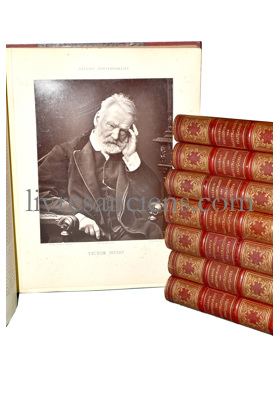
Galerie contemporaine des illustrations françaises.
Paris, Paul de Lacroix, [1884].
More Details >
6000 €
First edition.
Masterpiece of 19th century photography.
200 biographical chapters of 132 historical figures.
Copy complete with all the required notices and photographs.
Each chapter has 4 pages of text (8 for Corot 2 and Corot 3).
The series is therefore complete with the 200 entries for 132 biographies and is illustrated with 267 photographs:
- 131 portraits (65 in full-page and 66 in medallion in text)
- 136 reproductions of art works (135 in full-page and 1 in medallion the text).
Coming from the greatest photographic workshops (Nadar, Carjat, Goupil, Petit...) they are reproduced by photoglypie which is then the only printing process allowing such a faithful reproduction of photographic plates.
The portraits include the famous portrait of Baudelaire by Carjat but also those of Victor Hugo, Gustave Doré, Edmond de Goncourt, Ferdinand de Lesseps, Georges Sand, Sarah Bernhardt, Alexandre Dumas, Gustave Eiffel, Victor Hugo, Louis Pasteur, Emile Zola, ...
We added a rare "specimen" volume ( a commercial presentation volume).
ROBAUT, Alfred. COROT, Camille.
L'oeuvre de Corot.
Catalogue raisonné et illustré précédé de l'histoire de Corot et de ses oeuvres par Étienne Moreau-Nélaton.
Paris, H. Floury, 1905.
More Details >
8000 €
First edition printed at of only 400 copies.
One of the only five copies on old Japanese paper, the first large paper.
The reference catalogue raisonné of Jean-Baptiste Camille Corot's work preceded by an extensive biography of the artist's life and artwork by Etienne Moreau-Nelaton.
With descriptions and black-and-white reproductions of more than 3,000 of the artist's paintings, drawings, and engravings.
The fifth and final volume is devoted to the tables.
Our copy is bound with :
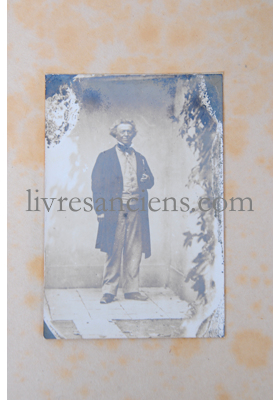
- in volume 1, two original photographs of Corot, the original Corot burial certificate, and finally two specimens for subscription to the book, dated 1904 (8 pages), one on vellum paper, the other on Japanese paper.
- in volume 4, p. 329, a photograph of Corot (Coll. Nadar, reproduced in 1910), three autograph letters signed by Corot with two stamped envelopes, and three sketches, attributed according to a pencil note to Robaut after Corot for the first and to Corot for the other two (without warranty for these attributions).
One of the letters is addressed to the parents of his student Emmanuel Damoye, in which Corot expresses concern that he has been drafted (in 1870).
A unique collection to which we are including, in paperback, the first supplement (ex. 18 of 600 copies) published 40 copies later in 1948.
UTRILLO, Maurice || CARCO, Francis.
Montmartre vécu par Utrillo.
Paris, Editions Pétridès, 1947.
More Details >
9000 €
First edition, limited edition of 240 copies.
Our copy (b), illustrated with 22 color lithographs based on gouaches by Maurice Utrillo.
CHEVREUL, Michel Eugène.
De la Loi du Contraste simultané des Couleurs et de l’Assortiment des Objets colorés, considéré d’après cette Loi dans ses Rapports avec la Peinture, les Tapisseries des Gobelins, les Tapisseries de Beauvais pour Meubles, les Tapis, la Mosaïque, les Vitraux colorés, l’Impression des Étoffes, l’Imprimerie, l’Enluminure, la Décoration des Édifices, l’Habillement et l’Horticulture.
Paris, Pitois-Levrault, 1839.
More Details >
9000 €
First edition.
One of the most influential books on art in the 19th century.
Michel-Eugène Chevreul (1786–1889) is known to chemists for his research on fatty substances (1810–1823) and on immediate organic analysis (1824), but it is as a color theorist that his name achieved lasting fame.
De la loi du contraste simultané des couleurs introduced a scientific understanding of color that had a profound and lasting impact on the painters of his time.
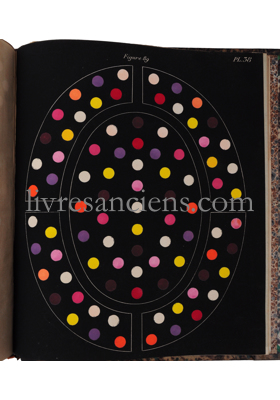
His “law” describes how the perception of a hue is altered by the surrounding colors, each color projecting its complementary onto its immediate environment (thus, a red object tends to cast a greenish glow on nearby surfaces, a yellow one a purplish tint, and so on). This principle is clearly illustrated in plate 7 of the Atlas, where colored dots on a white background seem to emit halos of their complementary hues.
Eugène Delacroix (1798–1863), a central figure of Romanticism, paid close attention to Chevreul’s research. According to the painter Paul Signac, Delacroix even sought to meet the chemist and acquired notes from his lectures in order to better grasp the law of simultaneous contrast. Several of his paintings feature harmonies built around complementary color pairs. For instance, The Entry of the Crusaders into Constantinople (1840) deliberately juxtaposes yellow/purple, blue/orange, and red/green to dramatize the scene—so effectively that art historian Lee Johnson called it an ideal “illustration” of Chevreul’s treatise.
But it was arguably within the Impressionist movement that Chevreul’s theories reached their highest artistic fulfillment. Claude Monet (1840–1926), in particular, used simultaneous contrast to heighten luminosity in his landscapes. He avoided black and earth tones, preferring instead to render shadows in color: purples and blues for shaded areas at sunset, accented with yellow-orange highlights in full light. This technique appears as early as Impression, Sunrise, the foundational work of the movement. One might also recall the poppy fields, a favorite motif of the Impressionists (Van Gogh, Monet, Pissarro…), where red flowers vibrantly stand out against green backgrounds.
A book heralding one of the greatest revolutions in painting.
Our copy is complete with all the color plates, most of them signed by Chevreul himself.
[ÉLOGES et PORTRAITS (Collection Bruker)].
Ensemble de 46 ouvrages illustrés par Dufy, Marquet, Bofa, Utrillo, Hasegawa.
Monte-Carlo, André Sauret, 1948.
More Details >
10000 €
Manuel Bruker, was born in 1891 in Radaut, Romania. He was three years old when his family arrived in France and settled in Paris around 1894.
After studying medicine and receiving his doctorate in 1917, he became an ear, nose and throat specialist.
Dr. Manuel Bruker was, in the words of Pierre Mac Orlan, a "book lover" with a real passion for art.
In 1926, at the age of thirty-five, he created his own publishing house on the advice of his friend Dr. Lucien-Graux, "the prince of bibliophiles".
Between 1931 and 1963, Bruker devoted himself to what was to be the most original and personal part of his work as a publisher: the creation of Praise and Portraits of Artists. He chose among his contemporaries those whose work he particularly esteemed; collaborating with them, he commissioned prints to illustrate the texts, which were written by writers or art critics often close to the artist. During these three decades Manuel Bruker publishes forty-six Praises and Portraits.
These works, which testify to the publisher's aspirations in the field of illustrated books - Manuel Bruker considered this field to be "a production in which France has been able to take the lead" - have rarely been brought together. They have been the subject of three exhibitions, the first at the municipal library of Toulouse in 1958, more recently at the Meguro Museum of Tokyo in the fall of 2003, and then at the Museum of Fine Arts of Bordeaux in 2005, from whom we borrow this introduction.
A very rare and complete collection of the 34 "Praises" and 12 "Portraits" published by Manuel Bruker.
If most of these works are easy to find, some are rare, such as the portrait of Hasegawa
Most of them are printed at 200 copies, some at 150 or 250 copies.
The "Eloges" :
Eloge de Raoul Dufy par Fernand Fleuret. Paris, 1932.
Eloge de J.-E Laboureur par le Dr Lucien-Graux. Paris, 1938.
Eloge de H. de Waroquier par A.- H Martinie. Paris, 1945.
Eloge de Pierre Bonnard par Léon Werth. Paris, 1946.
Eloge de Bernard Naudin par Claude Roger-Marx. Paris, 1947.
Eloge de Albert Marquet par Léon Werth. Paris, 1948.
Eloge de Gus Bofa par Pierre Mac Orlan. Paris, 1949.
Eloge de Jean Frélaut par Jacques de Laprade. Paris, 1950.
Eloge de Lucien Mainssieux par Manuel Bruker. Paris, 1950.
Eloge de Marcel Vertès par Georges Huisman. Paris, 1951.
Eloge de Louise Hervieu par Claude Roger-Marx. Paris, 1953.
Eloge de Henri Manguin par Charles Terrasse. Paris, 1954.
Eloge de Jacques Villon par Jacques Lassaigne. Paris, 1955.
Eloge de Maurice Brianchon par Claude Roger-Marx. Paris, 1955.
Eloge de Yves Brayer par Jean Bouret. Paris, 1955.
Eloge de Maurice Utrillo par Renée Willy. Paris, 1956.
Eloge de J.-G. Daragnès par Pierre Mac Orlan. Paris, 1956.
Eloge de Charles Camoin par Charles Vildrac. Paris, 1956.
Eloge de Van Dongen par Paul Guth. Paris, 1957.
Eloge de François Desnoyer par Jean Bouret. Paris, 1958.
Eloge de Clavé par Pierre Osenat. Paris, 1958.
Eloge de Gromaire par Guy Dornand. Paris, 1958.
Eloge de Cavaillès par Jean Cassou. 1958.
Eloge de Derain par Marc Sandoz. 1958.
Eloge de Roland Oudot par Claude Roger-Marx. Paris, 1958.
Eloge de Maurice Asselin par Marc Sandoz. Paris,1959.
Eloge de André Lhote par Guy Dornand. Paris,1960.
Eloge de Louis Neillot par Jean Bouret. Paris, 1962.
Eloge de Jean Lurçat par Robert Mallet. Paris, 1962.
Eloge de Robert Humblot par Claude Roger-Marx. Paris, 1962.
Eloge de Georges Oudot par Guy Dornand. Paris, 1962.
Eloge de Emile Bernard par Louis Hautecoeur. Paris, 1962.
Eloge de Michel Rodde par Gérard Mourgue. Paris, 1963.
Eloge de Dunoyer de Segonzac par Maurice Loncle. Paris, 1963
The "Portraits" :
Portrait de J.-L. Soulas par Jacques de Laprade. Paris, 1950.
Portrait d’A. Jacquemin par Louis Cheronnet. 1951.
Portrait d’Albert Decaris par lui-même. Paris, 1953.
Portrait de D. Galanis par André Beucler. Paris, 1954.
Portrait de Robert Lotiron par Claude Roger-Marx. Paris, 1955.
Portrait d’Abram Krol par Maurice Toesca. Paris, 1957.
Portrait de Jacob Balgley par Claude Roger-Marx. 1959.
Portrait de Monique Jörgensen par elle-même. Paris, 1959.
Portrait de Germaine de Coster par Raymond Cogniat. Paris, 1960.
Portrait de Ilya Bechkov par Bogomil Raino. 1960.
Portrait de Kiyoshi Hasegawa par Robert Rey. Paris, 1963.
Portrait de Hélène Marre par Jean-Luc Michaud. Paris, 1963.
DUCHENNE, Guillaume-Benjamin.
Mécanisme de la physionomie humaine ou analyse électro-physiologique de l’expression des passions.
Paris, Baillière, 1876.
More Details >
18000 €
Rare copy of the deluxe edition of the second edition with the atlas.
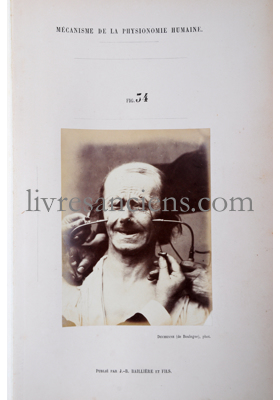
It's the first medical book illustrated with photographs of living subjects.
The celebrated work by Duchenne de Boulogne on facial expressions induced by electrification.
Duchenne de Boulogne’s research was intended both for anatomists and scientists (Darwin would later use Duchenne’s findings in his The Expression of the Emotions in Man and Animals) and for artists, who, as he said, “have not always been able to find the fundamental lines” of an expressive face.
Using his electrodes and induction coil, Duchenne assigned the precise role of each facial muscle in animating the human face.
He thus aimed to “make known, through electro-physiological analysis and with the help of photography, the art of accurately painting the expressive lines of the human face—a kind of orthography of physiognomy in motion” (from the preface).
A copy from the deluxe edition, issued by the publisher, accompanied by its atlas; the regular edition contained only the frontispiece and the nine plates in the text volume.
Our copy is complete with its atlas of 82 additional plates (the last eleven "aesthetic" plates are often missing).
The atlas reproduces the original photographs, whose portraits had been extracted to create the nine synoptic plates, now printed in large format on albumen paper and mounted.
The electrically induced emotions of the six models literally leap off the page.
The first series of experimental photographs (plates 3–73), featuring an old cobbler with a wrinkled face, was deemed too coarse when Duchenne first presented it. He was persuaded to create a second series (plates 74–84) showing young women in various poses—ecstatic to imitate Saint Teresa or cruel to mimic Lady Macbeth.
“Striving to satisfy those with a sense of beauty, and wishing to please while instructing, I have undertaken some new electrophysiological studies in which, as far as possible, I hope to meet the principal requirements of aesthetics: beauty of form, combined with the truth of facial expression, attitude, and gesture.” (p. 133)
He called this part of his work the aesthetic section.
Perhaps unconvinced of its scientific value, he did not always distribute these 11 “aesthetic” photographs with the atlas; for example, the copies sent to Darwin and Charcot stop at plate 73.
The publisher himself only anounced on the title page 74 plates. Copies with plates 74 to 84 are rare.
Duchenne stands at the crossroads of three recent scientific revolutions (electrical induction, physiology, and photography), yet here he has composed one of the true photographic masterpieces of the 19th century.
Results (121 - 142) of
142
<
3
4
5
New
Price ↓
Price ↑
Author A-Z
Author Z-A
Title A-Z
Title Z-A
Date ↑
Date ↓
About
Sell your books
Contact
Newsletter
Blog
52 rue des Ecoles 75005 Paris
tel. +33 (0)1 43 54 22 23
contact@livresanciens.com
Terms and conditions
European VAT number: FR87515091171
© Eric Zink, Antiquarian Bookseller