
Newsletter
About
New arrivals
Sell your books
Cart
Contact us
Blog
Categories
Categories
Science
Astronomy
Chemistry
Mathematics
Physics
Natural History
Engineering
History of science
Medicine
Medicine
Pharmacy
Occult
Astrology
Alchemy
Occult
Social Sciences
Economy
History
Philosophy
Law
Theology
Arts & Architecture
Art & Artist's Books
Architecture
Litterature
Miscellany
Manuscripts
Fine bindings
Early printings
FREE SHIPPING WORLWIDE
WE ACCEPT
Engineering
Results (121 - 150) of
182
<
3
4
5
6
7
>
New
Price ↓
Price ↑
Author A-Z
Author Z-A
Title A-Z
Title Z-A
Date ↑
Date ↓
FORESTIÉ, Édouard.
Les anciennes faïenceries de Montauban, Ardus, Nègrepelisse, Auvillar, Bressols, Beaumont, etc.
Montauban, Forestié Neveu, 1876.
More Details >
250 €
Fine copy of this rare study.
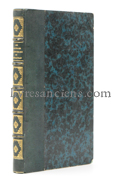
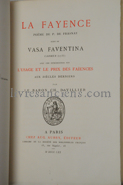
DAVILLIER, Jean Charles.
La Fayence; poème de P. de Frasnay suivi de Vasa Faventina Carmen (1735) avec une introduction sur l'usage et le prix des faïences aux siècles derniers.
Paris, Aubry, 1870.
More Details >
150 €
First edition. One of the rare on Whatman paper.
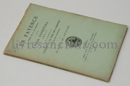
DAVILLIER, Jean Charles.
La Fayence; poème de P. de Frasnay suivi de Vasa Faventina Carmen (1735) avec une introduction sur l'usage et le prix des faïences aux siècles derniers.
Paris, Aubry, 1870.
More Details >
50 €
First edition.
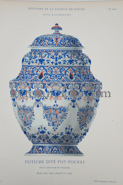
POTTIER, André.
Histoire de la Faïence de Rouen. Ouvrage postume publié par les soins de MM. L'Abbé Colas, Gustave Gouellain & Raymond Bordeaux. Orné de soixante planches imprimées en couleurs & des vignettes, d'après les dessins de Mlle. Emilie Pottier.
Rouen, Auguste le Brument, 1870.
More Details >
350 €
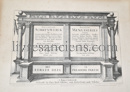
VREDEMAN DE VRIESE, Paul.
Plusieurs Menuiseries comme Portaulx, Garderobbes, Buffets, Chalicts.
Bruxelles, G. A. Van Trigt, 1869.
More Details >
100 €
Reprint in photolithographs of the original plates from 1630.
BECQUEREL. BABINET. DUHAMEL.
Instruction sur les Paratonnerres des magasins à poudre.
Paris, Gauthier-Villars, 1867.
More Details >
100 €
Rare offprint from 'Comptes rendus des séances de l'Académie des Sciences'.
In order to guarantee the powder warehouses against the risk of lightning, the Minister of War commissioned this study to the french science academy.
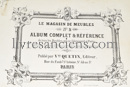
QUETIN, Victor.
Le magasin de meubles n°2: Album complet & Reference de tous Meubles qui se fabriquent a Paris contenant environ 250 modèles, dessinés en perspective.
Paris, Victor Quetin, [v.1865].
More Details >
250 €
First edition.
Collection of furniture designs by Victor Quetin, as required by the production of the time, the style of furniture oscillates between what would later be called the Louis-Philippe style and the Napoleon III style.
CHEVREUL, Michel Eugène.
Des couleurs et de leurs applications aux arts industriels à l’aide des cercles chromatiques. Avec XXVII planches gravées sur acier et imprimées en couleurs par René Digeon.
Paris, J.B. Baillière et Fils, 1864.
More Details >
5500 €
First edition of the rarest of Chevreul's publications on color.
Michel-Eugène Chevreul (1786-1889) is known to chemists for his research on fatty acids, saponification, and the discovery of stearin, but it is as a color theorist that his name will go down in history. Chevreul was appointed director of the Manufacture des Gobelins in 1824. Responsible for overseeing the production of dyes, he supported the work of dyers with his research on color perception. Thus, in 1839, he proposed a scientific approach to color complementarity and subsequently developed "color circles." A true "Pantone" color chart, a hundred years ahead of its time, Chevreul's color circles had the dual benefit of systematizing the production of hues (each with its own name) and making it easier to understand the concept of color complementarity. Thus, complementary colors are found on the same diameter of the color wheel, Red No. 2 corresponds to Green No. 2. "I believe I can affirm that it is possible to subject colors to a reasoned nomenclature, by relating them to types classified according to a simple method, accessible to the intelligence of all those who deal with colors" (extract from the preface). The standardization of color production was to interest first and foremost the industry then in full development, but it is undoubtedly in the Impressionist movement that Chevreul's theories found their finest accomplishment. Very early on, painters were inspired by Chevreul's work in their paintings, starting with Delacroix and then Monet. We will thus remember the fields of poppies dear to the Impressionists (Van Gogh, Monet, Pissaro...) where the red dots of the flowers burst out on complementary green backgrounds. The 27 spectacular plates were printed by René-Henri Digeon using chromochalcography, the process and difficulties of which are discussed in a paragraph in the book. Digeon appears to have presented a first edition of these plates at the 1855 World's Fair, for which he received a patent from the Empress. Several of the plates in our copy appear to be from this first edition and contain errors that have been corrected in other later copies that we have been able to consult.
RATIER, H.
Manuel du négociant en spiritueux.
Paris, F. Savy, 1863.
More Details >
800 €
First edition.
Rare book on the distillation and maturation of Cognac.
"My intention is therefore to demonstrate, as clearly as I can, the manner of distilling wines, to designate those which are most suitable for being burned, and in which regions they are harvested. I then give all the scales necessary to cellar masters, for the reduction and re-increase of degrees." (extract from the preface).
CHEVALIER, Arthur.
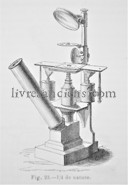
L'étudiant micrographe.
Paris, Adrien Delahaye, 1863.
More Details >
750 €
Rare first edition.
This book deals with five different types of microscopes (simple, composite, solar, gas, and electrical), and the various applications in botany, physiology, pathology and chemistry. The last chapter deals with optical instruments applied to medicine and surgery.
The atlas consists in 301 figures, in black and white, from observations made under the microscope.
[ÉCOLE POLYTECHNIQUE].
Cours d'Architecture.
s.l., s.n., [v.1860].
More Details >
190 €
Printed plates of the architecture course at the Ecole Polytechnique.
In this famous french school, student have to produce drawings of curves, surfaces, perspectives, shadows, stone cut, architecture, machine and gears, topography and fortifications.
ROBIQUET, Henri-Edmond.
Manuel théorique et pratique de photographie sur collodion et sur albumine.
Paris, Labé - Masson Sénez, 1859.
More Details >
750 €
Henri-Edmond Robiquet (1822-1860) was a French physicist and a member of the Société de Pharmacie.
He mastered photography and much of the photographic science in his textbook was personally tested in his lab at the school.
Rare first edition, complete with the photograph, using the carbon powder print technics of Garnier and Salmon.
In 1858, Henri Garnier and Alphonse Salmon discovered the photochemical reaction of ferric citrate, altering its hygroscopic and solubility properties. This led to the invention of their "dusting-on" process – procédé au charbon – using a positive rather than a negative to make the exposure. Pine soot, pigment, or metal salt particles were affixed to the tacky areas of unexposed emulsion, using a tampon in conjunction with the hot breath of the photographer. The particles were then easily washed out of the exposed areas of emulsion, leaving behind the grained image. A year later, Garnier and Salmon abandoned iron salts to pursue emulsions of ammonium dichromate and sugar. The plate in Robiquet's book is one of few, or maybe the sole, published example from their workshop of their carbon powder method.
FIGUIER, Louis.
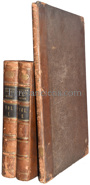
L'Année Scientifique et industrielle (7 volumes).
Paris, Hachette et Cie, 1858-1876.
More Details >
100 €
One of the first popular science journals.
Each volume devoted to a year: 1856,1859,1860,1861,1862,1869,1874.
VAN MONCKHOVEN, Désiré.
Méthodes simplifiées de photographie sur papier.
Paris, Marion et Cie, 1857.
More Details >
Sold
First edition.
Désiré Van Monckhoven is one of the most famous Belgian photographers. Chemist he participated in the dissemination of knowledge of photographic chemistry then in full explosion.
Photography on paper was invented a few years earlier by Talbo to overcome the drawbacks of daguerreotypes, in the 1850s it was still little used but it was this process (negative-positive) that allowed the photographs to be widely distributed.
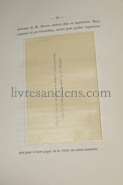
In this book Monckhoven gives the precise implementation of this process by giving in particular two samples of paper which allow to touch the papers which were then used in the middle of the XIXth century.
Following Monckoven's text were added 8 handwritten pages on collodion (another photographic process) and two notes on loose paper on these processes.
PARIS, François-Edmond.
Traité de l'Hélice Propulsive.
Paris, Arthus Bertrand, 1855.
More Details >
600 €
First edition.
Reference work on the beginnings of the use of the propeller as a means of propulsion of ships. T
he propeller improved in the 1830s begins to show its superiority over paddle wheels, and all commercial or military fleets are in full transition to steam propulsion.
The frontispiece represents the Himalaya, a British liner which is then the largest ship ever built. It will be used by the Royal Navy during the Second Opium War and will not be destroyed until 1940 by a German bombing.
Complete copy with all the required plates.
RENOU, Emilien.
Instructions météorologiques.
s.l., Société Météorologique de France, [v. 1855].
More Details >
50 €
Three texts extracted from the Yearbook of the Meteorological Society of France.
- Weather instructions.
- Usual meteorology tables.
- Errata and supplement.
[ECOLE POLYTECHNIQUE] BARDONNAUT, Ernest.
Épures - Ecole Polytechnique – 1847-49 (2vols).
s.l., s.n., 1847-1849.
More Details >
600 €
Collection of drawings, by Marie Henri Ernest Bardonnaut (X 1847).
The structure of these drawing as taught at the Ecole Polytechnique is often the same, with parts more or less developed, and drawings more or less elaborate according to the times and students.
We thus find drawings of curves, surfaces, perspectives, shadows, stone cut, architecture, machine and gears, topography and fortifications.
ANDRAUD, Antoine.
Chemins éoliques ou locomotion par l'air comprimé.
Paris, Guillaumin et Cie, 1847.
More Details >
350 €
First edition.
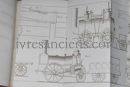
For Andraud, compressed air was an energy whose force was destined to change the face of the world. A visionary inventor, he developed a system of automobiles using compressed air as a propulsion system, the air was brought first by pipes along the route, then by tanks.
On August 26, 1844, Andraud and Tessié du Motay launched on the Paris-Versailles line (Left Bank) a new compressed air "locomotive-waggon". Weighing five tons and resembling a cylindrical boiler. As represented in the engravings in this book, Andraud planned to compete with the railways with "air-powered railways".
It was in fact in the tramway networks, after Andraud's death, that compressed air propulsion was developed in the 1860s-1870s
Presentation copy.
BERTALL.
Cahier des charges des chemins de fer. Pamphlet illustré.
Paris, J. Hetzel, 1847.
More Details >
50 €
Second edition.
Frontispiece and numerous drawings in the text by Bertall.
SCHRAMKE, Theophilus.
Description of the New-York Croton aqueduct : in English, German and French.
New York, at the authors, 1846.
More Details >
1500 €
First edition.
Rare publication on the construction of the Croton Aqueduct.
Following the Cholera epidemic of 1832, the city of New York, whose population was exploding at the time (the most populated city in the United States as early as 1820), decided to build an aqueduct to bring drinking water from the Catskills to the heart of the city.
The construction site, which spanned 40.5 miles (65 kilometers) from 1837 to 1842, was led by John B. Jervis and secured New York's water supply. It was then one of the largest works of hydraulic architecture, linking reservoirs, tunnels, and bridges. The Aqueduct remained in service until 1955.
It was the first of the monumental infrastructures that would make New York a new Rome.
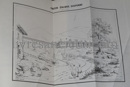
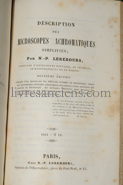
LEREBOURS, Noël Paymal.
Galerie Microscopique ET Instruction pratique sur les microscopes, contentant la description des microscopes achromatiques simplifiés.
Paris, N-P Lerebours, 1843.
More Details >
400 €
Three works on microscopes given by Lerebours
First french edition of the Microscopic cabinet of Pritchard.
Second edition of the "Description des Microscopes achromatiques simplifiés" followed, with title page and separate pagination of "description des microscopes achromatiques simplifiés " (third edition).
The Lerebours family had become specialists in the development of optical tools for scientific purposes. After being interested in daguerreotypes, Noël Paymal Lerebours turned to microscopy.
His achromatic microscopes of excellent quality are still sought after by collectors.
KUPFFER, Adolf Theodor.
Travaux de la commission pour fixer les mesures et les poids de l'empire de Russie.
St Petersbourg, Imprimerie de l'Expédition de la confection des papiers de la Couronne, 1841.
More Details >
2000 €
First edition.
Adolph Theodor Kupffer (1799-1865) was a Baltic German physical chemist and therefore subject of the Russian Empire. He proposed establishing a single system of weights and measures in Russia, whose system, still of medieval inspiration, was then very heterogeneous. Kupffer's unified system will be adopted by an imperial decree of Nicholas I in 1835. He explains the modalities in this publication in 1841. Although these works are written in French, the French decimal metric system seems to him to be mathematically logical. , too revolutionary for Russia. He preferred to draw inspiration from the London Commission of Weights and Measures and defined the standards of weight (the pound), length (the Sagène) and volume (the védro) based on English measurements. A Russian Sagène is thus worth six English feet. The basic standards are made of copper and platinum. The Kupffer system remained in use in Russia until the end of the 19th century, before the country finally adopted the metric system.
Very complete set of atlas of 15 plates which completes the text.
PENN, Johannes Jacobus.
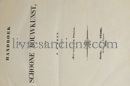
Handboek der Schoone Bouwkunst.
Breda, F.P. Sterk, 1841.
More Details >
200 €
Architecture book in Dutch.
PELOUZE, Edmond.
Secrets modernes des arts et métiers.
Paris, Librairie de Maison, 1840 - 1850.
More Details >
350 €
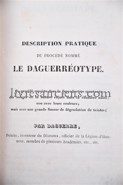
Third edition, the most important, because contains a description of the Daguerreotype's technique, presented at the Academy of Sciences of Paris on 7th January 1839 by Arago,
This book consists in many different chapters with one that reproduced the full text of the description of this revolutionary process, taken from the « Historique et description du daguerréotype et du diorama », published in 1839 by Daguerre.
It is one of the first diffusions of this technique in a book of scientific popularization (in 1840), which shows the huge success of photography among the public.
Complete copy in 3 volumes, with an additional manuscript volume written by an anonymous author (it contains a set of manufacturing methods for products such as linen marking ink, marine glue or how to make fabrics waterproof).
CHOPART, Louis Narcisse.
Essais sur les évolutions navales suivis de quelques tables.
Paris, Imprimerie royale, 1839.
More Details >
600 €
First edition.
Chopart will be Vice-Admiral of the French Navy, he will participate in particular in the Algiers expedition in 1830. His book is in line with the tactics of the 18th century sailing navy, but as a former student from polytechnique he constantly uses geometric tools to demonstrate his movements. Beautiful printing on quality paper for this naval tactics book.
CHEVALIER, Charles || PRITCHARD, Andrew.
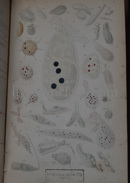
300 animalcules infusoires, dessinés à l'aide du microscope.
Paris, Charles Chevalier, 1838.
More Details >
350 €
First edition.
Chevalier, Charles (1804-1859) French optical engineer, manufacturer and seller of microscopes, including abroad, supplier in particular to the Academy of Sciences, the Collège de France, and the Ecole Polytechnique.
[POLYTECHNIQUE] CHAUVISE, Jules Thimotée.
Recueils d'Epures.
s.l., s.n., 1837-1839.
More Details >
650 €
Collection of drawings, by Jules Thimothé Chauvisé (X 1837 ; 1817-????).
The structure of these drawing as taught at the Ecole Polytechnique is often the same, with parts more or less developed, and drawings more or less elaborate according to the times and students.
We thus find drawings of curves, surfaces, perspectives, shadows, stone cut, architecture, machine and gears, topography and fortifications.
BIOT, Edouard.
Manuel du constructeur de chemins de fer.
Paris, Librairie encyclopédique Roret, 1834.
More Details >
250 €
First edition.
One of the very first works in French on railways.
Édouard Constant Biot (1803 - 1850) was a French engineer and sinologist. He participated as an engineer in the construction of the second French railway line, between Lyon and Saint-Étienne.
TERQUEM || [MANUEL RORET].
Manuel de mécanique, ou exposition élémentaire des lois de l'équilibre et du mouvement des corps solides, à l'usage des personnes privées des secours d'un maître.
Paris, Roret, 1828.
More Details >
50 €
First edition.
BULOS, Jean Antonin.
De la chaleur dans ses applications aux arts et aux manufactures.
Paris, Urbain Canel, 1825.
More Details >
60 €
First edition.
Results (121 - 150) of
182
<
3
4
5
6
7
>
New
Price ↓
Price ↑
Author A-Z
Author Z-A
Title A-Z
Title Z-A
Date ↑
Date ↓
About
Sell your books
Contact
Newsletter
Blog
52 rue des Ecoles 75005 Paris
tel. +33 (0)1 43 54 22 23
contact@livresanciens.com
Terms and conditions
European VAT number: FR87515091171
© Eric Zink, Antiquarian Bookseller