Newsletter
About
New arrivals
Sell your books
Cart
Contact us
Blog
Categories
Categories
Science
Astronomy
Chemistry
Mathematics
Physics
Natural History
Engineering
History of science
Medicine
Medicine
Pharmacy
Occult
Astrology
Alchemy
Occult
Social Sciences
Economy
History
Philosophy
Law
Theology
Arts & Architecture
Art & Artist's Books
Architecture
Litterature
Miscellany
Manuscripts
Fine bindings
Early printings
FREE SHIPPING WORLWIDE
WE ACCEPT
Engineering
Results (181 - 192) of
192
<
5
6
7
New
Price ↓
Price ↑
Author A-Z
Author Z-A
Title A-Z
Title Z-A
Date ↑
Date ↓
SCHRAMKE, Theophilus.
Description of the New-York Croton aqueduct : in English, German and French.
1846.
1500 €
More Details >
[CITROEN].
Meharee Citroën.
Album du Raid saharien Méhari.
[1968].
1500 €
More Details >
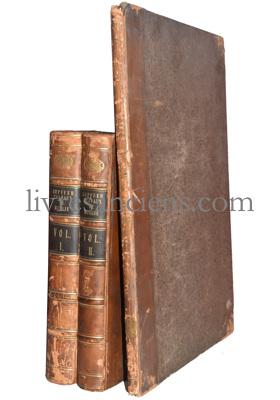
KUPFFER, Adolf Theodor.
Travaux de la commission pour fixer les mesures et les poids de l'empire de Russie.
1841.
2000 €
More Details >
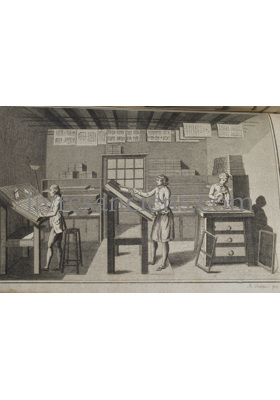
MOMORO, Antoine-François.
Traité élémentaire de l'imprimerie, ou le Manuel de l'Imprimeur.
1793.
2000 €
More Details >
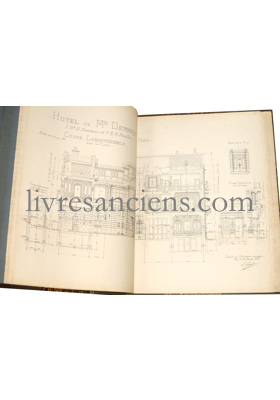
LEGRAND, Louis.
Hôtel de Mademoiselle de Marsy
Hôtel de Mme Riensch de Osa.
1894-1905.
2000 €
More Details >
GRIGNON, Pierre-Clément.
Mémoires de physique sur l'art de fabriquer le fer, d'en fondre et forger des canons d'artillerie; sur l'histoire naturelle et sur divers sujets particuliers de physique et d'économie, avec une table analytique des matières en forme de dictionnaire, pour servir à l'intelligence des termes techniques.
1775.
2400 €
More Details >
[Chambre syndicale des forces hydrauliques].
Album de la Chambre syndicale des forces hydrauliques.
1911.
2500 €
More Details >
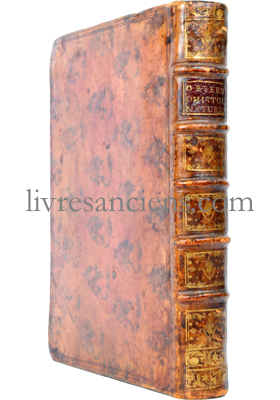
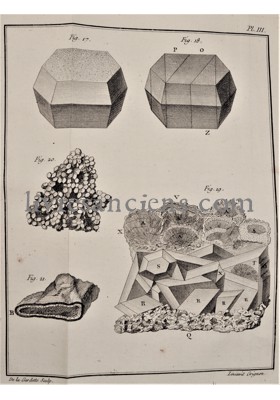
JOBLOT, Louis.
Observations d'histoire naturelle, faites avec le microscope.
1754-1755.
2500 €
More Details >
CHEVREUL, Michel Eugène.
Mémoire sur la vision des couleurs matérielles en mouvement de rotation et des vitesses numériques de cercles.
1882 [1881].
3000 €
More Details >
DESGODETZ, Antoine.
Les Édifices antiques de Rome, mesurés et dessinés très exactement sur les lieux.
1779.
3000 €
More Details >
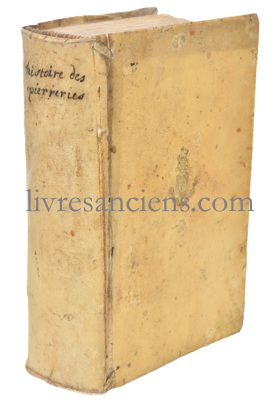
BOECE DE BOODT, Anselme.
Le Parfaict Joaillier, ou Histoire des pierreries ou sont amplement descrites leur naissance, de juste prix, moyen de les cognoistre, & se garder des contrefaites, facilitez medicinales, & propriectez curieuses.
1644.
3000 €
More Details >
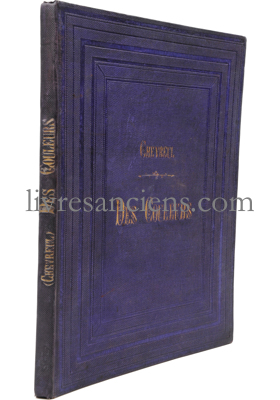
CHEVREUL, Michel Eugène.
Des couleurs et de leurs applications aux arts industriels à l’aide des cercles chromatiques. Avec XXVII planches gravées sur acier et imprimées en couleurs par René Digeon.
1864.
5500 €
More Details >
Results (181 - 192) of
192
<
5
6
7
New
Price ↓
Price ↑
Author A-Z
Author Z-A
Title A-Z
Title Z-A
Date ↑
Date ↓
About
Sell your books
Contact
Newsletter
Blog
52 rue des Ecoles 75005 Paris
tel. +33 (0)1 43 54 22 23
contact@livresanciens.com
Terms and conditions
European VAT number: FR87515091171
© Eric Zink, Antiquarian Bookseller





![Photo [CITROEN].](https://images.livresanciens.com/livres/200018/images/S1.jpg
)
![Photo [Chambre syndicale des forces hydrauliques].](https://images.livresanciens.com/livres/202915/images/S1.jpg
)