
Categories

Mathematics

Results (151 - 180) of 381
TilesList
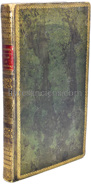
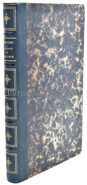
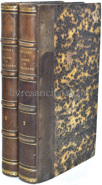
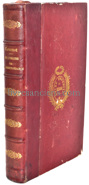
Photo GALOIS, Évariste. 

First edition of collected mathematical works of Evariste Galois given by Liouville in this volume of the Journal de Mathématiques pures et appliquées .

A brilliant mathematician, misunderstood in his day and with a tragic fate (he died at the age of 20 in a gallant duel), Galois created the notion of group, and his work has inspired generations of mathematicians.
A brilliant student, he was misunderstood by his contemporaries. Poisson rejected the work he wanted to present to the Paris Academy of Sciences.
In 1832, on the eve of his fatal duel, Galois wrote his mathematical will, which he entrusted to a friend.
It was not until 1846 that Liouville published them in this volume of the Journal des mathématiques, and not until 1870 that Jordan recognized their importance.

"When, yielding to the wish of Evariste's friends, I gave myself up, as it were under the eyes of his brother, to the attentive study of all the printed or manuscript pieces he left behind, I therefore thought I had to propose as my sole aim to seek out, to unravel, to then bring out as best I could, what was new in these productions.

My zeal was soon rewarded, and I was delighted when, after filling in a few small gaps, I recognized the complete accuracy of the method by which Galois proves, in particular, this beautiful theorem: For an irreducible equation of prime degree to be solvable by radicals, it is necessary and sufficient that all the roots be rational functions of any two of them.
This method, truly worthy of the attention of geometers, would alone suffice to secure our compatriot a place among the small number of scientists who have earned the title of inventor." (Liouville p.382).

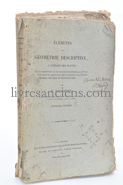
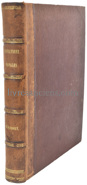
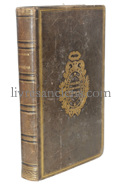
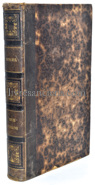
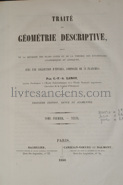
Photo MONGE, Gaspard. 

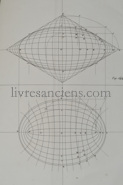
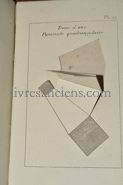
The first edition appeared in 1795 under the title 'Feuilles d'analyse appliquée à la géométrie'. In this work, Monge "assembled, along with general considerations regarding the theory of surfaces and the geometric interpretation of partial differential equations, monographs on about twenty families of surfaces defined by their mode of generation." (DSB [IX p. 476]).
In 1802, working with Hachette, he prepared a brief exposition, of analytic geometry that was designed to replace, the few remarks on the subject contained in the Feuilles. Entitled 'Application de l’algèbre à l’analyse', it was published separately in 1805; in 1807 edition and also for the fourth 1809 edition, it became, the first part of the final version of 'Feuilles d’analyse', now entitled 'Application de l'Analyse à la Géométrie.'
It's an, important work, in which, "The authors show that every plane section of a second degree surface is a second degree curve, and that parallel planes cut out similar and similarly placed curves. These results parallel Archimedes' geometric theorems. The authors also show that the hyperboloid of one sheet and the hyperbolic paraboloid are ruled surfaces, that is, each can be generated in two different ways by the motion of a line or each surfiace is formed by two systems of lines. The result on the one-sheeted hyperboloid was known by 1669 to Christopher Wren, who said that this figure could be Senerated by revolving a line about another not in the same plane. With the work of Euler, Lagrange, and Monge, analytic geometry became an independent and full-fledged branch of mathematics." (Kline in. Mathematical ... p. 547).

Fifth edition augmented by Joseph Liouville, who added substantial notes, as well as a translation of Carl Friedrich Gauss's key memoir (Disquisitiones generales circa superficies curvas, 1827) on the general theory of curved surfaces.

Results (151 - 180) of 381
TilesList
52 rue des Ecoles   75005 Paris
tel. +33 (0)1 43 54 22 23
European VAT number: FR87515091171
© Eric Zink, Antiquarian Bookseller