
Categories

All our Medicine and Pharmacy rarebooks

Do you know the quote from Georges Canguilhem "Medicine is an art at the crossroads of several Sciences"?
This is the history taught by our rare books on medicine, surgery and pharmacy: first empirical then experimental, the art of healing has been nourished by scientific progress over the centuries.
Discover how the sick were cared for under the elder ages.

Results (601 - 609) of 609
TilesList
Photo BABINSKI, Joseph - MARIE, Pierre - DEJERINE, Jules - RAYMOND, Fulgence - BRISSAUD, Édouard - BOURNEVILLE, Désiré Magloire - GUÉRARD, Léon - GEFFRIER, Paul - GILLE, Charles-Louis - GIRAUDEAU, Charles - BARTH, Henry - BLONDEAU, Amédée-René - BÉTOUS, Isidore - PLUYAUD, Pierre-Joseph - GOMBAULT, Albert - FLORAND, Antoine - LANNOIS, Maurice - ACHARD, Charles. 

Valuable collection of seventeen works on neurology.
Contains especially, the rare thesis Babinski with a handwritten dedication to Jules Comby.
Volume I :
1- BOURNEVILLE, Désiré Magloire - GUÉRARD, Léon. De la sclérose en plaques disséminées. 1869. Adrien Delahaye. Paris. (4)-239-(2) pages and one plate.
Multiple sclerosis is an autoimmune neurological disease of the central nervous system. Clinical manifestations are associated with demyelination of nerve fibers in the brain, spinal cord and optic nerve.
The causes remain unknown.
It was first described in 1868 by Charcot. So here it is one of the first study on the subject.
Bourneville was neurologist at the Bicetre hospital. He left his name to the Tuberous Sclerosis.
It is considered one of the leading child psychiatrists.
2. BABINSKI, Joseph. Étude anatomique et clinique sur la sclérose en plaques. 1885. G. Masson. Paris. 150-(1)-(1 bl.) pages et 2 planches.
Dedication signed by Babinski : "A mon ami le Dr Comby, Souvenir affectueux".
Babinski rare thesis on multiple sclerosis. He identifies than hemiplegia could be a symptom of multiple sclerosis.
Babinski remains famous for the Babinski sign.
3. GEFFRIER, Paul. Étude sur les troubles de la miction dans les maladies du système nerveux. 1884. O. Berthier. Paris. 185-(1) pages. Lack a preliminary leaf (blank or half title).
Dedication signed by Geffrier : "A mon excellent collègue Comby. Souvenirs des hopitaux".
4. GILLE, Charles-Louis . De l'hémiopie avec hémiplégie ou hémi-anesthésie. 1880. Adrien Delahaye. Paris. 45-(1 bl.)-(1)-(1 bl.) pages. Page 5 soiled.
Dedication signed by Gille :"A mon excellent ami et collègue Comby".
5. GIRAUDEAU, Charles. Des accidents vertigineux et apoplectiformes dans le cours des maladies de la moelle épinière. 1884. Adrien Delahaye. Paris. 81-(1 bl.)-(1)-(1 bl.) pages
6. BARTH, Henry. Du sommeil non naturel. Ses diverses formes. 1886. Asselin et Houzeau. Paris. (4)-186 pages.
Dedication signed by Barth : "A mon excellent ami Comby. Souvenirs affectueux".
An important thesis on sleeping.
7. DEJERINE, Jules. L'hérédité dans les maladies du système nerveux. 1886. Asselin et Houzeau. Paris. xv-(1 bl.)-293-(1 bl.) pages and 5 folding plates (The fisrt was cut in 2 parts by the binder). Lack a blank leaf at the beginning.
Heirs of Hippocrates [2114]

Volume II :
1. MARIE, Pierre. Contribution à l'étude et au diagnostic des formes frustes de la Maladie de Basedow. 1883. A. Delahaye et E. Lecrosnier. Paris. (4)-85-(1 bl.)-(1)-(1 bl.)-(1)-(1 bl.) pages. Stamp "Docteur Philippe Raverdy".
Dedication signed by Marie : "A mon ami J. Comby souvenir de Lariboisière".
G&M [3830] : "The fourth cardinal sign in exophthalmic goitre - tremor - was first mentionned by Pierre Marie"
2. BLONDEAU, Amédée-René : Étude clinique sur le pouls lent permanent avec attaques syncopales et épileptiformes. 1879. V.A. Delahaye et Cie. Paris. (4)-71-(1) pages.
Dedication signed by Blondeau : "A M. le Dr J. Comby assurance de mes sentiments sympatiques".
3. BÉTOUS, Isidore. Étude sur le tabes dorsal spasmodique. 1876. V.A. Delahaye et Cie. Paris. 46-(1)-(1 bl.) pages. Manuscript notes page 14.
4. PLUYAUD, Pierre-Joseph. Étude des réflexes tendineux dans la fièvre typhoïde. 1883. A. Delahaye et E. Lecrosnier. Paris. (4)-72-(1)-(1 bl.) pages.
5. RAYMOND, Fulgence. Étude anatomique, physiologique et clinique sur l'hémichorée l'hémianesthésie et les tremblements symptomatiques. 1876. A. Delahaye et Cie. Paris. (4)-139 (i.e. 138) pages and 3 plates.
Fulgence Raymond (1844-1910) was a French neurologist who succeeded Jean-Martin Charcot (1825-1893) as Chair of Neurology at the Salpêtrière in 1894.
6. BRISSAUD, Édouard. Recherches anatomo-pathologiques et physiologiques sur la contracture permanente des hémiplégiques. 1880. V.A. Delahaye et Cie. Paris. (4)-206 pages.
7. GOMBAULT, Albert. Étude sur la sclérose latérale amyotrophique. 1877. Ve Adrien Delahaye. Paris. (4)-86-(1)-(1 bl.) pages. Minor waterstain on margin.
8. FLORAND, Antoine. Contribution à l'étude de la sclérose latérale amyotrophique (Maladie de Charcot). 1887. G. Steinheil. Paris. 170(1)-(1 bl.). Browned, minor waterstain on margin.
Dedication signed by Florand : "Souvenir très affectueux à mon excellent ami le Docteur Jules Comby".
9. LANNOIS, Maurice. Nosographie des Chorées. 1886. J.-B. Baillère et Fils. Paris. (4)-172 pages. Minor waterstain on margin.
10. ACHARD, Charles. De l'apoplexie hystérique. 1887. Asselin et Houzeau. Paris. 98-(1)-(1 bl.) pages. Lack the half title. Minor waterstain on margin.marge
Collection of rare works made ​by Jules Comby that most books were autographed.
Comby (1853–1947) was a French pediatrician.
He has published many books on medical research on diseases in children.
The eponymous "Comby's sign" is named after him, which is an early indication of measles.

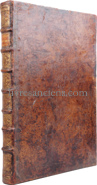
Photo [MANUSCRIT] MAHOT, Maurice. 

Original manuscript of an unpublished botanical treatise by a learned scholar from Nantes.
It presents botanical concepts as well as the classifications of Linnaeus and Tournefort. This manuscript, nearly 200 pages long, is written on the verso of the plates from Buc'hoz’s Flore Lorraine.
All plates are also annotated with details on plant names, their classification according to Linnaeus and Tournefort, and their medicinal uses—together forming a true pharmacopoeia.
These 187 plates were intended to illustrate Buc'hoz’s Traité historique des plantes qui croissent dans la Lorraine et les Trois-Évêchés, published in ten octavo volumes between 1762 and 1770. The plates, originally issued separately in installments and designed to be folded and bound in octavo, are gathered here in a single folio volume.
Buc'hoz, known for the beauty of his plates, had solicited financial support from fellow countrymen and botany enthusiasts for the production of these engravings. Thus, at the bottom of almost every plate, one finds the coat of arms and name of the sponsor who funded it.
Maurice Mahot, the author of this manuscript, sponsored plate 152.
While biographical information on Maurice Mahot “the elder” (1745–1810), a royal counselor, civil and criminal judge at the présidial, alderman (1777), and deputy mayor of Nantes (1779), offers little indication of an interest in natural sciences and botany, the same cannot be said of his son, Maurice Mahot “the younger” (1774–1842), a doctor of medicine and scholar who published several books on medicine and lexicography.
The annotations by the son—a physician—on the plates funded by the father—a botany enthusiast—explain the numerous pharmaceutical and medical recipes found in the work.
Another collector has left his name on the title page: Silas Boucher de la Ville Jossy, a member of a prominent Nantes family in the mid-19th century.
A fascinating manuscript, still largely unexplored, of exceptional character, both for the beauty of its annotated plates and for its content, which intertwines botanical classification and pharmacopoeia.

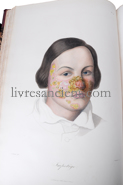
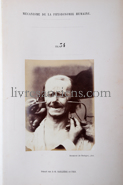
Photo DUCHENNE, Guillaume-Benjamin. 

Rare copy of the deluxe edition of the second edition with the atlas.
It's the first medical book illustrated with photographs of living subjects.
The celebrated work by Duchenne de Boulogne on facial expressions induced by electrification.
Duchenne de Boulogne’s research was intended both for anatomists and scientists (Darwin would later use Duchenne’s findings in his The Expression of the Emotions in Man and Animals) and for artists, who, as he said, “have not always been able to find the fundamental lines” of an expressive face.
Using his electrodes and induction coil, Duchenne assigned the precise role of each facial muscle in animating the human face.
He thus aimed to “make known, through electro-physiological analysis and with the help of photography, the art of accurately painting the expressive lines of the human face—a kind of orthography of physiognomy in motion” (from the preface).

A copy from the deluxe edition, issued by the publisher, accompanied by its atlas; the regular edition contained only the frontispiece and the nine plates in the text volume.
Our copy is complete with its atlas of 82 additional plates (the last eleven "aesthetic" plates are often missing).

The atlas reproduces the original photographs, whose portraits had been extracted to create the nine synoptic plates, now printed in large format on albumen paper and mounted.
The electrically induced emotions of the six models literally leap off the page.

The first series of experimental photographs (plates 3–73), featuring an old cobbler with a wrinkled face, was deemed too coarse when Duchenne first presented it. He was persuaded to create a second series (plates 74–84) showing young women in various poses—ecstatic to imitate Saint Teresa or cruel to mimic Lady Macbeth.
“Striving to satisfy those with a sense of beauty, and wishing to please while instructing, I have undertaken some new electrophysiological studies in which, as far as possible, I hope to meet the principal requirements of aesthetics: beauty of form, combined with the truth of facial expression, attitude, and gesture.” (p. 133)
He called this part of his work the aesthetic section.
Perhaps unconvinced of its scientific value, he did not always distribute these 11 “aesthetic” photographs with the atlas; for example, the copies sent to Darwin and Charcot stop at plate 73.
The publisher himself only anounced on the title page 74 plates. Copies with plates 74 to 84 are rare.

Duchenne stands at the crossroads of three recent scientific revolutions (electrical induction, physiology, and photography), yet here he has composed one of the true photographic masterpieces of the 19th century.

Results (601 - 609) of 609
TilesList
52 rue des Ecoles   75005 Paris
tel. +33 (0)1 43 54 22 23
European VAT number: FR87515091171
© Eric Zink, Antiquarian Bookseller