
Newsletter
About
New arrivals
Sell your books
Cart
Contact us
Blog
Categories
Categories
Science
Astronomy
Chemistry
Mathematics
Physics
Natural History
Engineering
History of science
Medicine
Medicine
Pharmacy
Occult
Astrology
Alchemy
Occult
Social Sciences
Economy
History
Philosophy
Law
Theology
Arts & Architecture
Art & Artist's Books
Architecture
Litterature
Miscellany
Manuscripts
Fine bindings
Early printings
FREE SHIPPING WORLWIDE
WE ACCEPT
Philosophy
Results (1 - 30) of
67
1
2
3
>
New
Price ↓
Price ↑
Author A-Z
Author Z-A
Title A-Z
Title Z-A
Date ↑
Date ↓
D'AQUIN, Thomas.
Summa de veritate celeberrimi doctoris sancte Thome Aquinatis.
Cologne, Quentell, 1508.
More Details >
2500 €
Post-incunable edition.
The most famous work of St Thomas Aquinas, which brings together 29 questions on the truth, and 253 articles of answers.
These disputed issues correspond to the first disputes led by Thomas Aquinas as master of theology at the University of Paris during the academic year 1256–1257, when Thomas Aquinas was a young professor.
In the first question, Thomas Aquinas defined truth as "the adequacy of the thing and the intellect.".
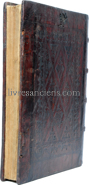
BESSE, Pierre de.
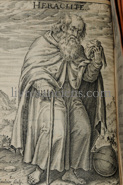
L' Héraclite chrestien c'est a dire les regrets & les larmes du pêcheur penitent.
Paris, Nicolas du Fossé, 1612.
More Details >
Sold
First edition.
Pierre de Besse, preacher from the beginning of the 17th century was inspired by the Greek philosopher Heraclitus, whose legend, peddled by Diogenes Laerce, said that he was perpetually in tears in front of the fate of men to draw from it a Christian Heraclitus desperate for the sins of the Men.
He will publish 3 years later the "Christian Democrite" showing a hilarious Democrite in front of the world as it is.
These two books did a lot to popularize the archetypes of a weeping Heraclitus and a laughing Democritus, which can be found in many works of art throughout the 17th century. One thinks in particular of the "Weeping Philosopher" of Rubens painted around 1636, or the Democrites of Velasquez and Rembrandt.
Engravings by Leonard Gaultier, famous french painter.
GUIBELET, Jourdain.
Examen de l'examen des esprits.
Paris, Veuve Jean de Heuqueville et Louis de Heuqueville, 1631.
More Details >
800 €
First edition.
Critical work of the Examen de ingenios para las sciencias by Juan Huarte de San Juan, which had been, in 1575, the first modern treatise to study the relationship between psychology and physiology.
Guibelet offers an in-depth analysis and a refutation of some of Huarte's theses, thus entering into the intellectual debates of the time on the nature of intelligence and human aptitudes. This text constitutes a valuable contribution to the history of ideas and to the study of the reception of psychological and medical theories at the dawn of the 17th century.
Title page in the name of the Heuquevilles with whom Soly (who appears on the privilege) shared the edition.
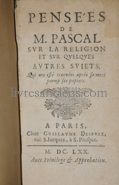
PASCAL, Blaise.
Pensées de M. Pascal sur la religion et sur quelques autres sujets qui ont été trouvées après sa mort parmy ses papiers.
Paris, Guillaume Desprez, 1670.
More Details >
750 €
Counterfeit of the Pensées, with the same collation of the first edition.
This edition with a slightly different title was spotted by Tchermerzine (V,71).
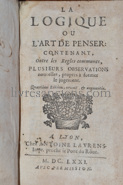
ARNAULD, Antoine || NICOLE, Pierre.
La logique ou l'art de penser, contenant, outre les règles communes, plusieurs observations nouvelles, propres à former le jugement.
Paris, Antoine Laurens, 1671.
More Details >
Sold
HUARTE, Jean.
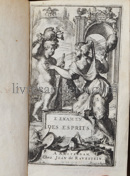
L'Examen des Esprits pour les Sciences.
Amsterdam, Jean de Ravestein / Pierre Mortier [Daniel Elzevier], 1672.
More Details >
400 €
First edition of the French translation by François Savinien d'Alquié.
Beautiful Elzevirian edition decorated with a frontispiece by Romeyn de Hooghe.
On our copy, a butterfly replaces the name of the publisher with that of Pierre Mortier with the date of 1704.
Fresh copy.
MALEBRANCHE, Nicolas.
Entretiens sur la Metaphysique & sur la Religion.
Rotterdam, Reiner Leers, 1688.
More Details >
Sold
First edition.
The Entretiens sur la métaphysique et sur la religion are the most accomplished of all Malebranche's works. A true literary work, demonstrating a magnificent mastery of the art of dialogue, these fourteen conversations are a model of pedagogy.
[LAMY, François].
Le nouvel athéisme renversé, ou réfutation du sistême de Spinosa tirée pour la plupart de la conoissance de la nature de l'homme.
Paris, Jean de Nully, 1696.
More Details >
900 €
Rare first edition in a morocco bilding with gilt arms on covers.
[LE CLERC, Jean].
Réflexions sur ce que l'on appelle bonheur et malheur en matière de loteries, et sur le bon usage qu'on en peut faire.
Amsterdam, Georges Gallet, 1696.
More Details >
600 €
First edition.
Jean Le Clerc (1657-1736) was a Protestant theologian and pastor. He was a member of the Remontrants, disciples of Arminius, breaking with Calvinism on questions of grace and predestination. The lottery and games of chance, then very popular in the Netherlands, were an ideal subject for reflection on these subjects. By rejecting any idea of an "invisible hand" behind chance or good fortune, he ends up with an ultimately very modern definition of chance:
"Tous ces mots ne sont que des termes négatifs, comme je l'ai dit, & qui ne servent qu'à faire comprendre que l'effet, dont on parle, n'est pas la production d'une cause nécessaire & déterminée à la produire".
In other words, we speak of chance where we do not know the sum of the causes that determine the effect that we observe.
BARBEYRAC, Jean.
Traité du jeu, où l'on examine les principales questions de droit naturel et de morale qui ont du rapport à cette matière.
Amsterdam, Pierre Humbert, 1709.
More Details >
750 €
First edition.
Philosophical dissertation around the game, its dangers and its abuses all the moral, economic and social facets related to the practice of games are discussed. Barbeyrac writes at a key moment when the notion of chance (behind which hides divine intervention) gradually gives way to what will become a theory of games and probabilities.
ERASME.
Les Colloques.
Leiden, Pierre Vander Aa, 1720.
More Details >
150 €
First edition of the French translation of the Erasmus colloques by Gueudeville.
This edition is sought after for the engravings by Hooge placed at the beginning of the chapter.
Our copy incomplete of 4 text sheets but complete with all the engravings.
LOCKE, John.
Essai philosophique concernant l'entendement humain, où l'on montre qu'elle est l'étendue de nos connoissances certaines, et la manière dont nous y parvenons.
Amsterdam, Pierre Mortier, 1729.
More Details >
Sold
Second edition augmented of the french translation.
Major work by John Locke in which he develops an empiricist theory of knowledge that opposes the innate ideas of Descartes.
MARTIN, Benjamin.
Grammaire des Sciences Philosophiques, ou Analyse abrégée de la Philosophie moderne, appuyée sur les expériences.
Paris, Briasson, 1749.
More Details >
600 €
First french edition.
[ESPIARD DE LA BORDE, François-Ignace].
L'Esprit des nations.
La Haye, Isaac Beauregard, 1753.
More Details >
100 €
Third edition.
[BOYER D'ARGENS, Jean-Baptiste (de)].
Lettres chinoises, ou Correspondance philosophique, historique et critique, entre un Chinois voyageur à Paris & ses correspondans à la Chine, en Moscovie, en Perse et au Japon.
La Haye, Pierre Paupie, 1755.
More Details >
550 €
New edition.
Epistolary fiction told in the form of letters exchanged between a Chinese, Hoang, and a European. It is a social and philosophical critique that highlights the absurdities of European society through the eyes of a foreign character, a process often used by the Enlightenment to offer an external perspective on the customs and beliefs of the time. The last volume contains the author's philosophical dreams in which he develops several political utopias.
[HELVETIUS, Claude-Adrien].
De l'Esprit.
Paris, Durand, 1758.
More Details >
450 €
First edition in B state.
Major work by Helvetius which caused a scandal upon its publication and was condemned to be burned. Too radical for its time, the book was nevertheless widely read thereafter.
[BLANCHET, Jean].
L'Homme éclairé par ses besoins.
Paris, Durand, 1764.
More Details >
150 €
First edition.
The work of a philosopher who was won over to the ideas of the Lumières, Blanchet is resolutely modern: the 18th century is marked by the reign of science and the arts, and the passions of modern man are the subject of vibrant praise, including self-esteem, because it is they which allow the realization of the great projects of humanity, which a Diderot would not deny.
[VOLTAIRE].
Souvenirs de Madame de Caylus.
Amsterdam, Marc Michel Rey, 1770.
More Details >
200 €
Edition published the same year as the original edition.
Bengesco [II, pp.415-417] comments at length on the difference between this edition and that of Geneva at Robert. The text in Rey's edition goes as far as the hardback edition of the Robert edition except for the last sentence. S
ome hypotheses suggest that it was Diderot who had this Amsterdam edition published, whereas Madame de Caylus's manuscript had been passed from hand to hand for several years. However, a few rare copies have a 22-page notebook with a preface by Voltaire which is absent from our copy [cf. Bengesco].
[VOLTAIRE].
Questions sur l'encyclopédie par des amateurs.
[Neufchatel], s.n., 1771-1773.
More Details >
550 €
New expanded edition.
Little-known book by Voltaire, his Questions on the Encyclopedia having been included in the Philosophical Dictionary of the Kehl edition which now makes reference.
"This attempt with an encyclopedic vocation claims to supplement, even amend and correct the great work of the Age of Enlightenment" (Mervaud, "L’Encyclopédisme des Questions sur l’Encyclopédie de Voltaire?”).
Composite copy with volumes published from 1771 to 1773.
EBERHARD, Jean Auguste || SOCRATE.
Examen de la Doctrine touchant le salut des payens, ou nouvelle apologie pour Socrate.
Amsterdam, E. Van Harrevelt, 1773.
More Details >
125 €
First edition in French.
Eberhard is a German Protestant philosopher and theologian, disciple of Leibniz he was one of the most virulent opponents of Kant.
[FONTENAY, (Abbé)].
Antilogies et Fragmens Philosophiques, ou Collection méthodique des morceaux les plus curieux & les plus intéressans sur la Religion, la Philosophie, les Sciences & les Arts, extraits des écrits de la Philosophie moderne.
Paris, Vincent, 1774-1775.
More Details >
800 €
First edition.
Louis Abel de Bonafous, a Jesuit priest, became a writer when his order was banned in 1773, under the name of Abbé Fontenay.
The Antilogies are a collection of contradictory arguments, often used to demonstrate paradoxes or to question certain dogmatic assertions. This work is typical of the way in which certain authors of the 18th century, particularly during the Enlightenment, questioned established truths and rigid systems of thought.
The Antilogies had a certain influence in the philosophical circles of its time, because of its innovative approach to logic and theology.
[MANUSCRIT].
Metaphysica.
s.l., s.n., 1775.
More Details >
200 €
Original manuscript.
Course in metaphysics and ontology with a long section on theodicy.
GRETRY, André-Ernest.
Mémoires ou essai sur la musique.
Paris, Prault, 1789.
More Details >
150 €
First edition.
The Memoirs of Gretry constitute a document of particular importance for the musical and literary history of the 18th century. There are indeed many details concerning not only the life of Gretry, his feelings, his musical works, but also music in general, comedy, painting, travel .... and various writers and composers.
CONDORCET, Jean Antoine Nicolas de Caritat, marquis de.
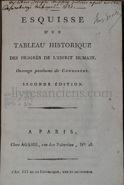
Esquisse d'un tableau historique des progrès de l'esprit humain.
Paris, Agasse, An III [1795].
More Details >
375 €
Second edition.
Reprint of the original edition published the same year, with a new title page. Condorcet's work marks the birth of the idea of Progress, which would become the credo of the 19th century.
LOCKE, John.
Essai philosophique concernant l'entendement humain, où l'on montre quelle est l'étendue de nos connoissances certaines, et la manière dont nous y parvenons.
Paris, Bossange, An VII [1798].
More Details >
Sold
John Locke's (1632-1704) An Essay Concerning Human Understanding is a foundational work of empiricism and Enlightenment philosophy. First published in 1689, it explores the origin, certainty, and extent of human knowledge, rejecting the idea of innate ideas and asserting that all knowledge derives from sensory experience and reflection. This French edition from "An VII" (1798-1799), translated by Pierre Coste, is particularly notable as it incorporates posthumous additions by Locke and the translator's remarks, thereby enriching the original work and demonstrating its continued influence on French thought.
FOURIER, Charles.
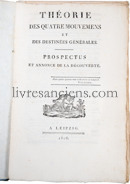
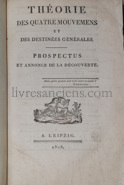
Théorie des Quatre Mouvemens et des Destinées Générales. Prospectus et Annonce de la Découverte.
Leipzig [Lyon], [Pelzin], 1808.
More Details >
3500 €
First edition.
Founding work of Fourierism.
It is in this book that Charles Fourier sets out for the first time his theories on the organization of human societies. Discoveries, which, according to him, is on a par with Newton's theory of gravitation. Fourier defines four phases of universal history (ascending chaos, ascending plenitude, descending plenitude, descending chaos), each phase subdivided into a multitude of times. Humanity is currently going through the fifth time of the first phase: Civilization. The revelation to humanity of "passionate attraction" will bring about Harmony, a phase of bliss in which Fourier's Utopia is realized.
When it was published, no one understood anything about this work, riddled with neologisms, divisions and subdivisions, extravagant considerations... the press passed over the book in silence and Fourier, annoyed that he was not recognized as a Genius, would not publish again for fourteen years.
Rare untouched copy.
FOURIER, Charles.
Théorie des Quatre Mouvemens et des Destinées Générales. Prospectus et Annonce de la Découverte.
Leipzig [Lyon], [Pelzin], 1808.
More Details >
2000 €
First edition.
Founding work of Fourierism. It is in this book that Charles Fourier sets out for the first time his theories on the organization of human societies. Discoveries, which, according to him, is on a par with Newton's theory of gravitation. They must lead Humanity to a state of universal Harmony.
Some handwritten corrections.
Bound with is a rare brochure by Fourier:
[FOURIER], Mnémonique géographique ou méthode pour apprendre en peu de leçons la géographie, la statistique et la politique. Paris, Impr. Carpentier-Méricourt, [1824]. 15-(1) pages.
"Brand-new views on the teaching of one of the positive sciences, formerly cultivated, that Fourier was most fond of. The procedures he indicates, and particularly that of the Theory of Causes in Creation, are related to his system of Universal Unity. This piece is very curious. " (notice from the 'catalogue raisonné de l'école sociétaire', 1842).
PASCAL, Blaise.
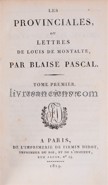
Les provinciales.
Paris, Firmin Didot, 1819.
More Details >
50 €
LECHEVALIER, Jules.
Études sur la science sociale. Année 1832. Théorie de Charles Fourier.
Paris, Librairie générale de Capelle [Renduel], 1834.
More Details >
200 €
First edition.
Jules Lechevalier Saint-André is a French utopian socialist publicist and economist. He is considered one of the pioneers of social economics. The year 1832 marks his conversion to Fourierism after having been a Saint-Simonian.
VIGOUREUX, Clarisse.
Parole de Providence.
Paris, Bossange, Novembre 1834.
More Details >
3500 €
Scarce first edition of the only work by the first female disciple of Charles Fourier.
Clarisse Vigoureux (1789-1865), born Charlotte-Dorothée-Claire Gauthier, was a fervent follower of Fourier's theories: it was she who introduced Victor Considerant to Fourierism (the latter married his daughter Julie).
She put her personal fortune at the service of the Fourierist cause by financing Phalanges (the journal of Charles Fourier) and later the exile of Considerant and then their attempt to found the Réunion phalanstery in Texas. Ruined, she will end her life alone in San Antonio.
François Barrier, central personality of the Fourierist movement, he adhered to the Fourierist doctrine in 1843. He was, in 1845, one of the founders of the African Agricultural Union and became the main leader and financial supporter from the Lyon Corporate School in the 1860s.
His work responded to the Words of a Believer, published in April 1834 by Lamennais, in which he promoted violence in the service of the class struggle. Clarisse Vigoureux, deeply pacifist and feminist, will answer him:
"What is this war cry and this reverberation which has been heard on all sides? [...] I ask the stronger sex who knows how to dethrone their kings, and who, calling himself a king, does not know how to hold the reins of the world" (excerpt from the preface)
This book will be condemned by the Roman Church and put in the Index catalog on September 22, 1836.
On the false title we see. finds the following mention written in pencil : "Given by Miss Beuque to Mr Barrier. (April 1845). Aimée Beuque (1788-1871) met Charles Fourier at Clarisse Vigoureux in 1828 and immediately adhered to his ideas, she will lead the Fourierist circles of Lyon. François Barrier, professor of medicine at the Faculty of Lyon, adhered to the Fourierist doctrine in 1844.
Results (1 - 30) of
67
1
2
3
>
New
Price ↓
Price ↑
Author A-Z
Author Z-A
Title A-Z
Title Z-A
Date ↑
Date ↓
About
Sell your books
Contact
Newsletter
Blog
52 rue des Ecoles 75005 Paris
tel. +33 (0)1 43 54 22 23
contact@livresanciens.com
Terms and conditions
European VAT number: FR87515091171
© Eric Zink, Antiquarian Bookseller