
Newsletter
About
New arrivals
Sell your books
Cart
Contact us
Blog
Categories
Categories
Science
Astronomy
Chemistry
Mathematics
Physics
Natural History
Engineering
History of science
Medicine
Medicine
Pharmacy
Occult
Astrology
Alchemy
Occult
Social Sciences
Economy
History
Philosophy
Law
Theology
Arts & Architecture
Art & Artist's Books
Architecture
Litterature
Miscellany
Manuscripts
Fine bindings
Early printings
FREE SHIPPING WORLWIDE
WE ACCEPT
Physics
Results (121 - 140) of
140
<
3
4
5
New
Price ↓
Price ↑
Author A-Z
Author Z-A
Title A-Z
Title Z-A
Date ↑
Date ↓
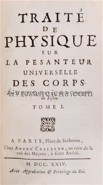
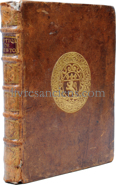
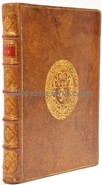
CASTEL, Louis-Bertrand.
Traité de physique sur la pesanteur universelle des corps.
Paris, André Cailleau, 1724.
More Details >
900 €
First edition.
Louis Bertrand Castel (1688-1757) was a Jesuit, mathematician, physicist and French journalist.
This book is one of the first scientific treatises published by this author. He explains his theory according to which all the phenomena of the universe are explicable according to two principles, which are: the gravity of the bodies, which makes everything tend to rest, and the activity of the spirits, which incessantly creates the movement.
In France, he was one of the main opponents of Newton's theory of gravitation.
OZANAM, Jacques.
Récréations mathématiques et physiques, qui contiennent plusieurs problèmes d'arithmétique, de géométrie, de musique, d'optique, de gnomonique, de cosmographie, de mécanique, de pyrotechnie, & de physique. Avec un traité des horloges élémentaires.
Paris, Claude Jombert, 1723.
More Details >
900 €
New edition, revised, corrected and augmented since the first one published in 1694.
The first edition with 136 plates.
This book on mathematics and physics deals with various problems in arithmetic, geometry, music, optics, gnomonics, cosmography, mechanics, acoustics, pyrotechnics, physics, water clocks, natural phosphors, perpetual lamps, etc.
NEWTON, Isaac.
Traité d'optique sur les réflexions, réfractions, inflexions et les couleurs de la lumière.
Paris, Montalant, 1722.
More Details >
Sold
Second French edition of this important work in which Newton sets out his theory of light, the study of the refraction and diffraction of light. He observes in particular that light is composed of a multitude of colors.
This edition is more sought after than the first because the translation by Pierre Varignon was revised and supervised by Newton himself.
Handwritten note at the end: "Bookplate Musei C.Dupré. 1 quarto volume purchased on April 2, 1779"
An old handwritten note states that this copy was purchased on May 2, 1863, at the library sale... and placed to their proper place the plates that had been incorrectly inserted by the bookbinder.
GROLLIER DE SERVIÈRE, Gaspard.
Recueil d'ouvrages curieux de mathématique et de mécanique, ou description du cabinet de Monsieur Grollier de Servière avec des figures en taille douce.
Lyon, David Forey, 1719.
More Details >
2200 €
First edition.
Among the mechanical inventions depicted in Grollier de Serviere's Cabinet are those for propelling ships, making elevations, various kinds of clocks, lamps, mechanical figures, mills, optical contrivances and geometrical instruments.
MARIOTTE, Edme.
Oeuvres de Mr Mariotte, de l'Académie royale des Sciences.
Leide, Pierre Vander, 1717.
More Details >
1500 €
First collected edition, and first edition for the "Traité du mouvement des pendules" is published here for the first time.
Edme Mariotte was one of the pioneers of experimental physics in France and, with Newton, one of the great figures of European physics. His works bear witness to great originality and great diversity. In 1660 he undertook research on the elastic deformations of solids and laid down a law. In 1676, he also established the gas compressibility law which bears his name and formulated it in his treatise On the nature of air: at constant temperature, the volume of a gas varies inversely with pressure.
He also studied optics, hydrodynamics, fluid mechanics, as evidenced by his numerous writings on vision, colors (he opposed, like Hooke or Huygens, Newton's theory), weather forecasts , fluid movements, body shock ...
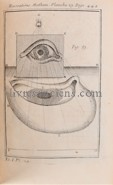
He also left his name to the "Mariotte spot", which is a part of the completely blind retina.).
POLINIERE, Pierre.
Expériences de Physique.
Paris, Jean de Laulne, 1709.
More Details >
950 €
First edition.
Pierre Polinière is considered the founder of experimental physics in France. After studying mathematics with Pierre Varignon (1654 – 1722), Polinière opened a physics course at the college of Harcourt, it was one of the first public courses given in Paris. His public demonstration sessions were very successful and did much to disseminate the scientific method of experimental research. His experiments were very popular and, among the spectators, we found all of Paris, and even the young Louis XV in 1722.
In 1706 during an experiment before the Academy of Sciences, Polinière discovered electroluminescence. This discovery is contemporary but independent of that of Hauksbee in London.
The protocol of the experiment is described here in the chapter “Phosphorus through Movement”.
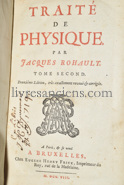
ROHAULT, Jacques.
Traité de Physique.
Bruxelles, Eugène Henry Fricx, 1708.
More Details >
450 €
Second french edition.
Jacques Rohault was a great popularizer of Cartesian physics, he organized weekly public sessions, the "Wednesdays of Rohault" in which spectacular experiments served as a support for the explanation of physical theories.
His Treatise on Physics follows the same principle, experimentation is central and facts precede explanations.
MEAD, Richard.
De Imperio Solis ac Lunae in corpora Humana et Morbis inde oriundis.
Londres, Raphael Smith, 1704.
More Details >
1500 €
First edition.
Richard Mead (1673-1754), a physician and friend of Isaac Newton, attempts in this book to demonstrate the influence of gravitational forces on human health. Mesmer drew heavily on this book to write his doctoral thesis in 1766 (On the Influence of the Planets on the Human Body). The term "animal gravitation," taken from Mead, was later changed by Mesmer to "animal magnetism.".
LA HIRE, Philippe (De).
Traité de Mécanique, où l'on explique Tout ce qui est nécessaire dans la pratique des Arts, & les propriétés des corps pesants lesquelles ont un plus grand usage dans la Physique.
Paris, Jean Anisson, 1695.
More Details >
550 €
First edition.
Numerous woodcut figures in the text.
OZANAM, Jacques.
Dictionnaire Mathématique, ou idée Générale des Mathématiques.
Dans lequel sont contenus les termes de cette science, outre plusieurs termes des Arts & des autres sciences, avec des raisonnemens qui conduisent peu à peu l'esprit à une connoissance universelle des Mathématiques.
Amsterdam, Huguetan, 1691.
More Details >
400 €
A reprint of the first edition, published the same year by Michallet in Paris.
The dictionnary is divided into sections dealing with subjects such as arithmetic, algebra, geometry, cosmography, astronomy, navigation, optics, perspective, mechanics, hydrostatics, architecture, fortification and music.
CHERUBIN D'ORLEANS, Père.
Effets de la force de la contiguité des corps par lesquelles on répond aux expériences de la crainte du Vuide, & à celles de la Pesanteur de l'Air.
Paris, Etienne Ducastin, 1689.
More Details >
950 €
First edition, re-issue with cancel title (first issue 1679 with the imprint of Couterot, an other in 1689 of Lucas).
In this work, Chérubin d'Orléans discuss of the air-pump experiments of Pascal and Torricelli. He thought that vaccuum doesn't exist.
[LAMY, Dom Francois].
Conjectures physiques sur deux colonnes de nüe qui ont paru depuis quelques années & sur les extraordinaires effets du tonnerre.
Paris, Veuve de Sébastien Mabre-Cramoisy, 1689.
More Details >
Sold
First edition.
Illustrated with a folding plate and four figures in the text, two of which are full-page.
Lamy studies here two "lightning strikes" that had left their mark, the first on April 26, 1676 in Soissons had left an astonishing frieze (which is reproduced on the folding plate) in the dormitory of an Abbey. The second in Lagny on July 18, 1689, where lightning had struck the altar of the Church of Saint-Sauveur and imprinted the canon of the mass on its tablecloth.
Camille Flammarion devotes an entire chapter in his book "Les Caprices de la foudre" to Lamy's observations, and tells us: "A monk, Father Lamy, of the Congregation of Saint-Maur, published in 1696 [Editor's note: 2nd ed.] an excellent pamphlet, dictated by the clearest common sense, on the curious effects of lightning, which were then the subject of the most superstitious commentaries. Voltaire could not have reasoned better.".
ALENCE, Joachim d'.
Traitté de l'aiman. Divisé en deux parties. La premiére contient les expériences; & la seconde les raisons que l'on en peut rendre. Par M. D***.
Amsterdam, Henry Wetstein, 1687.
More Details >
900 €
First edition of this complete treatise on magnets.
Beautiful 33 engravings by Adriaan Schoonebeek, the pupil of Romeyn de Hooghe.
VARIGNON, Pierre.
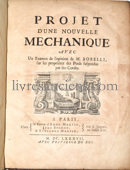
Projet d’une nouvelle mechanique: avec un Examen de l'opinion de M. Borelli.
Paris, Veuve d’Edme Martin, Jean Boudot & Estienne Martin, 1687.
More Details >
450 €
First edition.
DESCARTES, René.
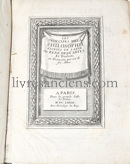
Les Principes de la philosophie de René Descartes.
Paris, Nicolas Le Gras, 1681.
More Details >
Sold
Fourth edition.
"The Principles of Philosophy" by René Descartes is a fundamental work of Western philosophy. In this treatise, Descartes sets out his vision of the world, based on metaphysical and physical principles. He develops his method of doubt, his famous "cogito, ergo sum" (I think, therefore I am), and his conceptions on the nature of the soul and the body.
PARDIES, Ignace Gaston.
Discours du mouvement local. Avec des remarques sur le Mouvement de la Lumière.
Paris, P. Fr. Gueffier, 1674.
More Details >
900 €
Second enlarged edition.
Pardies was at the heart of the debates concerning the nature of light, corresponding with Newton, Leibniz, and Huygens. Before Huygens, he was the first to propose a detailed and well-argued theory based on the wave nature of light.
In 1670, Pardies sent a draft of his "discours sur le mouvement d’ondulation" to Huygens. This treatise was, for the Dutch scholar, who acknowledged it, an important source of inspiration in his conception of light, which he published much later, in 1690.
Pardies died on April 21, 1673, at the age of 36, from a fever contracted while visiting the sick at the Bicêtre hospice. His work on optics is known only indirectly, through the commentaries of his colleagues, but especially through the publication in 1682 by the Jesuit Father Pierre Ango of the work "Optics," inspired by the papers of Pardies that he had in his possession.
This second edition of his "Discourse on Local Movement" is interesting because it is expanded (compared to the first of 1670) with "Remarks on a letter from Mr. Descartes concerning light," in which, on p. 174, he hypothesizes that a sound would form in the sun and that the wave thus created would be transported to Earth.
ROHAULT, Jacques.
Traité de Physique.
Paris, Veuve Charles Savreux, 1671.
More Details >
600 €
First edition.
Jacques Rohault was a great popularizer of Cartesian physics, he organized weekly public sessions, the "Wednesdays of Rohault" in which spectacular experiments served as a support for the explanation of physical theories.
His Treatise on Physics follows the same principle, experimentation is central and facts precede explanations.
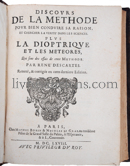
DESCARTES, René.
Discours de la méthode pour bien conduire sa raison et chercher la vérité dans les sciences.
Plus la Dioptrique et les Météores qui sont des essais de cette méthode.
Paris, Michel Bobin & Nicolas Le Gras, 1668.
More Details >
Sold
The true third edition with the privilège dated 28 avril 1668.
DESCARTES, René.
Le Monde de Mr Descartes ou le traité de la lumière et des autres principaux objets des sens.
Paris, Jacques Le Gras, 1664.
More Details >
3000 €
First edition.
Very rare copy with title page in unlisted condition in the name of Jacques Le Gras.
Descartes wrote this treatise in 1632 and 1633. He defended in particular the heliocentric system of Copernicus, but following Galileo's condemnation, he gave up publishing this work during his lifetime. It will not be finally published, according to his will, until after his death. At the end of 1663, the Le Gras and Clerselier family will dispute the privilege of publishing the posthumous works of Descartes. For the "World" it is Jacques Le Gras who will be the first to deposit the privilege. (cf. CARTESIAN BULLETIN V. (1976). Archives de Philosophie, 39 (3), 445–494) Jacques Le Gras, the holder of the privilege, then shared it with Thomas Girard (his brother-in-law) and Michel Bobin.
Our title page is unknown to Tchermerzine and Guibert as well as to Mathias Van Otegem who in his bibliography of the works of Descartes published in 2002, after consulting the copies in public libraries, describes only four states of the title page of this edition.
Our copy therefore presents a fifth state of the still unpublished title page.
Our title page has the same typographical mark as the Thomas Girad state (6 fleurons) canonically considered to adorn the true first edition. In addition, like the copy "Thomas Girad" from the Munich library (BSB: Rar. 4594) our title page is margined shorter than the rest of the book body and printed with the same characters, which suggests an impression at the same time.
The copies having a recomposed title page with a typographical mark "à l'oiseau" only coming, according to bibliographers, in a second step.
"In Le Monde, Descartes wants to ruin the concepts of scholasticism, and 'evacuate' Aristotle's physics, by giving a physical interpretation of the new heliocentric astronomy. As opposed to traditional finalism, he envisions, in the form of a "Fable", the mechanical formation of the cosmos, from an initial state of chaos (pieces of matter of various shapes and sizes agitated by all-out movements) and only by virtue of the general laws of nature: principle of inertia, laws of the communication of movement, etc ... "Robert Maggiori, Liberation, 26.
PASCAL, Blaise.
Traitez de l'équilibre des liqueurs et de la pesanteur de la masse d'air.
Paris, Guillaume Desprez, 1663.
More Details >
3500 €
First edition.
Milestone in the history of science in which Pascal discovers atmospheric pressure.
The famous experiment, carried out by his brother-in-law in Auvergne, consisted of comparing the height of a column of mercury in Clermont-Ferrand and then at the top of Puy-de-Dôme.
The question of the weight of the air was already under discussion in Descartes and Galileo, but it is Pascal with this experience who provides the proof. He thus broke with nearly 2000 years of Aristotelian physics: "Nature abhors a vacuum", more than a popular maxim then took the place of the only physical principle of hydrostatics.
"Nature has no repugnance for emptiness; she makes no effort to avoid it; all the effects that have been attributed to this horror proceed from the gravity and pressure of the air; she is the only one. real cause, and, lack of knowing it, we had invented this imaginary horror of emptiness on purpose, to make it right." (extract from chapter II)
Then pascal (Pa) will be adopted as the international unit of measurement of pressure.
Results (121 - 140) of
140
<
3
4
5
New
Price ↓
Price ↑
Author A-Z
Author Z-A
Title A-Z
Title Z-A
Date ↑
Date ↓
About
Sell your books
Contact
Newsletter
Blog
52 rue des Ecoles 75005 Paris
tel. +33 (0)1 43 54 22 23
contact@livresanciens.com
Terms and conditions
European VAT number: FR87515091171
© Eric Zink, Antiquarian Bookseller