Newsletter
About
New arrivals
Sell your books
Cart
Contact us
Blog
Categories
Categories
Science
Astronomy
Chemistry
Mathematics
Physics
Natural History
Engineering
History of science
Medicine
Medicine
Pharmacy
Occult
Astrology
Alchemy
Occult
Social Sciences
Economy
History
Philosophy
Law
Theology
Arts & Architecture
Art & Artist's Books
Architecture
Litterature
Miscellany
Manuscripts
Fine bindings
Early printings
FREE SHIPPING WORLWIDE
WE ACCEPT
Physics
Results (91 - 120) of
140
<
2
3
4
5
>
New
Price ↓
Price ↑
Author A-Z
Author Z-A
Title A-Z
Title Z-A
Date ↑
Date ↓
DEGUIN, Nicolas.
Cours élémentaire de physique, à l'usage des collèges et des autres établissemens d'instruction publique.
Paris, Belin-Mandar, 1841.
More Details >
75 €
Third edition of these basic physics lessons, by Nicolas Deguin (1809-1860) who was professor of Physics at the Faculty of Science in Besançon.
DE BROGLIE, Louis.
La mésomérie. Réunions d'études et de mises au point tenues sous la présidence de L. De Broglie.
Paris, Edition de la revue d'optique théorique et instrumentale, 1947.
More Details >
25 €
First edition.
Charles Dufraisse : La mésomérie au point de vue du chimiste organicien - Paul Rumpf : L'étude expérimentale des conditions dans lesquelles se produit l'effet de mésomérie - A. Pacault : Relations entre la magnétochimie et la mésomérie - Paul Meunier : L'intervention de l'effet de mésomérie dans l'étude des vitamines - Raymond Daudel : Etude théorique de la mésomérie - Jean Cabannes : La mésomérie mise en évidence par l'analyse spectrale - Alberte Pullman: L'utilisation des méthodes de la mésomérie dans l'étude des composés cancérigènes et de leurs antagonistes - Jean Guy : Bases théoriques et conditions de la mésomérie - Jean-Louis Destouches : Difficultés théoriques rencontrées dans l'étude de la mésomérie.
DARLES DE LINIERE, ?.
Pompes sans cuirs.
Paris, Manufacture royale, 1768.
More Details >
400 €
First edition.
Darles de Linière presents his pump models in which the leather bladders and valves were replaced by copper pistons. The plates show models of merchant ship pumps, wheeled fire pumps (the ancestor of the fire truck), and pumps for raising water from wells.
DAGUIN, Pierre-Adolphe.
Traité élémentaire de physique théorique et expérimentale avec les applications à la météorologie et aux arts industriels.
Toulouse / Paris, Édouard Privat / Tandou et Cie / Delagrave et Cie, 1867-1868.
More Details >
120 €
Third edition.
D'ALEMBERT, Jean Le Rond dit || CONDORCET, Nicolas de || BOSSUT, Charles.
Nouvelles expériences sur la résistance des fluides.
Paris, Claude-Antoine Jombert, 1777.
More Details >
300 €
First edition.
Collection of hydrodynamic experiments carried out in a basin of the Military School by D'Alembert, Condorcet and Bossut. Turgot had commissioned them to look for ways to improve river navigation. The results of these experiments led to establish what will become the D'Alembert paradox, which will only be solved with the theory of wakes.
Indeed according to the hydrodynamic equations of the time, "a body should be able to progress in a fluid without experiencing any resistance or, which amounts to the same thing, that a bridge pier plunged into the course of a river should not. undergo no pushing on his part ", which the experiments carried out denied.
Beyond the treatise on hydrodynamics, this book bears witness to a science in progress which intricates theory and experience.
CURIE, Pierre || CURIE, Marie.
Oeuvres de Pierre Curie. Publiées par les Soins de la Societe Francaise de Physique.
Paris, Gauthier-Villars, 1908.
More Details >
Sold
First edition.
First edition of the works of Pierre Curie. His wife Marie Curie signs the preface here.
CROS, G.
Cours de physique pour les classes de Mathématiques A et B. Programme du 14 mai 1912.
s.l., s.n., 1912.
More Details >
20 €
[COURS DE PHYSIQUE].
Cours de physique. 1ère Section, suivi d'un Cours de 2ème Division.
s. l, s. n, [vers 1912].
More Details >
50 €
Lithographic course of General Physics, with a lot of diagrams.
The course of physics of 1st Section is organized around the following parts: Units of measurement, Notions of mechanics, Gravity, Hydrostatic, The density of solid and liquid bodies, Areometry, Hydrodynamics, Compressibility of gases, Acoustics, The notions of potential, The measurement of surfaces and angles, Heat, Calorimetry, The notions of thermodynamics, Changes of state of bodies and Steam.
The 2nd division physics course has the following plan: Gas liquefaction, hygrometry, meteorology, sound, optics, refraction of light, optical instruments, radiation studies , Photometry and Notions of Physical Optics.
COTES, Roger.
Leçons de physique expérimentale, sur l'équilibre des liqueurs, & sur la nature & les propriétés de l'air.
Paris, David fils, 1742.
More Details >
700 €
First edition in French.
Roger Cotes (1682-1716) was an English mathematician, closed to Isaac Newton with whom he shared the discovery of the Newton-Cotes method of numerical analysis, which generally extended the trapezoidal method and Simpson's method for calculating integrals.
This book was first published posthumously in 1738 under the title "Hydrostatical and Pneumatic Lectures", and it contains the first French translation of Newton's scale of degrees of heat, his law of cooling.
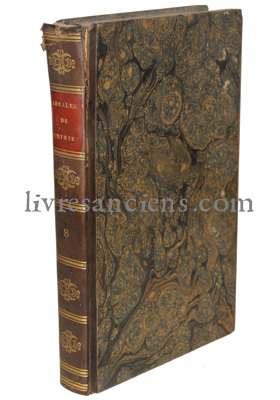
CORNU, Alfred.
Mémoire sur la détermination de la vitesse de la lumière entre l'observatoire et Montlhéry, par M. A. Cornu. in Annales de l'Observatoire de Paris, publiées par U. -J. Le Verrier - Mémoires - Tome XIII.
Paris, Gauthier-Villars, 1876.
More Details >
200 €
First edition.
Alfred Cornu (1841-1902), is famous for his three measurements of the speed of light between 1872 and 1874, made with the method of Fizeau for which he had great admiration.
The last and the best was done between the Observatory and the Montlhéry Tower. This article of 315 pages, is devoted to this last experiment.
The article "Recherches sur les observations magnétiques faites à l'observatoire de Paris de 1667 à 1872", by M. G. Rayet is bound in at the end of the volume.
COPPEL, Th. || FOURNIER, Georges || YOVANOVITCH, D. K.
Quelques suggestions concernant la Matière et le Rayonnement.
Paris, Albert Blanchard, 1928.
More Details >
150 €
Rare work in which the authors evoke a non-archimedean geometry to study intra-atomic phenomena.
[COCHET, Jean].
La Physique expérimentale et raisonnée, qui contient en abrégé ce que cette science a de plus intéressant.
Paris, Claude Herissant, 1756.
More Details >
250 €
First edition.
CLÉMENT & DÉSORMES, BECQUEREL.
Détermination expérimentale du Zéro absolu de la chaleur et du caloriques spécifique des Gaz in. "Journal de Physique, de chimie, d'histoire naturelle et des arts, avec des planches et des arts".
Paris, Vve Courcier, 1819.
More Details >
Sold
Important memory of Clement and Désormes : "Détermination expérimentale du Zéro absolu de la chaleur et du calorique spécifique des Gaz".
This work was submitted to the Academy of Sciences in 1812, but didn't win the price and wasn't printed in the memory of the academy. It thus appears here for the first time .
It deal with the determination of the absolute zero and the specific heat of gas.
Presentation copy of Antoine César Becquerel to his grandson Henry with this : "Donné à mon petit fils henry, qu'il conserve cela en souvenir de mes trois premiers mémoires publiés en 1819 et du tendre attachement que je lui porte".
These three memories on mineralogy are in pages 235-240, 308-309, 462-467.
CLAUDIUS || [RUELLE, Charles].
La science populaire de Claudius ; Simples discours sur toutes choses : Sur la chaleur.
Paris, Jules Renouard, 1840.
More Details >
20 €
First edition.
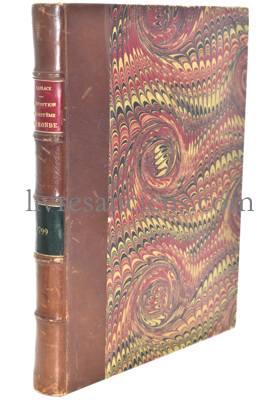
CLAIRAUT, Alexis.
Théorie de la Lune, déduite du seul principe de l'attraction.
Paris, Dessaint & Saillant, 1765.
More Details >
1500 €
Second edition.
This second edition brings together the Theory of the Moon and the Tables of the Moon published by Clairaut in 1752 and 1754 which are the first approximate resolution of the three-body problem. Between 1747 and 1754, three of the greatest mathematicians of their time, Euler, D'Alembert and Clairaut, opposed each other on a common project: to develop new mathematical methods in order to resolve the complex problems posed by the movement of the Moon, subject to both to the gravitational pull of the Earth and the Sun. The issue was both scientific and economic since the establishment of precise astronomical tables was necessary for the reliability of navigation at sea.
CHEVREUL, Michel Eugène.
Mémoire sur la vision des couleurs matérielles en mouvement de rotation et des vitesses numériques de cercles.
Paris, Firmin-Didot, 1882 [1881].
More Details >
3000 €
First edition of Chevreul's last works on color.
A rare offprint with its own title page published by Firmin-Didot in 1882, of an article presented to the Academy of Sciences in December 1880 and January 1881 (one generally only finds the article extracted from the Mémoires de l'institut published in 1883). Chevreul is interested here in physiological optics, trying to analyze how the contrast between complementary colors is affected by movement.
In his conclusion, in which he calls himself "the dean of students in France" (he was then 95 years old), he sees a direct application of his work to signaling for train drivers.
CHEVREUL, Michel Eugène.
Des couleurs et de leurs applications aux arts industriels à l’aide des cercles chromatiques. Avec XXVII planches gravées sur acier et imprimées en couleurs par René Digeon.
Paris, J.B. Baillière et Fils, 1864.
More Details >
5500 €
First edition of the rarest of Chevreul's publications on color.
Michel-Eugène Chevreul (1786-1889) is known to chemists for his research on fatty acids, saponification, and the discovery of stearin, but it is as a color theorist that his name will go down in history. Chevreul was appointed director of the Manufacture des Gobelins in 1824. Responsible for overseeing the production of dyes, he supported the work of dyers with his research on color perception. Thus, in 1839, he proposed a scientific approach to color complementarity and subsequently developed "color circles." A true "Pantone" color chart, a hundred years ahead of its time, Chevreul's color circles had the dual benefit of systematizing the production of hues (each with its own name) and making it easier to understand the concept of color complementarity. Thus, complementary colors are found on the same diameter of the color wheel, Red No. 2 corresponds to Green No. 2. "I believe I can affirm that it is possible to subject colors to a reasoned nomenclature, by relating them to types classified according to a simple method, accessible to the intelligence of all those who deal with colors" (extract from the preface). The standardization of color production was to interest first and foremost the industry then in full development, but it is undoubtedly in the Impressionist movement that Chevreul's theories found their finest accomplishment. Very early on, painters were inspired by Chevreul's work in their paintings, starting with Delacroix and then Monet. We will thus remember the fields of poppies dear to the Impressionists (Van Gogh, Monet, Pissaro...) where the red dots of the flowers burst out on complementary green backgrounds. The 27 spectacular plates were printed by René-Henri Digeon using chromochalcography, the process and difficulties of which are discussed in a paragraph in the book. Digeon appears to have presented a first edition of these plates at the 1855 World's Fair, for which he received a patent from the Empress. Several of the plates in our copy appear to be from this first edition and contain errors that have been corrected in other later copies that we have been able to consult.
CHEVREUL, Michel Eugène.
De la Loi du Contraste simultané des Couleurs et de l’Assortiment des Objets colorés, considéré d’après cette Loi dans ses Rapports avec la Peinture, les Tapisseries des Gobelins, les Tapisseries de Beauvais pour Meubles, les Tapis, la Mosaïque, les Vitraux colorés, l’Impression des Étoffes, l’Imprimerie, l’Enluminure, la Décoration des Édifices, l’Habillement et l’Horticulture.
Paris, Pitois-Levrault, 1839.
More Details >
9000 €
First edition.
One of the most influential books on art in the 19th century.
Michel-Eugène Chevreul (1786–1889) is known to chemists for his research on fatty substances (1810–1823) and on immediate organic analysis (1824), but it is as a color theorist that his name achieved lasting fame.
De la loi du contraste simultané des couleurs introduced a scientific understanding of color that had a profound and lasting impact on the painters of his time.
His “law” describes how the perception of a hue is altered by the surrounding colors, each color projecting its complementary onto its immediate environment (thus, a red object tends to cast a greenish glow on nearby surfaces, a yellow one a purplish tint, and so on). This principle is clearly illustrated in plate 7 of the Atlas, where colored dots on a white background seem to emit halos of their complementary hues.
Eugène Delacroix (1798–1863), a central figure of Romanticism, paid close attention to Chevreul’s research. According to the painter Paul Signac, Delacroix even sought to meet the chemist and acquired notes from his lectures in order to better grasp the law of simultaneous contrast. Several of his paintings feature harmonies built around complementary color pairs. For instance, The Entry of the Crusaders into Constantinople (1840) deliberately juxtaposes yellow/purple, blue/orange, and red/green to dramatize the scene—so effectively that art historian Lee Johnson called it an ideal “illustration” of Chevreul’s treatise.
But it was arguably within the Impressionist movement that Chevreul’s theories reached their highest artistic fulfillment. Claude Monet (1840–1926), in particular, used simultaneous contrast to heighten luminosity in his landscapes. He avoided black and earth tones, preferring instead to render shadows in color: purples and blues for shaded areas at sunset, accented with yellow-orange highlights in full light. This technique appears as early as Impression, Sunrise, the foundational work of the movement. One might also recall the poppy fields, a favorite motif of the Impressionists (Van Gogh, Monet, Pissarro…), where red flowers vibrantly stand out against green backgrounds.
A book heralding one of the greatest revolutions in painting.
Our copy is complete with all the color plates, most of them signed by Chevreul himself.
CHERUBIN D'ORLEANS, Père.
Effets de la force de la contiguité des corps par lesquelles on répond aux expériences de la crainte du Vuide, & à celles de la Pesanteur de l'Air.
Paris, Etienne Ducastin, 1689.
More Details >
950 €
First edition, re-issue with cancel title (first issue 1679 with the imprint of Couterot, an other in 1689 of Lucas).
In this work, Chérubin d'Orléans discuss of the air-pump experiments of Pascal and Torricelli. He thought that vaccuum doesn't exist.
CHAM.
Cours de Physique.
Paris, Maison Martinet, [v.1861].
More Details >
50 €
Cham, pseudonym of Amédée de Noé (1818-1879), is a French illustrator, caricaturist and playwright known and recognized.
This book is atypical and at the opposite of those received in schools!
It is a collection of very humorous illustrations, which are about the principles of Physics. With its simple, fast, sharp and precise style, Cham manages to make readers laugh about serious areas in the different fields of this science.
CAUCHY, Augustin Louis || ACADÉMIE ROYALE DES SCIENCES.
Mémoires sur la théorie des nombres . IN. Mémoires de l'Académie Royale des Sciences de l'Institut de France. Tome XVII.
Paris, Firmin Didot, 1840.
More Details >
950 €
Mémoire sur la Théorie des Nombres, Présenté a l'Académie des Sciences, le 31 Mai 1830, par M. Augustin Cauchy.
First edition of this important memoir (pp/ 249 to 768 of this volume of memoirs of the academy of sciences).
The writing of this memoir is quite abrupt, with a succession of formulas difficult to relate to each other, and it will be criticized by Biot in particular.
However, Jenny Boucard, after an in-depth study of Cauchy's work, concluded that Cauchy exposes a coherent method around the quadratic forms 4p^μ=x²+ny² which he applies in different cases, depending on whether n is prime or compound. (Boucard, p.365).
This volume of the Mémoires de l'Académie Royale des Sciences contains :
PONCELET : Théorie des effets mécaniques de la turbine Fourneyron.
TURPIN :
- Mémoire sur les différences qu'offrent les tissus cellulaires de la pomme et de la poire ...
- Mémoire sur la cause et les effets de la fermentation alcoolique et acéteuse.
- Recherches microscopiques sur divers laits ...
BECQUEREL : Nouvelles recherches sur le dégagement de la chaleur dans le frottement
CAUCHY. Mémoires sur la théorie des nombres.
BIOT. Mémoire sur l'existence d'une condition physique qui assigne à l'atmosphère terrestre une limite supérieure d'élévation qu'elle ne peut dépasser.
CHEVREUL. Recherches physico chimiques sur la teinture
And the Flourens' historical praise of Jussieu and Arago's praise of James Watt.
CAUCHY, Augustian-Louis.
La théorie de la lumière.
Paris, De Bure Frères, 1830.
More Details >
750 €
Rare original edition of this first memory of Cauchy on the propagation of light.
Cauchois. Friedel. Mott. Herpin. Blin. Aigrain. Curien. Mayer. Perio. Tournaire. Gance. Lambert. Guinier. Chapiro. Uebersfeld.
Action des rayonnements de grande énergie sur les solides.
Paris, Gauthier-Villars, 1956.
More Details >
15 €
CASTEL, Louis-Bertrand || [NEWTON - DESCARTES}.
Le vrai système de physique générale de M. Isaac Newton exposé et analysé en parallèle avec celui de Descartes.
Paris, Claude-François Simon, 1743.
More Details >
950 €
First edition.
CASTEL, Louis-Bertrand.
Traité de physique sur la pesanteur universelle des corps.
Paris, André Cailleau, 1724.
More Details >
900 €
First edition.
Louis Bertrand Castel (1688-1757) was a Jesuit, mathematician, physicist and French journalist.
This book is one of the first scientific treatises published by this author. He explains his theory according to which all the phenomena of the universe are explicable according to two principles, which are: the gravity of the bodies, which makes everything tend to rest, and the activity of the spirits, which incessantly creates the movement.
In France, he was one of the main opponents of Newton's theory of gravitation.
CASTEL, Louis Bertrand.
L'Optique des couleurs.
Paris, Briasson, 1740.
More Details >
500 €
First edition.
We find there in particular the description of an ocular harpsichord, a famous creation of Castel which would aim to play colors as one would play sounds. A synesthetic instrument that would no doubt have delighted the surrealists.
BULOS, Jean Antonin.
De la chaleur dans ses applications aux arts et aux manufactures.
Paris, Urbain Canel, 1825.
More Details >
60 €
First edition.
BUIGNET, Henri.
Manipulations de physique. Cours de travaux pratiques.
Paris, J.-B. Baillière et fils, 1876.
More Details >
80 €
First edition.
BRUNHES.
Esquisse des progrès de la physique dus aux savants de la Bourgogne.
Paris, s.n., [1891].
More Details >
50 €
Rare offprint.
BRUN, Charles-Marie.
Étude sur la théorie mécanique de la chaleur.
Paris, Librairie militaire de L. Baudoin, 1893-1895.
More Details >
350 €
Rare first edition.
Only one copy of the first volume in public libraries (Bibliothèque polytechnique. ccfr. Only the second volume in worldcat).
Results (91 - 120) of
140
<
2
3
4
5
>
New
Price ↓
Price ↑
Author A-Z
Author Z-A
Title A-Z
Title Z-A
Date ↑
Date ↓
About
Sell your books
Contact
Newsletter
Blog
52 rue des Ecoles 75005 Paris
tel. +33 (0)1 43 54 22 23
contact@livresanciens.com
Terms and conditions
European VAT number: FR87515091171
© Eric Zink, Antiquarian Bookseller