
Newsletter
About
New arrivals
Sell your books
Cart
Contact us
Blog
Categories
Categories
Science
Astronomy
Chemistry
Mathematics
Physics
Natural History
Engineering
History of science
Medicine
Medicine
Pharmacy
Occult
Astrology
Alchemy
Occult
Social Sciences
Economy
History
Philosophy
Law
Theology
Arts & Architecture
Art & Artist's Books
Architecture
Litterature
Miscellany
Manuscripts
Fine bindings
Early printings
FREE SHIPPING WORLWIDE
WE ACCEPT
Alchemy
Results (31 - 43) of
43
<
1
2
New
Price ↓
Price ↑
Author A-Z
Author Z-A
Title A-Z
Title Z-A
Date ↑
Date ↓
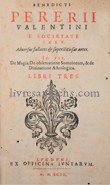
PERERIUS, Benedictus.
Adversus fallaces et superstitiosas Artes. Id est, de Magia, de Observasione Somniorum et de Divinatione Astrologica.
Lugduni, Officina Juntarum, 1592.
More Details >
1750 €
Rare treaty on witchcraft and magic of the sixteenth century.
Lyon first edition (first in 1591), well complete with the last blank leaf (with old manuscript notes).
The book is divided into three parts. The first deals with different aspects of magic, the second is about dreams and their interpretation and the last on astrology.
PERNETY, Antoine Joseph.
Les Fables Egyptiennes et Grecques dévoilées & réduites au même principe, avec une explication des hiéroglyphes et de la guerre de Troye.
Paris, Delalain, 1786.
More Details >
600 €
Second edition.
Treatise by Pernety in which he argues that the Greek and Egyptian mythologies contain the secret of the Great Work.
PERNETY, Antoine-Joseph.
Dictionnaire mytho-hermétique dans lequel on trouve les allégories fabuleux des poètes, les métaphores, les énigmes et les termes barbares des philosophes hermétiques expliqués.
Paris, Delalain, 1787.
More Details >
Sold
Seconde edition of this important source for knowledge of the history of alchemy and its symbols.
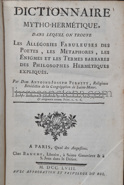
PERNETY, Antoine-Joseph.
Dictionnaire mytho-hermétique dans lequel on trouve les Allégories Fabuleuses des Poètes, les Métaphores, les énigmes et les Termes barbares des Philosophes Hermétiques expliqués.
Paris, Bauche, 1758.
More Details >
650 €
First edition of this important source for knowledge of the history of alchemy and its symbols.
PHILALETHE, Eiraeneus.
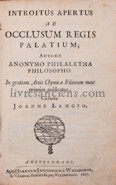
Introitus apertus ad occlusum regis palatium.
Amsterdam, Joannemm Janssonium, 1667.
More Details >
7500 €
The scarce first edition of this monument of the alchemical litterature.
Not in Duveen, Neville, Dorbon, Guaita, Verginelli, Ouvaroff.
PLANIS CAMPY, David de.
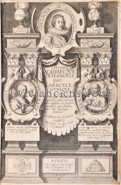
L’Hydre morbifique exterminée par l’Hercule chimique ou les sept maladies tenues pour incurables jusques à présent, rendues guérissables par l’art chimique médical.
Paris, Hervé du Mesnil, 1628.
More Details >
1500 €
The first edition.
Complete with thebeautiful extra engraved title and the portrait.
One of the most interesting ancient medical books, based on alchemy and astrology (Dorbon).
[REIBEHAND, Christophe].
Le Filet d'Ariadne : pour entrer avec seureté dans le labyrinthe de la philosophie hermétique.
Paris, Laurent D'Houry, 1695.
More Details >
2000 €
First edition in french.
Unusual work of alchemy of which bibliographers do not agree on the identity of the author.
For some [Dorbon, Caillet, Lenglet Dufresnoy] it is the German author Christophe Reibehand whose work was originally published in Latin in 1636.
For others [Brunet, Duveen, Ferguson] it is Gaston Le Doux (or Duclos or Claves).
Some figures on wood in the text illustrate the equipment of an alchemical laboratory.
If no bibliographer mentions the presence of a plate, certain rare copies have a folding table classically giving the correspondence between the alchemical symbols and the compounds used. This board is missing here.
REYNIER, Jean-Louis-Antoine.
Du Feu et de quelques-uns de ses principaux effets.
Lausanne, Mourer, 1787.
More Details >
Sold
First edition.
Reynier makes "fire" in this work, an essential constituent of the material which ensures its cohesion.
His theory announces, following Lavoisier, the replacement of the phlogiston theory by the caloric theory.
Our modern gaze would find that by replacing “fire” with “energy”, Reynier demonstrates many interesting intuitions here. As such it is often cited by Bachelard in his “Psychoanalysis of Fire”.
SCHULTZ, Gottfried || MICHAELIS, Johann.
Dissertatio pharmaceutico-therapeutica de Natura Tincturae Bezoardicae
[Relié à la suite : ]
Scrutinium Cinnabarinum Seu Triga Cinnabriorum, Hall. Saxon, Simon Joh. Hubner, 1680.
Hall. Saxon, Simon Joh. Hubner, 1678.
More Details >
1350 €
Bound together, two rare works by Gottfried Schultz (1643-1698) based on the work of Johann Michaelis (1606-1667).
1. First edition of this work in wich Schultz focuses on the preparation and use of the Michaelis bezoardic dye. This preparation will be part of the pharmacopoeia until the second half of the eighteenth century.
2. First edition.
Work devoted to the preparation and use of cinnabar (mercury sulphide) in the pharmacopoeia. The author discusses the different forms of cinnabar, natural cinnabar, cinnabar of antimony, ...
It is Paracelsus who first popularizes the use of cinnabar in medicine with its antimony oil.
At the end we find an appendage devoted to magnetic plaster.
Few references of a medicine then strongly influenced by alchemical works.
[SENDIVOGIUS, Michel].
Cosmopolite ou Nouvelle lumière chymique.
Paris, Laurent d'Houry, 1723.
More Details >
1800 €
Latest expanded edition.
Contains the following three treatises:
I - of nature in general, where Mercury is spoken of.
II - Sulfur
III - real Salt of the philosophers
as well as with separate pagination the Philosophical Letter of Antoine Duval.
At the end of the first treatise are the "Philosophical Enigma to the Sons of Truth" and the curious "Dialogue between Mercury, the Alchymist and Nature".
Sethon Alexander spent his life convinced of the reality of alchemy.
Completely disinterested, he went from town to town to convince the most incredulous by making transmutes lead into gold.
The product of its transmutations is given to the public.
His reputation was growing and he was called to the course of the Elector of Saxony, Christian II, where he made a transmutation.
Gold produced withstood all tests. Then told to give her secret. Sethon refused, he was tortured and imprisoned in vain.
He was released by Michael Sendivogius to whom he gave his supply of philosopher's stone and manuscripts. He died shortly afterwards from his injuries.
After marrying his widow, Sendivogius Sethon treaties under the name of Cosmopolitan.
Here the evidence of a transmutation performed before the scientific and Wolfgang Jacob Zwinger Deinheim (in de medicina Miberali. Argentorate. 1610)
"In 1602, writes Dr. Dienheim, when in the middle of summer I returned from Rome to Germany, I found myself next to a man singularly spiritual, small in size but big enough, a face colored of a sanguine temperament, wearing a brown beard trimmed to the fashion of France. He was wearing a black satin dress and had every sequence a single servant, that could distinguish among all by his red hair and beard the same color. The man was Alexander was born Sethonius.Il Molia, an island in the ocean. In Zurich, where the priest gave him a letter Tghlin for Dr. Zvinger, we hired a boat and we went by water to Basel. When we arrived in this city, my companion said: -
"You remember that, throughout the trip and the boat. you attacked alchemy and alchemists. You will also recall that I promised to answer, not demonstrations, but by a philosophical action. I still await someone I want to convince the same time as you. so that the opponents of alchemy cease their doubts about this art. "
It was then looking for the man in question, I knew only by sight and who did not live far from our hotel. I learned later that it was Dr Jacob Zvinger, whose family has so many famous naturalists. We went every three workers in a gold mine, with several sheets of lead that had Zvinger removed from his house, a crucible that we took a goldsmith, and sulfur that we bought in ordinary way. Sethon not touched anything. He made the fire, ordered to lead and sulfur in the crucible, place the lid and shake the ground with sticks. Meanwhile, he chatted with us. After a quarter of an hour. He says: -
"Take this little paper in the molten lead, but the middle and try that nothing falls into the fire !...»
In this paper was a pretty heavy powder, a color that seemed to lemon yellow; the rest, he must have good eyes to distinguish. Although also incredulous that St. Thomas himself, we did everything we had ordered. After the mass had been heated about a quarter of an hour, and continuously stirred with rods of iron, the goldsmith was ordered off the pot by pouring water on it, but there was the slightest trace of lead, we found the purest gold, which, in the opinion of the goldsmith, surpassed even as the fine gold of Hungary and Saudi. It weighed as much as lead, which he had taken the place. We sat stunned with astonishment was scarcely dare we believe our eyes. But Sethonius, mocking us:
- "Now, he says, where are you with your pedantry? You see the truth of the matter, and is more powerful than everything, even your sophistry. -
Then he cut a piece of gold, and gave a souvenir to Zvinger. I also kept a piece that weighed about four ducats, and I kept in mind that day. As for you, unbelievers, you will laugh perhaps what I write. But I still live, and I am a witness ready to say what I saw. Zwinger is still alive but he will not keep quiet and will testify about what I say. Sethonius still live and his servant, the latter in England and the first in Germany, as we know. I could even say exactly where he lives, if there were not too indiscreet in which research should engage to find out what happened to this great man, this saint, this half -god. "
Jacob Zwinger, including Dr. Dienheim invokes the testimony, was a physician and professor at Basel, outside of these titles, he enjoyed a high reputation for learning, and he left a highly respected name in the history of German medicine.
This impeccable witness died of the plague in 1610. But from the year 1606, it confirmed until the last detail the story of John Wolfgang Dienheim in a Latin letter Emmanuel Konig, professor at Basel, had printed in his Almanac.
The same letter tells us that before leaving Basel Sethon made a second attempt in the house of the silversmith Andrew Bletz, where he changed in several ounces of gold lead. As for the piece of gold he had given Zwinger, we read in the library of chemical Manget that the family of the doctor kept and made him long to see foreigners and curious.
One of the most significant treaty on conventional alchemy.
VIGENERE, Blaise de.
Traicté du feu et du sel. Excellent et rare opuscule du Sieur Blaise de Vigenère, Bourbonnois, trouvé parmy ses papiers après son décès.
Rouen, Jacques Cailloué, 1642.
More Details >
3500 €
Copy of the 1618 edition.
This classical alchimical treatise contains an interesting passage in which VigenEre described the discovery of the crystalline benzoic acid, obtained by the sublimation of gum benzoin (Partington).
[VILLAIN, Etienne-Francois].
Histoire critique de Nicolas Flamel et de Pernelle sa femme.
Paris, G. Desprez, 1761.
More Details >
Sold
First edition.
Nicolas Flamel, who died in 1418, is undoubtedly the most famous of alchemists, Abbé Villain looks into the historical truth of this character who has become a legend.
WECKER, Jean Jacques.
Les Secrets et merveilles de nature.
Lyon, Jean Aymée Candy, 1652.
More Details >
Sold
Jean-Jacques Wecker (1528-1585) German physician, philosopher and alchemist. This book contains beauty secrets, advice on destroying parasites, information on dyes, varnishes and gilding, gardening, preserving fruit, making ink, how to remove stains, amusing physics tricks... and more esoteric chapters on demons and alchemy.
Results (31 - 43) of
43
<
1
2
New
Price ↓
Price ↑
Author A-Z
Author Z-A
Title A-Z
Title Z-A
Date ↑
Date ↓
About
Sell your books
Contact
Newsletter
Blog
52 rue des Ecoles 75005 Paris
tel. +33 (0)1 43 54 22 23
contact@livresanciens.com
Terms and conditions
European VAT number: FR87515091171
© Eric Zink, Antiquarian Bookseller