Newsletter
About
New arrivals
Sell your books
Cart
Contact us
Blog
Categories
Categories
Science
Astronomy
Chemistry
Mathematics
Physics
Natural History
Engineering
History of science
Medicine
Medicine
Pharmacy
Occult
Astrology
Alchemy
Occult
Social Sciences
Economy
History
Philosophy
Law
Theology
Arts & Architecture
Art & Artist's Books
Architecture
Litterature
Miscellany
Manuscripts
Fine bindings
Early printings
FREE SHIPPING WORLWIDE
WE ACCEPT
Alchemy
Results (1 - 30) of
43
1
2
>
New
Price ↓
Price ↑
Author A-Z
Author Z-A
Title A-Z
Title Z-A
Date ↑
Date ↓
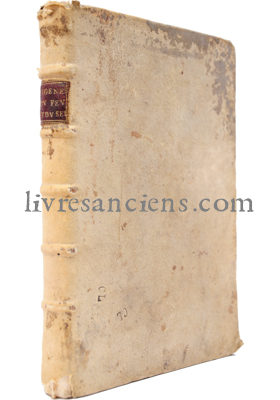
REYNIER, Jean-Louis-Antoine.
Du Feu et de quelques-uns de ses principaux effets.
Lausanne, Mourer, 1787.
More Details >
Sold
First edition.
Reynier makes "fire" in this work, an essential constituent of the material which ensures its cohesion.
His theory announces, following Lavoisier, the replacement of the phlogiston theory by the caloric theory.
Our modern gaze would find that by replacing “fire” with “energy”, Reynier demonstrates many interesting intuitions here. As such it is often cited by Bachelard in his “Psychoanalysis of Fire”.
PERNETY, Antoine-Joseph.
Dictionnaire mytho-hermétique dans lequel on trouve les allégories fabuleux des poètes, les métaphores, les énigmes et les termes barbares des philosophes hermétiques expliqués.
Paris, Delalain, 1787.
More Details >
Sold
Seconde edition of this important source for knowledge of the history of alchemy and its symbols.
PERNETY, Antoine Joseph.
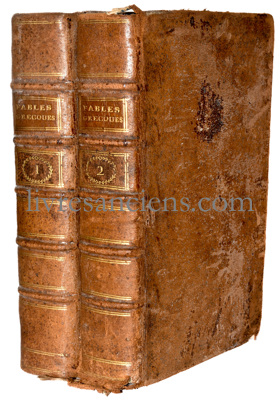
Les Fables Egyptiennes et Grecques dévoilées & réduites au même principe, avec une explication des hiéroglyphes et de la guerre de Troye.
Paris, Delalain, 1786.
More Details >
600 €
Second edition.
Treatise by Pernety in which he argues that the Greek and Egyptian mythologies contain the secret of the Great Work.
PALISSY, Bernard.
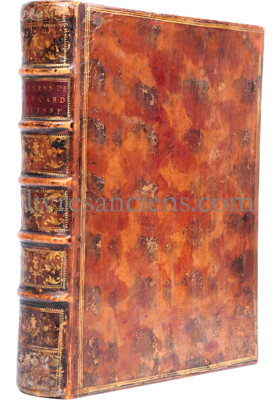
Oeuvres de Bernard Palissy revues sur les exemplaires de la Bibliothèque du Roi ; avec des notes par M. Faujas de Saint Fond, et des additions par M. Gobet.
Paris, Ruault, 1777.
More Details >
450 €
First edition of the complete works of Bernard Palissy. As always without the portrait and the dedicatory epistle to Franklin, which were deleted by the editor prior to publication.
In this copy a later portrait as been added.
It contains the texts on alchemy, but also on agriculture, geology, botany, ceramics, embalming, engineering, hydrology , medicine, metallurgy, meteorology, mineralogy, paleontology, philosophy, physics, toxicology and zoology.
Palissy, first became famous through his technique for making a rustic enameled earthenware, a skill which gained him the appointment of inventeur des rustiques figurines du roy. Palissy was probably one of the first men in France to teach natural sciences from facts, specimens and demonstrations rather than hypotheses. (DSB).
[VILLAIN, Etienne-Francois].
Histoire critique de Nicolas Flamel et de Pernelle sa femme.
Paris, G. Desprez, 1761.
More Details >
Sold
First edition.
Nicolas Flamel, who died in 1418, is undoubtedly the most famous of alchemists, Abbé Villain looks into the historical truth of this character who has become a legend.
ORSCHALL, Johann Christian.
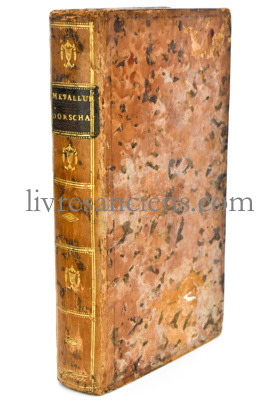
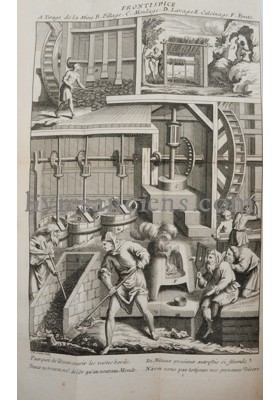
Oeuvres métallurgiques, contenant : I. l'Art de la Fonderie - II. un traité de la Liquation - III. un traité de la Macération des Mines - IV. le traité des trois Merveilles.
Paris, Hardy, 1760.
More Details >
700 €
First french edition.
The collected edition of the author's scattered German works on mining, metallurgy, and metallurgical chemistry, translate by Baron d'Holbach.
Detailed descriptions are given of three alchemical processes for making large quantities of gold.
Despite its alchemical overtones, the book gives much valuable information on extractive metallurgy.
Orschall remains known for his description of a process for obtaining false rubies by dyeing glass (described in this work).
PERNETY, Antoine-Joseph.
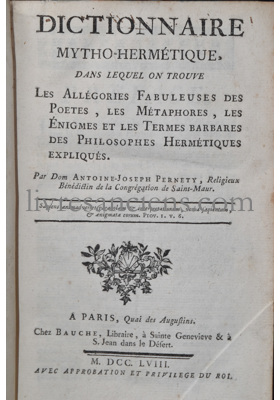
Dictionnaire mytho-hermétique dans lequel on trouve les Allégories Fabuleuses des Poètes, les Métaphores, les énigmes et les Termes barbares des Philosophes Hermétiques expliqués.
Paris, Bauche, 1758.
More Details >
650 €
First edition of this important source for knowledge of the history of alchemy and its symbols.
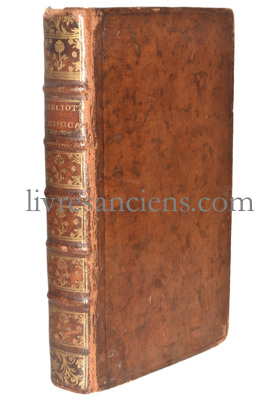
LEMERY (Nicolas) augmenté par BARON.
Cours de chymie contenant la manière de faire les opérations qui sont en usage dans la Médecine par une Méthode facile. Avec des raisonnemens sur chaque Opération, pour l'Instruction de ceux qui veulent s'appliquer à cette science. Nouvelle édition Revue, corrigée & augmentée.
Paris, Laurent-Charles d'Houry, 1757.
More Details >
Sold
French chemist, Nicolas LEMERY was born at Rouen on the 17th of November 1645. After learning pharmacy in his native town he became a pupil of C. Glaser's in Paris, and then went to Montpellier, where he began to lecture on chemistry. He next established a pharmacy in Paris, still continuing his lectures. Lemery did not concern himself much with theoretical speculations, but holding chemistry to be a demonstrative science, confined himself to the straightforward exposition of facts and experiments. In consequence, his lecture-room was thronged with people of all sorts, anxious to hear a man who shunned the barren obscurities of the alchemists, and did not regard the quest of the philosopher's stone and the elixir of life as the sole end of his science. Of his Cours de chymie (1675) he lived to see 13 editions, and for a century it maintained its reputation as a standard work.
The 1756's edition (the first one in 4to) is considered by Dorbon and P.Larousse as the best one. The only difference with our edition (1757) is the title engraving which is without the artist signature.
EIDOUS, Marc-Antoine.
Mémoires littéraires sur différens sujets de Physique, de Mathématique, de Chymie, de Médecine, de Géographie, d'Agriculture, d'Histoire naturelle.
Paris, André Cailleau, 1750.
More Details >
150 €
First edition.
Compilation of different texts collected throughout Europe by Eidus on subjects as diverse as the Philosopher's Stone, burning fountains, the increase in yields, the origin of nations ...
The author indicates in the preface that he will publish other memoirs if this first volume is successful, which he did the same year.
KEIL, Christoph Heinrich.
Compendiöses doch vollkommenes philosophisches hand-büchlein, das ist : philosophische grund-sätze zur universal-tinctur auf menschen und metallen, womit alle wahre philosophi so von der welt bis hieher gewesen sind, übereinstimmen, als welches der wahre grund alle philosophische bücher gründlich zu verstehen, und die höchste medicin zu machen.
Bayreuth und hof, Johann Gottlieb Vierling, 1748.
More Details >
600 €
Rare second edition of this work by Christoph Heinrich Keil, published for the first time in 1736.
LORRIS Guillaume de & MEUNG Jean de.
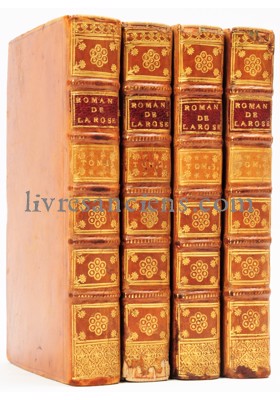
Le Roman de la Rose, par Guillaume de Lorris & Jean de Meun, dit Clopinel.
Revu sur plusieurs éditions & sur quelques anciens manuscrits. Accompagné de plusieurs autres ouvrages, d'une préface historique, de notes & d'un glossaire.
Paris, Veuve Pissot, 1735.
More Details >
1250 €
With the rare "Supplément au glossaire du Roman de la Rose (J.-B. Lantin de Damerey). 1737, J.Sirot at Dijon".
GOSSET.
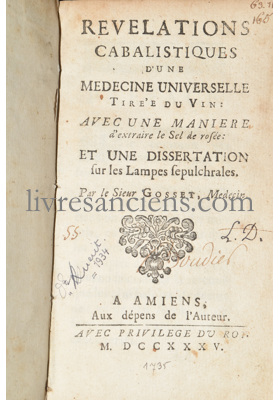
Révélations Cabalistiques d'une Médecine Universelle tirée du Vin: avec une manière d'extraire le Sel de Rosée et une Dissertation sur les Lampes Sépulchrales.
Amiens, Aux dépens de l'auteur, 1735.
More Details >
1300 €
First edition.
Rare alchemical work in which the author describes a panacea derived from wine.
He also discusses the principle of sepulchral lamps, lamps which burn without wear and which were found, it is said, in certain tombs, in particular in that of Tullia, daughter of Cicero. Gosset hopes that the luminous spirits of gold and silver will soon be extracted to distill a "golden oil" which will burn without consuming. This passage is commented on by Gaston Bachelard in his book on the formation of the scientific mind.
.
BARBA, Alvarez Alphonse.
Traité de l'art metalique, extrait des Oeuvres d'Alvarez Alfonse Barba, célèbre artiste dans les mines du Potozi, auquel on a joint un mémoire concernant les mines de France; avec un Tarif qui démontre les opérations qu'il faudroit faire pour tirer de ces mines l'or et l'argent qu'en tiroient les Romains lorsqu'ils étoient maîtres de Gaules.
Paris, Pierre Prault, 1730.
More Details >
450 €
First edition in french
Rare book containing curious precepts of hermeticism and data on metal art.
[SENDIVOGIUS, Michel].
Cosmopolite ou Nouvelle lumière chymique.
Paris, Laurent d'Houry, 1723.
More Details >
1800 €
Latest expanded edition.
Contains the following three treatises:
I - of nature in general, where Mercury is spoken of.
II - Sulfur
III - real Salt of the philosophers
as well as with separate pagination the Philosophical Letter of Antoine Duval.
At the end of the first treatise are the "Philosophical Enigma to the Sons of Truth" and the curious "Dialogue between Mercury, the Alchymist and Nature".
Sethon Alexander spent his life convinced of the reality of alchemy.
Completely disinterested, he went from town to town to convince the most incredulous by making transmutes lead into gold.
The product of its transmutations is given to the public.
His reputation was growing and he was called to the course of the Elector of Saxony, Christian II, where he made a transmutation.
Gold produced withstood all tests. Then told to give her secret. Sethon refused, he was tortured and imprisoned in vain.
He was released by Michael Sendivogius to whom he gave his supply of philosopher's stone and manuscripts. He died shortly afterwards from his injuries.
After marrying his widow, Sendivogius Sethon treaties under the name of Cosmopolitan.
Here the evidence of a transmutation performed before the scientific and Wolfgang Jacob Zwinger Deinheim (in de medicina Miberali. Argentorate. 1610)
"In 1602, writes Dr. Dienheim, when in the middle of summer I returned from Rome to Germany, I found myself next to a man singularly spiritual, small in size but big enough, a face colored of a sanguine temperament, wearing a brown beard trimmed to the fashion of France. He was wearing a black satin dress and had every sequence a single servant, that could distinguish among all by his red hair and beard the same color. The man was Alexander was born Sethonius.Il Molia, an island in the ocean. In Zurich, where the priest gave him a letter Tghlin for Dr. Zvinger, we hired a boat and we went by water to Basel. When we arrived in this city, my companion said: -
"You remember that, throughout the trip and the boat. you attacked alchemy and alchemists. You will also recall that I promised to answer, not demonstrations, but by a philosophical action. I still await someone I want to convince the same time as you. so that the opponents of alchemy cease their doubts about this art. "
It was then looking for the man in question, I knew only by sight and who did not live far from our hotel. I learned later that it was Dr Jacob Zvinger, whose family has so many famous naturalists. We went every three workers in a gold mine, with several sheets of lead that had Zvinger removed from his house, a crucible that we took a goldsmith, and sulfur that we bought in ordinary way. Sethon not touched anything. He made the fire, ordered to lead and sulfur in the crucible, place the lid and shake the ground with sticks. Meanwhile, he chatted with us. After a quarter of an hour. He says: -
"Take this little paper in the molten lead, but the middle and try that nothing falls into the fire !...»
In this paper was a pretty heavy powder, a color that seemed to lemon yellow; the rest, he must have good eyes to distinguish. Although also incredulous that St. Thomas himself, we did everything we had ordered. After the mass had been heated about a quarter of an hour, and continuously stirred with rods of iron, the goldsmith was ordered off the pot by pouring water on it, but there was the slightest trace of lead, we found the purest gold, which, in the opinion of the goldsmith, surpassed even as the fine gold of Hungary and Saudi. It weighed as much as lead, which he had taken the place. We sat stunned with astonishment was scarcely dare we believe our eyes. But Sethonius, mocking us:
- "Now, he says, where are you with your pedantry? You see the truth of the matter, and is more powerful than everything, even your sophistry. -
Then he cut a piece of gold, and gave a souvenir to Zvinger. I also kept a piece that weighed about four ducats, and I kept in mind that day. As for you, unbelievers, you will laugh perhaps what I write. But I still live, and I am a witness ready to say what I saw. Zwinger is still alive but he will not keep quiet and will testify about what I say. Sethonius still live and his servant, the latter in England and the first in Germany, as we know. I could even say exactly where he lives, if there were not too indiscreet in which research should engage to find out what happened to this great man, this saint, this half -god. "
Jacob Zwinger, including Dr. Dienheim invokes the testimony, was a physician and professor at Basel, outside of these titles, he enjoyed a high reputation for learning, and he left a highly respected name in the history of German medicine.
This impeccable witness died of the plague in 1610. But from the year 1606, it confirmed until the last detail the story of John Wolfgang Dienheim in a Latin letter Emmanuel Konig, professor at Basel, had printed in his Almanac.
The same letter tells us that before leaving Basel Sethon made a second attempt in the house of the silversmith Andrew Bletz, where he changed in several ounces of gold lead. As for the piece of gold he had given Zwinger, we read in the library of chemical Manget that the family of the doctor kept and made him long to see foreigners and curious.
One of the most significant treaty on conventional alchemy.
BARCHUSEN, Johann Conrad.
Elementa chemiae, quibus subjuncta est confectura lapidis philosophici imaginibus repræsentara.
Leyde, Theodorum Haak, 1718.
More Details >
9000 €
Second edition.
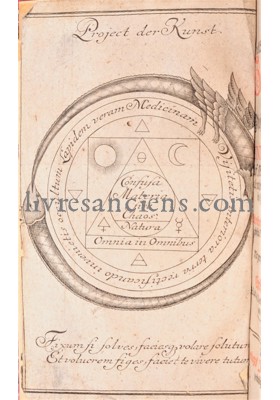
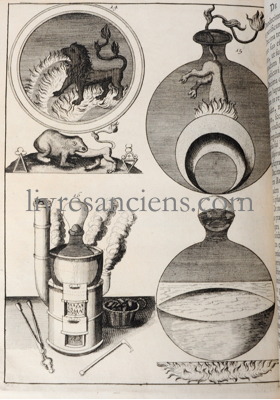
While the original edition (Pyrosophia, Utrecht, 1698) included only the five plates depicting the chemistry laboratory and its instrumentation, our edition is enriched with 19 additional plates—printed here for the first time—featuring 78 symbolic figures tracing the stages of the alchemical process.
As noted by Adam McLean, this suite constitutes the only early reproduction of the images from The Crowning of Nature, the renowned medieval alchemical manuscript.
It is one of the rarest works devoted to the philosopher’s stone, with the hidden meaning of its symbolic illustrations giving rise to numerous interpretations. Among them appear some of the most familiar emblems of alchemical tradition, such as the ouroboros, the green lion, and the phoenix.
This work was studied—alongside the Mutus Liber—by psychoanalyst Carl Gustav Jung in his Psychology and Alchemy (1953), where he discusses in particular the symbolic resonance of the image of the “winged dragon consuming itself within the alchemical vessel” (a figure reproduced in Jung’s book).
Through it, Jung integrates Barchusen’s iconography into his broader reflection on the alchemical transformation of the self.
[ALARY, François].
Le Parnasse Assiégé ou la Guerre Declarée entre les Philosophes Anciens & Modernes.
Lyon, Antoine Boudet, 1697.
More Details >
1750 €
First edtion.
It is only recently that the author of this rare treatise has been identified through the work of Didier Kahn. François Alary is also the author of the famous Texte d'Alchymie, et le songe-verd.
"It is a very curious effusion in which the author attemps to prove the reality of the Hermetic Science and the correctness of the views of Paracelsus" (Duveen).
[REIBEHAND, Christophe].
Le Filet d'Ariadne : pour entrer avec seureté dans le labyrinthe de la philosophie hermétique.
Paris, Laurent D'Houry, 1695.
More Details >
2000 €
First edition in french.
Unusual work of alchemy of which bibliographers do not agree on the identity of the author.
For some [Dorbon, Caillet, Lenglet Dufresnoy] it is the German author Christophe Reibehand whose work was originally published in Latin in 1636.
For others [Brunet, Duveen, Ferguson] it is Gaston Le Doux (or Duclos or Claves).
Some figures on wood in the text illustrate the equipment of an alchemical laboratory.
If no bibliographer mentions the presence of a plate, certain rare copies have a folding table classically giving the correspondence between the alchemical symbols and the compounds used. This board is missing here.
ETTMULLER, Michel.
Nouvelle Chymie raisonnée.
Lyon, Thomas Amaulry, 1693.
More Details >
400 €
First french edition.
Professor of botany and surgery at the University of Leipzig, Ferguson [I,251] reports that Ettmuller died on March 9, 1683 as a result of an unfortunate chemistry experiment.
DIGBY, Kenelm (Chevalier).
Discours fait en une célèbre assemblée [...] touchant la guérison des playes par la poudre de sympathie.
Paris, Charles Osmont, 1681.
More Details >
200 €
New edition containing in a second part the Dissertation on the powder of sympathy, translated in french from the Latin of Mr. Papin
Kenelm Digby (1603 – 1665) was an English courtier and diplomat, and an alchemist. Explaining everything by occult causes, fermentation, and effluvia, he thought he could cure with the “Powder of Sympathy”, a preparation of pulverized and calcined vitriol supposed to act, even at a distance, on wounds and injuries.
SCHULTZ, Gottfried || MICHAELIS, Johann.
Dissertatio pharmaceutico-therapeutica de Natura Tincturae Bezoardicae
[Relié à la suite : ]
Scrutinium Cinnabarinum Seu Triga Cinnabriorum, Hall. Saxon, Simon Joh. Hubner, 1680.
Hall. Saxon, Simon Joh. Hubner, 1678.
More Details >
1350 €
Bound together, two rare works by Gottfried Schultz (1643-1698) based on the work of Johann Michaelis (1606-1667).
1. First edition of this work in wich Schultz focuses on the preparation and use of the Michaelis bezoardic dye. This preparation will be part of the pharmacopoeia until the second half of the eighteenth century.
2. First edition.
Work devoted to the preparation and use of cinnabar (mercury sulphide) in the pharmacopoeia. The author discusses the different forms of cinnabar, natural cinnabar, cinnabar of antimony, ...
It is Paracelsus who first popularizes the use of cinnabar in medicine with its antimony oil.
At the end we find an appendage devoted to magnetic plaster.
Few references of a medicine then strongly influenced by alchemical works.
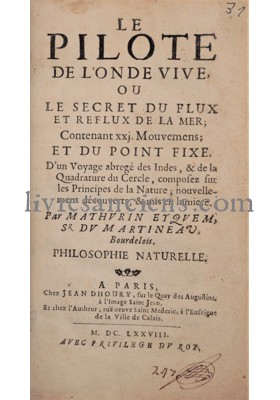
EYQUEM du MARTINEAU, Mathurin.
Le pilote de l'onde vive, ou le secret du flux et reflux de la mer.
Paris, Jean Dhoury, 1678.
More Details >
2200 €
Rare first edition of this alchemical work.
With the author signature on the title page.
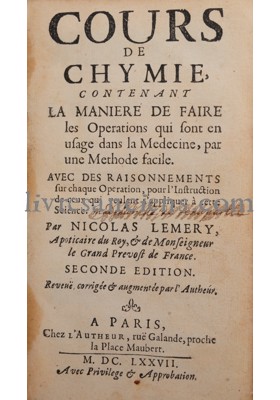
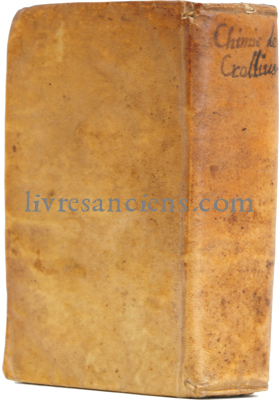
LEMERY, Nicolas.
Cours de Chymie.
Paris, Chez l'autheur, 1677.
More Details >
950 €
The rare second edition.
[BELIN, Albert].
Les Avantures du philosophe inconnu en la recherche & en l'invention de la Pierre Philosophale.
Paris, Jacques de Laize-de-Bresche, 1674.
More Details >
1350 €
Second edition of this rare alchemical work.
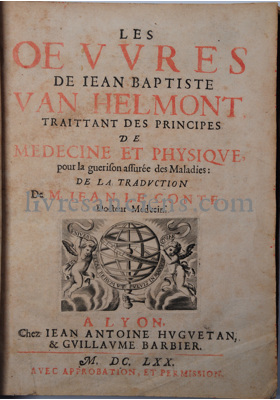
HELMONT, Jean Baptiste van.
Les Oeuvres de Jean Baptiste Van Helmont Traittant des Principes de Médecine et Physique pour la guerison assurée des Maladies : de la traduction de M. Jean le Conte.
Lyon, Jean Antoine Huguetan, 1670.
More Details >
850 €
First edition in french of th works of Helmont, and first issue with the date 1670.
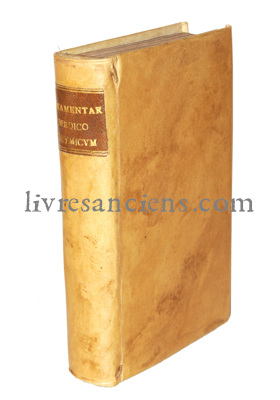
MYNSICHT, Adrian von.
Thesaurus et Armamentarium medico chymicum.
Lyon, Jean Antoine Huguetan, 1670.
More Details >
600 €
Adrian von Mynsicht (1603-1638) is a German physician and alchemist. In his Thesaurus, he gives us his best recipes of ointments, emplatres, liqueurs for medicine. As always at this time, chemistry, alchemy and pharmacopoeia are closely intertwined.
In the Testamentum Hadrianeum following the Thesaurus, we are given in a versified form the secret of the philosopher's stone of Mynsicht.
Rare edition not spotted by Ferguson, nor Caillet.
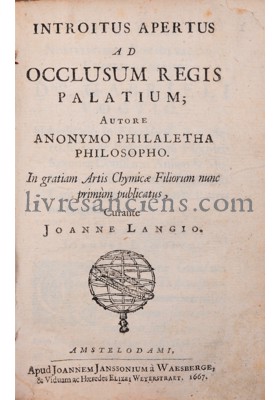
PHILALETHE, Eiraeneus.
Introitus apertus ad occlusum regis palatium.
Amsterdam, Joannemm Janssonium, 1667.
More Details >
7500 €
The scarce first edition of this monument of the alchemical litterature.
Not in Duveen, Neville, Dorbon, Guaita, Verginelli, Ouvaroff.
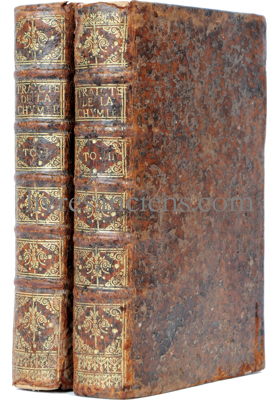
LE FEBVRE, Nicolas.
Traicté de la Chymie.
Paris, Thomas Jolly, 1660.
More Details >
2500 €
First edition.
Nicolas Lefèvre [id is Le Febvre] was a chemistry teacher at the Jardin des Plantes. He then became a member of the Royal Academy in London, a city to which he had come at the request of King Charles II of England.
A skilful chemist, people in the art praise the exactness with which he describes the operations and reports their results. It also indicates the means of recognizing fraud in pharmaceutical preparations.
A great admirer of Paracelsus, he claimed to have discovered, like him, a secret for restoring or maintaining all the vigor of youth in advanced age.
His chemistry course was a great success, went through several editions and was translated into several languages.
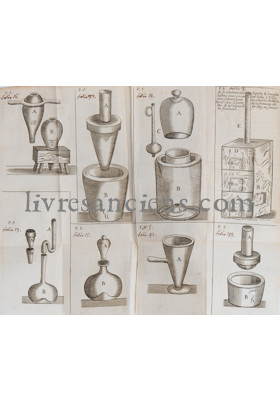
GLAUBER, Jean Rodolphe.
1. La Description des nouveaux fourneaux philosophiques, ou art distillatoire par le moyen duquel sont tirez les esprits, Huiles, Fleurs, & autres médicaments: Par une voye aisée & avec grand profit, des Vegetaux, Animaux, & Mineraux. Avec leur usage, tant dans la chymie, que dans la Medecine. Mis en lumiere en faveur des Amateurs de la Vérité par Jean Rodolphe Glauber et traduit en nostre langue par le Siuer Du Teil
2. Première [seconde, troisième] partie de l’oeuvre minérale, où est enseignée la séparation de l’Or des Pierres à feu, Sable, Argile, et autres Fossiles, par l’Esprit de Sel, ce qui ne se peut faire par autre voye. Comme aussi une Panacée, ou Médecine niverselle, antimoniale, & son usage.
3. La Teinture de l'or ou le véritable or potable
4. Traitté de la Médecine universelle, ou le vray or potable.
5. La Consolation des navigants. Dans laquelle est enseigné à ceux qui voyagent sur mer un moyen de se garantir de la faim & de la soif, voire mesme des maladies qui leur pourroient survenir durant un long voyage.
Paris, Thomas Jolly, 1659.
More Details >
5000 €
First edition in French.
Rare copy including all of Glauber's alchemical works published in French by Du Teil.
It is rare to find both "The Description of the New Philosophical Furnaces" and the collection of Glauber's small treatises in a uniform binding, as these are usually sold separately.
Glauber is the Paracelsus of his time (Hoefer). He made many discoveries in chemistry (he discovered sodium sulfate, then called Glauber's salt, and was one of the first to have glimpsed the existence of chlorine). Like Paracelsus, Glauber was a supporter of alchemical operations and theories. His work on recipes for panaceas and other marvelous medicines caused him the same harm as it did Paracelsus.
The Description of the Philosophical Furnaces is complete with all its illustrations and the "Annotations" which make up the sixth part, which is often missing.
In this work, which Ferguson considers one of the most remarkable chemistry books of the 17th century, Glauber describes the construction of furnaces and their use for distillation, the preparation of oils, extraction, the separation of metals, and the manufacture of balms. The appendix is bound at the head of volume 2.
Following are bound with separate title pages and pagination:
- Les trois parties de l'Oeuvre minérale
- La Teinture de l'or
- Le Traitté de la Médecine universelle
- La Consolation des navigants.
Rare set of Glauber's five alchemical treatises in French.
GLAUBER, Johann Rudolf.
Première [seconde, troisième] partie de l’oeuvre minérale, où est enseignée la séparation de l’Or des Pierres à feu, Sable, Argile, et autres Fossiles, par l’Esprit de Sel, ce qui ne se peut faire par autre voye. Comme aussi une Panacée, ou Médecine niverselle, antimoniale, & son usage.
[Reliés à la suite :]
- La Teinture de l'or ou le véritable or potable
- Traitté de la Médecine universelle, ou le vray or potable.
- La Consolation des navigants. Dans laquelle est enseigné à ceux qui voyagent sur mer un moyen de se garantir de la faim & de la soif, voire mesme des maladies qui leur pourroient survenir durant un long voyage.
Paris, Thomas Jolly, 1659.
More Details >
2500 €
First edition in French.
Rare treatises on Glauber's alchemy.
The 3 parts of the mineral work as well as the three linked works have a title page and a separate pagination.
Our copy contains the treatise on "or potable" panacea widely used throughout the Renaissance.
GLAUBER, Jean Rodolphe.
Miraculum mundi, sive plena perfectaque descriptio admirabilis naturae ac proprietatis potentissimi subiecti, ab antiquis menstruum philosophorum dicti : quo vegetabilia, animalia & mineralia facillime in faluberrima medicamenta, & imperfecta metalla in permanentia ac perfecta transmutari possunt.
Amsterdam, Joannem Janssonium, 1653.
More Details >
900 €
First Latin edition.
Rare copy.
Results (1 - 30) of
43
1
2
>
New
Price ↓
Price ↑
Author A-Z
Author Z-A
Title A-Z
Title Z-A
Date ↑
Date ↓
About
Sell your books
Contact
Newsletter
Blog
52 rue des Ecoles 75005 Paris
tel. +33 (0)1 43 54 22 23
contact@livresanciens.com
Terms and conditions
European VAT number: FR87515091171
© Eric Zink, Antiquarian Bookseller