
Newsletter
About
New arrivals
Sell your books
Cart
Contact us
Blog
Categories
Categories
Science
Astronomy
Chemistry
Mathematics
Physics
Natural History
Engineering
History of science
Medicine
Medicine
Pharmacy
Occult
Astrology
Alchemy
Occult
Social Sciences
Economy
History
Philosophy
Law
Theology
Arts & Architecture
Art & Artist's Books
Architecture
Litterature
Miscellany
Manuscripts
Fine bindings
Early printings
FREE SHIPPING WORLWIDE
WE ACCEPT
Engineering
Results (1 - 30) of
196
1
2
3
4
5
>
New
Price ↓
Price ↑
Author A-Z
Author Z-A
Title A-Z
Title Z-A
Date ↑
Date ↓
VARELA, Francisco.
Principles of Biological Autonomy.
New York, North-Holland, 1979.
More Details >
1500 €
First edition.
Francisco Varela (1946 - 2001) was a Chilean neurobiologist whose work in theoretical biology and cognitive science had an influence far exceeding his initial fields of study and thus influenced the field of artificial intelligence research.
Francisco Varela’s Principles of Biological Autonomy was a groundbreaking text when it was first published in 1979, putting forth a novel theory of how living systems produce and maintain themselves.
This foundational book introduces the key concept of autonomy derived as an elaboration of the idea of autopoiesis (the self-production and self-distinction) of living organisms.
Varela covers topics in systems theory, neuroscience, theories of perception, and immune networks and offers a participatory epistemology that goes on to be further developed in later enactive literature. (The MIT Press, 2025).
These ideas are compelling not only for historical reasons but also because they still illuminate current efforts in developing the enactive approach toward wider and more challenging goals (including language, human cognition, ethics, and environmentalism).
Varela’s ideas continue to shape cognitive science through the ongoing development of the enactive approach, which today encompasses accounts of various aspects of cognition and is becoming an increasingly influential framework. Yet it’s often forgotten how deeply Varela’s work was grounded in a conception of biological autonomy. So much so, in fact, that the label enactivism is frequently invoked without reference to its foundational commitment to autonomy.
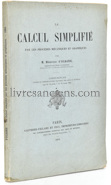
D'OCAGNE, Maurice.
Le Calcul Simplifié par les Procédés Mécaniques et Graphiques.
Paris, Gauthier-Villars, 1894.
More Details >
Sold
First edition.
Maurice d'Ocagne (1862-1938), chief engineer of the Ponts et Chaussées and répétiteur at the École Polytechnique, was a French mathematician, inventor of nomography.
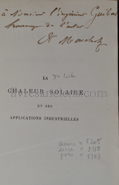
MOUCHOT, Augustin.
La Chaleur solaire et ses applications industrielles.
Paris, Gauthier-Villars, 1879.
More Details >
700 €
Second edition, the first with the 2 plates representing his invention.
Augustin Mouchot (1825-1912) was a French inventor and engineer, a pioneer in solar energy. His book La chaleur solaire et ses applications industrielles (Solar Heat and Its Industrial Applications) is a major work detailing his research and inventions for capturing and utilizing solar energy.
Mouchot is famous for developing solar collectors and steam engines powered by solar energy, thus anticipating the importance of renewable energy by several decades. This book is an essential resource for the history of solar technology and 19th-century engineering, presenting concepts that are still relevant today.
Presentation copy to Théophile Guibal (1814-1888).
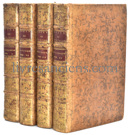
BEZOUT, Etienne.
Cours de mathématiques, à l'usage du corps royal de l'artillerie.
Paris, Imprimerie Royale, 1770-1772.
More Details >
680 €
First edition.
This is an adaptation of the course for the Navy published previously, between 1764 and 1770. This version for the artillery was very successful, partly because the first two volumes (arithmetic, geometry, algebra) were also used to assess candidates for entrance exams to military schools and the École Polytechnique. The artillery course became a standard reference, and other editions followed.
EIFFEL, Gustave.
La résistance de l'air et l'aviation expériences effectuées au laboratoire du champ-de-mars.
Paris, Dunod et Pinat, 1910.
More Details >
400 €
First edition.
After experimental aerodynamic tests obtained by free fall from the second floor of the tower he had built on the Champ de Mars in Paris, Gustave Eiffel had a wind tunnel built there in 1909. It was made up of a vein of tests of 3 meters in diameter over a length of 2.5 meters. The flow, generated by a propeller driven by a 70hp engine, could vary between 5 and 20 meters per second. The installation was enclosed in a 240 square meter hangar so as not to be influenced by the outside wind. This installation was used, in particular, for testing the Eiffel wing profiles which would equip a large number of French aircraft from the First World War. It was moved to Auteuil in 1912 and is still in operation today, operated by the Aérodynamic Eiffel company.
Copy with the stamp "Hommage de G. Eiffel" on the half title.
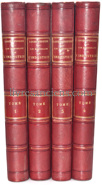
FIGUIER, Louis.
Les Merveilles de l'industrie ou description des principales industries modernes.
Paris, Furne, [v. 1870].
More Details >
200 €
Complete set of all four published volumes.
BLEUNARD, A.
Histoire générale de l'Industrie : Industries du règne végétal. Industries du règne animal. Industries du règne minéral.
Paris, H. Laurens, [v. 1895].
More Details >
200 €
First edition.
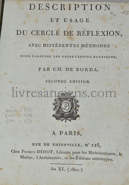
DE BORDA, Jean-Charles.
Description et usage du cercle de réflexion, avec différentes méthodes pour calculer les observations nautiques.
Paris, Firmin didot, 1802.
More Details >
200 €
Second edition.
Jean-Charles de Borda, a mathematician and navigator, designed the reflecting circle, an instrument for measuring angles used in navigation. This work is a technical manual describing the construction, use, and theory of this instrument, which helped improve the precision of observations at sea.
OZANAM, Jacques.
Méthode de lever les plans et les cartes de terre et de mer avec toutes sortes d'instrumens, et sans instrumens. La description & l'usage de ces instrumens, qui sont le demi-cercle, la planchette de diverses façons, la boussole, l'instrument universel, et le récipiangle.
Paris, Claude Jombert, 1716.
More Details >
200 €
In addition to detailing the geometric methods of surveying plans, Ozanam describes the composition and use of the equipment specific to surveyors of the time: copper board, compass, Huygens level, etc.
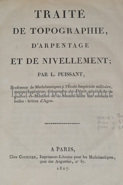
PUISSANT, Louis.
Traité de topographie, d'arpentage et de nivellement.
Paris, Courcier, 1807-1810.
More Details >
190 €
First edition.
Louis Puissant (1769-1843) was a French engineer, geographer, and mathematician. He was a professor at the central school in Agen in 1795. In 1802 and 1804, he was commissioned to survey the island of Elba in Italy.
Complete with the Supplement published in 1810.
ROSWAG, C.
Les métaux précieux considérés au point de vue économique.
Paris, Eugène Lacroix, 1865.
More Details >
120 €
First edition.
Presentation copy.
LEVRET.
- Cours de physique, de l'école navale
- Précis de chimie
- Précis de fortification.
Paris, Edouard Anner, 1839.
More Details >
80 €
First edition.
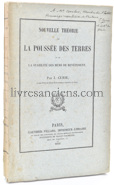
CURIE, Jean.
Nouvelle théorie de la poussée des terres et de la stabilité des murs de revêtement.
Paris, Gauthier-Villars, 1870.
More Details >
60 €
Jean Curie (1829-1910) was a military engineer and a former student of the École Polytechnique. His work Nouvelle théorie de la poussée des terres et de la stabilité des murs de revêtement (New Theory of Earth Pressure and the Stability of Retaining Walls) is a technical treatise on soil mechanics and construction. It proposes a new approach to calculating the lateral pressure exerted by the earth on retaining walls, a crucial problem in civil engineering.
Presentation copy.
POCHET, Léon.
Nouvelle mécanique industrielle. les machines à vapeur - à air chaud - à gaz - à air comprimé. les injecteurs à vapeur. la nouvelle contre-vapeur. les chaudières à vapeur. nouvelles tables pratiques.
Paris, Dunod, 1874.
More Details >
60 €
First edition.
RÉSAL, Jean.
Stabilité des constructions : cours de l'école des ponts et chaussées.
Paris, C. Béranger, 1901.
More Details >
50 €
First edition.
Copy signed by the author.
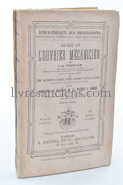
ORTOLAN, Jean Antoine.
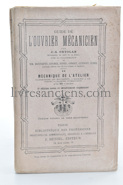
Guide de l'ouvrier mécanicien : Principes et pratique de la machine à vapeur.
Paris, J. Hetzel et Cie, 1888.
More Details >
35 €
Jean Antoine Ortolan (1811-1875) was a chief mechanic of the French Fleet and an officer of the Légion d'Honneur. He is known for his writings on mechanics and steam engines. This work is a technical manual intended for mechanics, with sections on steam engines, industrial fuels, and steam motors. It illustrates the technical and practical teaching of mechanics at the end of the 19th century.
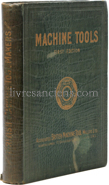
ASSOCIATED BRITISH MACHINE TOOLS MAKERS.
Catalogue of Machine Tools.
Paris, Payot, [v.1910-1920].
More Details >
90 €
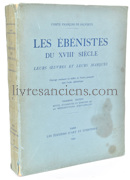
SALVERTE, François de.
Les Ébénistes du XVIIIe Siècle. Leurs œuvres et leurs marques.
Paris, Les Éditions d'Art et d'Histoire, 1934.
More Details >
Sold
Count François de Salverte (1753-1823) was a writer and historian, known for his work on the 18th century. This work is a reference treatise on 18th-century French cabinetmaking, detailing the works, marks (stamps), and biographies of the craftsmen.
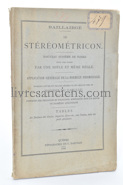
BAILLAIRGÉ, Charles.
Le stéréométricon. Nouveau système de toiser tous les corps par une seule et même règle.
Québec, C. Darveau, 1884.
More Details >
70 €
First edition.
Charles Baillairgé (1826-1906) was a Quebecois architect, engineer, and land surveyor. He was the president of the Canadian Institute of Quebec. This work is a technical treatise on stereometry, the measurement of volumes. It proposes a new calculation method based on the prismoidal formula and includes tables for calculating surfaces and volumes, making it a reference tool for professionals of his time.
TOMMASI, Donato.
Traité des piles électriques : piles hydro-électriques accumulateurs, piles thermo-électriques et pyro-électriques.
Paris, Georges Carré, 1889.
More Details >
60 €
First edition.
REULEAUX, Franz.
Le constructeur. Principes, formules, tracés, tables et renseignements pour l'établissement des projets de machines. À l'usage des ingénieurs, constructeurs, architectes, mécaniciens etc.
Paris, Librairie F. Savy, 1890.
More Details >
60 €
Franz Reuleaux (1829-1905) was a German mechanical engineer, professor at the Berlin Polytechnic, considered the "father of modern kinematics." His work Le constructeur (The Constructor) is a fundamental technical manual for machine design, highly influential in the late 19th century. It provides principles, formulas, drawings, and tables necessary for engineers, constructors, and mechanics. The French translation by A. Debize, chief engineer of State Manufactures, based on the fourth German edition (fully revised and augmented), testifies to the international importance of Reuleaux's work and his role in disseminating knowledge in mechanical engineering.
ORTOLAN, Jean Antoine.
Guide de l'ouvrier mécanicien : Mécanique de l'atelier.
Paris, J. Hetzel, [v. 1890].
More Details >
40 €
Jean Antoine Ortolan (1811-1875) was a chief mechanic of the French fleet. This work is a technical guide on workshop mechanics, the transmission of movements, air machines, pumps, and hydraulic machines. The book was designed for practical instruction and was a reference in the field of industrial mechanics.
MORIN, Arthur.
Aide-mémoire de mécanique pratique à l'usage des officiers d'artillerie et des ingénieurs civils et militaires.
Paris, Hachette, 1864.
More Details >
30 €
Bound with :
FURIET, Eléments de mécanique, Paris, Mallet-Bachelier, 1856.
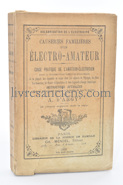
D'ARGY, Albert.
Causeries familières d'un électro-amateur.
Paris, Ch. Mendel, 1891.
More Details >
30 €
Albert D'Argy was an author specializing in popular science works, particularly on electricity. He is known for his pedagogical and practical approach. This work is a guide for electricity amateurs, explaining in a simple and detailed manner the operation and construction of household electrical devices of the time, such as bells and telephones.
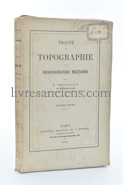
BERTRAND, Ernest.
Traité de topographie et de reconnaissances militaires.
Paris, J. Dumaine, 1875.
More Details >
30 €
Second edition.
Ernest Bertrand was an officer in the military engineering corps and a former professor at the École Spéciale Militaire. The work is intended for a military audience, providing a technical guide to topography and reconnaissance techniques. This manual contributed to the training of French officers in mapping and terrain analysis in the 19th century.
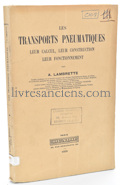
LAMBRETTE, A.
Les Transports Pneumatiques. Leur calcul, leur construction, leur fonctionnement.
Paris, Dunod, 1935.
More Details >
30 €
A. Lambrette was an engineer and collaborator of several European industrial societies and institutions, as indicated on the cover. His work Les Transports Pneumatiques (Pneumatic Transport) is a technical treatise that covers the practical and theoretical aspects of transporting materials by air. The book details the calculation, construction, and operation of these systems, which are important for industry, agriculture, and public works. It is a specialized source on the history of engineering and industrial technologies of the interwar period.
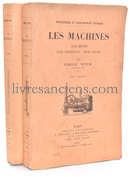
WITH, Émile.
Les Machines. Leur histoire, leur description, leurs usages.
Paris, J. Baudry, 1873.
More Details >
Sold
Firszt edition.
Émile With (1824-1886) was a French civil engineer, known for his writings on the history of technology and industry. His work Les Machines (Machines) is a technical treatise that focuses on the history, description, and use of machines in the 19th century. It is part of the "Bibliothèque de l'Enseignement Technique," which highlights its pedagogical purpose.
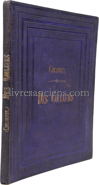
CHEVREUL, Michel Eugène.
Des couleurs et de leurs applications aux arts industriels à l’aide des cercles chromatiques. Avec XXVII planches gravées sur acier et imprimées en couleurs par René Digeon.
Paris, J.B. Baillière et Fils, 1864.
More Details >
5500 €
First edition of the rarest of Chevreul's publications on color.
Michel-Eugène Chevreul (1786-1889) is known to chemists for his research on fatty acids, saponification, and the discovery of stearin, but it is as a color theorist that his name will go down in history. Chevreul was appointed director of the Manufacture des Gobelins in 1824. Responsible for overseeing the production of dyes, he supported the work of dyers with his research on color perception. Thus, in 1839, he proposed a scientific approach to color complementarity and subsequently developed "color circles." A true "Pantone" color chart, a hundred years ahead of its time, Chevreul's color circles had the dual benefit of systematizing the production of hues (each with its own name) and making it easier to understand the concept of color complementarity. Thus, complementary colors are found on the same diameter of the color wheel, Red No. 2 corresponds to Green No. 2. "I believe I can affirm that it is possible to subject colors to a reasoned nomenclature, by relating them to types classified according to a simple method, accessible to the intelligence of all those who deal with colors" (extract from the preface). The standardization of color production was to interest first and foremost the industry then in full development, but it is undoubtedly in the Impressionist movement that Chevreul's theories found their finest accomplishment. Very early on, painters were inspired by Chevreul's work in their paintings, starting with Delacroix and then Monet. We will thus remember the fields of poppies dear to the Impressionists (Van Gogh, Monet, Pissaro...) where the red dots of the flowers burst out on complementary green backgrounds. The 27 spectacular plates were printed by René-Henri Digeon using chromochalcography, the process and difficulties of which are discussed in a paragraph in the book. Digeon appears to have presented a first edition of these plates at the 1855 World's Fair, for which he received a patent from the Empress. Several of the plates in our copy appear to be from this first edition and contain errors that have been corrected in other later copies that we have been able to consult.
CHEVREUL, Michel Eugène.
Mémoire sur la vision des couleurs matérielles en mouvement de rotation et des vitesses numériques de cercles.
Paris, Firmin-Didot, 1882 [1881].
More Details >
3000 €
First edition of Chevreul's last works on color.
A rare offprint with its own title page published by Firmin-Didot in 1882, of an article presented to the Academy of Sciences in December 1880 and January 1881 (one generally only finds the article extracted from the Mémoires de l'institut published in 1883). Chevreul is interested here in physiological optics, trying to analyze how the contrast between complementary colors is affected by movement.
In his conclusion, in which he calls himself "the dean of students in France" (he was then 95 years old), he sees a direct application of his work to signaling for train drivers.
LE BLOND, Guillaume.
Elémens de fortification.
Paris, Charles-Antoine Jombert, 1756.
More Details >
150 €
Fourfth edition.
Remarkable work by its plates of fortifications.
Results (1 - 30) of
196
1
2
3
4
5
>
New
Price ↓
Price ↑
Author A-Z
Author Z-A
Title A-Z
Title Z-A
Date ↑
Date ↓
About
Sell your books
Contact
Newsletter
Blog
52 rue des Ecoles 75005 Paris
tel. +33 (0)1 43 54 22 23
contact@livresanciens.com
Terms and conditions
European VAT number: FR87515091171
© Eric Zink, Antiquarian Bookseller