
Newsletter
About
New arrivals
Sell your books
Cart
Contact us
Blog
Categories
Categories
Science
Astronomy
Chemistry
Mathematics
Physics
Natural History
Engineering
History of science
Medicine
Medicine
Pharmacy
Occult
Astrology
Alchemy
Occult
Social Sciences
Economy
History
Philosophy
Law
Theology
Arts & Architecture
Art & Artist's Books
Architecture
Litterature
Miscellany
Manuscripts
Fine bindings
Early printings
FREE SHIPPING WORLWIDE
WE ACCEPT
Pharmacy
Results (1 - 30) of
60
1
2
>
New
Price ↓
Price ↑
Author A-Z
Author Z-A
Title A-Z
Title Z-A
Date ↑
Date ↓
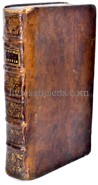
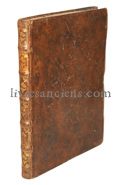
[MANUSCRIT].
Explication des plantes usuelles.
s.l., s.n., [1714].
More Details >
1300 €
Handwritten botany course focusing on "common plants", plants that can be used in medicine.
This course lists 486 plants, each with its Latin binomial name and its therapeutic use.
The plants seem to follow an order whose logic is not explained in the short introduction: "The large number of plants that I will have the honor of discussing with you during the short time that this course will last does not allow me to stop here for a long preface where I could explain to you in general how these same plants act, whether they are considered purgatives or simply as alteratives, [...] I propose to follow the order that we will follow in the demonstrations so that at the same time as you learn to know these same plants, you enter into the knowledge of their virtues."
The Latin names refer to the catalogues of Bauhin (C.B.) and Tournefort (inst. r. h.) which suggests that this course was dictated before the penetration of Linnaeus' classification in France, i.e. before the 1760s.
The structure of this course differs from the known courses on "Usual Plants", as dictated by Chomel and Jussieu.
We find, bound below, a manuscript by the same hand:
"Observations on bone diseases explained and demonstrated by Mr Arnaud In the amphitheater of the Jardin du Roy on June 13, 1714" 42 pages.
This suggests that both courses were taken at the Jardin du Roi or Royal Garden of Medicinal Plants (the future Museum of Natural History from 1793), which at the beginning of the 18th century was a major center for teaching medicine and surgery. It is known that at that time both Antoine Jussieu and Sébastien Vaillant were teaching botany there.
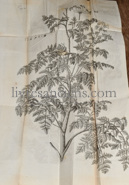
[MANUSCRIT] MAHOT, Maurice.
Traité de Botanique sur Estampes du Traité historique des Plantes de Buchoz classées suivant Tournefort & Linné.
[Nancy], [Buc'Hoz], [1762-1770].
More Details >
7000 €
Original manuscript of an unpublished botanical treatise by a learned scholar from Nantes.
It presents botanical concepts as well as the classifications of Linnaeus and Tournefort. This manuscript, nearly 200 pages long, is written on the verso of the plates from Buc'hoz’s Flore Lorraine.
All plates are also annotated with details on plant names, their classification according to Linnaeus and Tournefort, and their medicinal uses—together forming a true pharmacopoeia.
These 187 plates were intended to illustrate Buc'hoz’s Traité historique des plantes qui croissent dans la Lorraine et les Trois-Évêchés, published in ten octavo volumes between 1762 and 1770. The plates, originally issued separately in installments and designed to be folded and bound in octavo, are gathered here in a single folio volume.
Buc'hoz, known for the beauty of his plates, had solicited financial support from fellow countrymen and botany enthusiasts for the production of these engravings. Thus, at the bottom of almost every plate, one finds the coat of arms and name of the sponsor who funded it.
Maurice Mahot, the author of this manuscript, sponsored plate 152.
While biographical information on Maurice Mahot “the elder” (1745–1810), a royal counselor, civil and criminal judge at the présidial, alderman (1777), and deputy mayor of Nantes (1779), offers little indication of an interest in natural sciences and botany, the same cannot be said of his son, Maurice Mahot “the younger” (1774–1842), a doctor of medicine and scholar who published several books on medicine and lexicography.
The annotations by the son—a physician—on the plates funded by the father—a botany enthusiast—explain the numerous pharmaceutical and medical recipes found in the work.
Another collector has left his name on the title page: Silas Boucher de la Ville Jossy, a member of a prominent Nantes family in the mid-19th century.
A fascinating manuscript, still largely unexplored, of exceptional character, both for the beauty of its annotated plates and for its content, which intertwines botanical classification and pharmacopoeia.
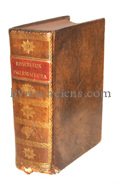
ABANO, Pierre (d') || PARACELSE.
Traicté des venins.
Lyon, Jean Huguetan, 1593.
More Details >
Sold
First publication in French of the treatise De Venenis eorumque remediis liber attributed to Peter of Abano (or Petrus de Abano), a famous Italian physician and philosopher of the 13th century.
It contains short descriptions of various poisons and venoms, more or less strange: hemlock, mandrake, spider bite, cat brain, deer tail... As well as the means of treating them, starting with the use of the Bezoar, which is the subject of a dedicated chapter.
Lazare Boet, the translator, adds for the first time in French, Paracelsus' treatise on the virtues and marvelous properties of worms, serpents, spiders, toads, and dunces.
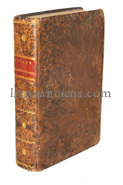
DUMOULIN, Nicolas.
Cours de Thérapeutique.
[Gand], s.n., [v. 1869].
More Details >
400 €
Course on Therapeutic Pharmacology given by Nicolas Dumoulin during the years 1868-1869 at the University of Ghent. Nicolas Du Moulin (1827-1890) was a Belgian physician. In 1857, he was appointed to lecture in pharmacology and toxicology at the University of Ghent (Faculty of Medicine). In 1870, he exchanged his pharmacology courses for internal medicine courses. The writer, Cyrille Van Cauwenberghe, left his signature at the head of the book. The course details the different formulations of medications and their therapeutic uses. Noteworthy is a long chapter on rye ergot, used as an abortive substance.
DUMOULIN, Nicolas.
Cours de Pharmacologie.
[Gand], s.n., 1868-1869.
More Details >
400 €
Pharmacology course given by N. Dumoulin during the years 1868-1869, possibly at the University of Ghent. The manuscript is divided into 11 numbered notebooks on lined paper that were bound together. The writer, Cyrille Van Cauwenberghe, left his signature at the beginning and end of the notebooks. The teaching details the different types of medications, their methods of administration, with sometimes advanced aspects of pharmacodynamics and chemistry.
BRUGNATELLI, Luigi-Vincenzo.
Pharmacopée générale à l'usage des pharmaciens et des médecins modernes, ou dictionnaire des préparations pharmaceutico-médicales simples et composées les plus usités de nos jours, suivant les nouvelles théories chimiques et médicales.
Paris, D.Colas, 1811.
More Details >
200 €
First french edition.
MATTIOLI, Per André.
Les commentaires de M. P. André Matthiolus, médecin senois, sur les six livres de Pedacius Dioscoride Anazarbeen, de la matière médecinale.
Lyon, Claude Prost, 1655.
More Details >
1200 €
Latest revised and corrected edition, expanded.
Translation from Latin into French by Antoine du Pinet.
The work comments on the six books of Dioscorides on medicinal materials, with additions on simple remedies, oils, distillations and the treatment of various diseases. Our edition is illustrated with a full-page portrait of the author and numerous small woodcuts in the text representing a large number of carefully engraved plants, as well as some crustaceans, fish, shellfish, insects, animals, scenes of country life. In fine, Brief discourse on the distillation of water with figures showing distillation apparatus. Mattioli, in addition to his work to match ancient botanical descriptions with contemporary botany, describes more than 100 new plants and notably one of the first European varieties of tomato.
LEMERY, Nicolas.
Pharmacopée universelle contenant toutes les compositions de pharmacie.
Avignon, Jean Delorme, 1716.
More Details >
450 €
Second edition augmented.
A fundamental treatise by Nicolas Lemery, a renowned French pharmacist and physician. This work presents a comprehensive overview of pharmaceutical preparations used in early 18th-century Europe, accompanied by a pharmaceutical glossary. Lemery is a major figure in modern chemistry and pharmacy.
LUDWIG, Daniel || ETTMÜLLER, Michel.
Traité du bon choix des médicamens.
Lyon, Frères Bruyset, 1730.
More Details >
200 €
Second french edition.
Galenic Pharmacopoeia translated from texts by German physicians Ludwig (Ludovicus) and Ettmuller.
An important pharmacological treatise, originally published in Latin, intended to guide physicians and pharmacists in the judicious selection of medications. It provides practical and precise advice for choosing the most appropriate remedies for each condition based on their effectiveness, qualities, and potential toxicity.
ORFILA, Mathieu.
Traité des poisons tirés des règnes minéral, végétal et animal, ou toxicologie générale.
Paris, Crochard, 1818.
More Details >
200 €
Second edition.
[PHARMACOPEE].
Codex, Pharmacopée française.
Paris, Béchet Jeune, 1839.
More Details >
60 €
1839 edition of the Codex Medicamentarius, a directory of medicines published by the Faculty of Medicine.
BOYER, Jean-Baptiste.
Codex medicamentarius seu pharmacopoea Parisiensis.
Francfort-sur-le-Main, Franciscum Varrentrapp, 1760.
More Details >
100 €
First printed edition in Germany of the Codex parisiensis.
Pharmacopoeia written in 1758 under the direction of Jean Baptiste Boyer, professor of pharmacy at the Faculty of Paris.
STORCK, Antoine.
Observations nouvelles sur l’usage de la cigüe.
Vienne / Paris, P. Fr. Didot le jeune, 1762.
More Details >
150 €
Storck was one of the first to promote the internal use of hemlock for medical treatments. His experiments were instrumental in the controlled reintroduction of this poison into pharmacopoeia. He is famous for having conducted experiments on himself to test the boundary between therapeutic doses and toxic and lethal doses.
AILHAUD, Jean.
Traité de l’origine des maladies et de l’usage de la poudre purgative.
Avignon, Esprit-Joseph Rousset, 1748.
More Details >
100 €
Third edition.
Jean d'Ailhaud (1675-1756), a native of Lourmarin, a doctor of medicine and surgeon, became famous throughout Europe for having invented a medicinal powder to which he gave his name and which brought him fortune. His Treatise is a veritable advertising brochure extolling the benefits of his powder. Copy duly signed by the author's son, associated with the Ailhaud powder business.
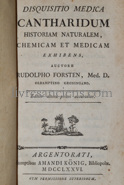
FORSTEN, Rudolphe.
Disquisitio medica cantharidum.
Strasbourg, Amandi König, 1776.
More Details >
200 €
First edition.
This study details the medicinal and chemical properties of cantharide (Spanish fly), known for its aphrodisiac and vesicant uses.
TAUVRY, Daniel.
Traité des médicamens, et la manière de s’en servir.
Paris, Estienne Michallet, 1695.
More Details >
Sold
Second edition.
This medical-pharmaceutical treatise links pharmacology and clinical experience. Tauvry (1669-1701), a French physician and anatomist, combines recipes, pathologies, and dosages, reflecting the empirical evolution of modern medicine.
TENCKE, H. (Jerôme).
Formules de médecine tirées de la pharmacie galénique et chymique.
Lyon, Jean Certe, 1690.
More Details >
300 €
Second edition in French.
This work by Jerôme Tencke (?-1687), a physician from Montpellier, is a treatise on pharmacy that combines galenic and chemical approaches to medicine. It presents various formulas and methods for preparing pharmaceutical remedies. The book is part of a transitional period where traditional galenic pharmacy rubbed shoulders with new chemical approaches to medicine.
BATE, George.
Pharmacopoea Bateana.
Lyon, Apud Amabilem Auroy, 1704.
More Details >
200 €
George Bate (1608-1668) was physician to Charles I and II of England and Oliver Cromwell's family.
Unusual English pharmacopoeia.
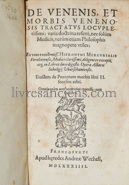
MERCURIALE, Geronimo || SCHELIGA, Albert.
De venenis et morbis venenosis tractatus.
Francfort, Andreae Wecheli, 1584.
More Details >
500 €
Edition published same year as the first edition in Venice.
Pioneering work on knowledge on poisons.
Some period handwritten annotations in the margins.
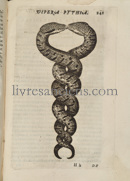
SEVERINO, Marco Aurelio.
Vipera Pythia id est, De Viperae Natura, Veneno, Medicina, Demonstrationes, et Experimenta nova.
Padoue, Pauli Frambotti, 1651.
More Details >
800 €
Second edition.
Marco Auelio Severino (1580-1656) was a prominent Italian anatomist and surgeon. In 1610, he was appointed professor of anatomy and surgery in Naples. His work, "Vipera Pythia," deals with venomous snakes, their anatomy, venom, and medicinal properties and virtues. It provides extensive information on the mythology, superstitions, and occult traditions surrounding snakes.
Many of the engravings, mostly full-page, depict mythological images as well as pagan deities, symbols, and idols associated with snakes.
COMTE, Jean Baptiste.
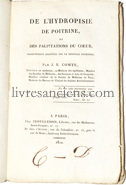
De l'Hydropisie de poitrine : et des palpitations du coeur, promptement dissipées par la digitale pourprée.
Paris, Croullebois, 1822.
More Details >
80 €
First edition.
Copy with large margins.
LA BROSSE, Guy (de).
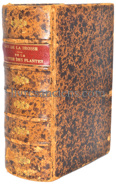
De la nature, vertu, et utilité des plantes.
Paris, Rollin Baragnes, 1628.
More Details >
700 €
First edition.
Guy de La Brosse was Louis XIII's regular physician and founder of the Jardin du Roi (ancestor of the Jardin des Plantes). The last part, entitled "Dessein d'un Jardin Royal pour la culture des plantes médicinales", presents the project for the future Jardin des Plantes.
While the author remains famous for having successfully completed this project, he is also known for having been one of the first French Paracelsians. This work, one of the first great French botanical treatises, detailing the medicinal virtues of plants, their classification and their therapeutic use, is very much inspired by Bacon and Paracelsus. The book illustrates in a very clear way one of the schools of thought of the nascent revolution, that of Paracelsianism.
LEMERY, Nicolas.
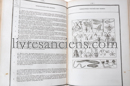
Dictionnaire universel des drogues simples.
Paris, L. Ch. d'Houry, 1759.
More Details >
400 €
New edition.
Work in which are classified in alphabetical order the names, origin, choice, principles and therapeutic virtues of plants, minerals and animals known at the time. A very complete copy of the 25 plates outside the text.
SMYTTÈRE, Philippe-Joseph-Emmanuel.
Tables synoptiques de l'histoire naturelle, pharmaceutique et médicale.
Paris, Librairie médicale de Crochard, 1833.
More Details >
450 €
Second edition.
Philippe-Joseph-Emmanuel de Smyttère (1800-1886) was a French physician, botanist and historian. His work, inspired by the classifications of Candolle, offers classification tables where medicinal properties are highlighted.
"I conceived the project of demonstrating, through application, the link that unites natural history to therapeutics" (extract from the preface).
DIGBY, Kenelm (Chevalier).
Discours fait en une célèbre assemblée [...] touchant la guérison des playes par la poudre de sympathie.
Paris, Charles Osmont, 1681.
More Details >
200 €
New edition containing in a second part the Dissertation on the powder of sympathy, translated in french from the Latin of Mr. Papin
Kenelm Digby (1603 – 1665) was an English courtier and diplomat, and an alchemist. Explaining everything by occult causes, fermentation, and effluvia, he thought he could cure with the “Powder of Sympathy”, a preparation of pulverized and calcined vitriol supposed to act, even at a distance, on wounds and injuries.
ETTMULLER, Michel || SCHRÖDER, Johann.
La Pharmacopée raisonnée de Schroder, commentée par Michel Ettmuller.
Lyon, Thomas Amaulry, 1698.
More Details >
450 €
Ettmüller was member of the Naturae Curiosum Academia of Leipzig. He died during one of his chemical experience.
FAVROT, C.
Traité élémentaire d'histoire naturelle pharmaceutique et médicale contenant la botanique, la zoologie, la minéralogie et la matière médicale.
Paris, Labé, 1843.
More Details >
120 €
First edition.
Book specially designed for students preparing for pharmacy and medicine exams with 500 figures in the text.
BUC'HOZ, Pierre-Joseph.
Supplément aux choix des meilleurs médicamens pour les maladies les plus désespérées.
Paris, Chez L'Auteur, 1785.
More Details >
80 €
First edition.
Continuation of the "Choice of the best medicines for the most desperate diseases", a work published the previous year. Pierre-Joseph Buc'hoz was a botanist, member of the Royal College of Medicine of Nancy and of many academies. From 1776 and until at least 1800, he self-published, distributing his prolific editorial production to his successive Parisian homes.
ROUSSEAU, Abbé.
Secrets et remèdes éprouvez dont les préparations ont été faites au Louvre.
Paris, Jean Jombert, 1697.
More Details >
Sold
First edition.
Work published posthumously by Rousseau de la Grangerouze, the brother of Abbot Rousseau, who was a Capuchin monk at the Louvre alongside Abbot Tranquille.
It contains the recipes for Baume Tranquille (a powerful sleeping pill based on Henbane, Poppy and Nightshade) and Rousseau's Laudanum, which made the reputation of the Capuchins of the Louvre.
Here he reveals the secret.
Note the experiment noted by Dorbon, which consisted of killing a toad by looking at it... an experiment that once almost turned out to be unfavorable for the abbot, a toad with a glowing red gaze having left him in a state of weakness for several days.
[WEBER, Georges Adolph].
Exposition systématique de tous les médicamens qui on été soumis à l'expérience pour reconnaitre leur véritable action.
s.l., s.n., 1831.
More Details >
1200 €
Manuscript proposing one of the first directories of homeopathic medicines in the French language through a translation of the work by Georg Adolph Weber: "Systematische Darstellung der reinen Arzneiwirkungen aller bisher geprüften Symptome" published in German in 1831.
The work will not be published in French only in 1833 with a translation by the Swiss homeopath Peschier under the title "Systematic exposition of the pure pathogenetic effects of all the remedies put to date in experience" (Geneva, Cherbuliez, 1833).
Our manuscript uses the same two-part structure as the German edition and should probably precede the French edition. The binding is typical of the 1830s, we are thus at the very beginning of the development of homeopathy in Europe under the impetus of the German school directed by Hannemahn (1755-1843) of whom Weber was a disciple.
It is in Switzerland and in Lyon that homeopathy in French language develops, Count Sébastien Des Guidi creates in 1830 the Homeopathic Society Lyonnaise and opens its consultations, there are 5 or 6 homeopaths in France in 1832 then 25 in 1833, 52 in 1835. (Cf. Bariety, "The beginnings of homeopathy in France", 1969)
Witness to the beginnings of homeopathy in France.
Results (1 - 30) of
60
1
2
>
New
Price ↓
Price ↑
Author A-Z
Author Z-A
Title A-Z
Title Z-A
Date ↑
Date ↓
About
Sell your books
Contact
Newsletter
Blog
52 rue des Ecoles 75005 Paris
tel. +33 (0)1 43 54 22 23
contact@livresanciens.com
Terms and conditions
European VAT number: FR87515091171
© Eric Zink, Antiquarian Bookseller