
Newsletter
About
New arrivals
Sell your books
Cart
Contact us
Blog
Categories
Categories
Science
Astronomy
Chemistry
Mathematics
Physics
Natural History
Engineering
History of science
Medicine
Medicine
Pharmacy
Occult
Astrology
Alchemy
Occult
Social Sciences
Economy
History
Philosophy
Law
Theology
Arts & Architecture
Art & Artist's Books
Architecture
Litterature
Miscellany
Manuscripts
Fine bindings
Early printings
FREE SHIPPING WORLWIDE
WE ACCEPT
Economics, Philosophy, Law, Political Science, History and Theology
Results (1 - 30) of
402
1
2
3
4
5
>
New
Price ↓
Price ↑
Author A-Z
Author Z-A
Title A-Z
Title Z-A
Date ↑
Date ↓
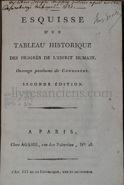
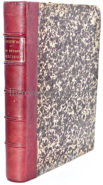
CONDORCET, Jean Antoine Nicolas de Caritat, marquis de.
Esquisse d'un tableau historique des progrès de l'esprit humain.
Paris, Agasse, An III [1795].
More Details >
375 €
Second edition.
Reprint of the original edition published the same year, with a new title page. Condorcet's work marks the birth of the idea of Progress, which would become the credo of the 19th century.
COMTE, Auguste.
Cours de philosophie positive.
Paris, J. B. Baillière et Fils, 1864.
More Details >
250 €
Second edition with an expanded preface by Émile Littré, his main disciple.
Auguste Comte (1798-1857) is the founder of positivism and sociology. His Cours de philosophie positive, originally published in six volumes between 1830 and 1842, is his major work, which sets out the whole of his philosophical and scientific thought. Volume I: General Preliminaries and Mathematical Philosophy. Volume II: Astronomical Philosophy and the Philosophy of Physics. Volume III: Chemical Philosophy and Biological Philosophy. Volume IV: The Dogmatic Part of Social Philosophy. Volume V: The Historical Part of Social Philosophy in Everything Concerning the Theological and Metaphysical States. Volume VI: The Complement of Social Philosophy and General Conclusions.
AMPÈRE, André-Marie.
Essai sur la Philosophie des Sciences, ou Exposition analytique d'une classification naturelle de toutes les connaissances humaines.
Paris, Bachelier, 1834.
More Details >
200 €
First edition.
André-Marie Ampère (1775-1836) was a French mathematician, physicist, and chemist, considered one of the founders of electromagnetism. A member of the Royal Academy of Sciences and a professor at the Collège de France and the École Polytechnique, he is famous for Ampère's law and the unit of electric current that bears his name. Beyond his scientific contributions, Ampère was also interested in the classification of sciences, as this Essay demonstrates.
ROSWAG, C.
Les métaux précieux considérés au point de vue économique.
Paris, Eugène Lacroix, 1865.
More Details >
120 €
First edition.
Presentation copy.
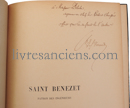
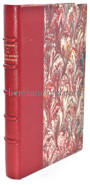
SAINT-VENANT, Adhémar (de).
Saint Benezet Patron des Ingénieurs. Œuvre posthume publiée par ses enfants.
Bourges, Tardy, 1889.
More Details >
80 €
First edition.
Presentation copy to Mr. Deloche.
THÉON DE SMYRNE.
Exposition des connaissances mathématiques utiles pour la lecture de Platon.
Paris, Impression anastaltique culture et civilisation, 1892 [1966].
More Details >
60 €
Reprint from 1892 edition.
BACHELARD, Gaston.
Le Nouvel Esprit Scientifique.
Paris, Librairie Félix Alcan, 1934.
More Details >
50 €
First edition.
BRUNSCHVICG, Léon.
Le Progrès de la conscience dans la philosophie occidentale.
Paris, Félix Alcan, 1927.
More Details >
50 €
First edition.
Léon Brunschvicg (1869-1944) was a French philosopher, a member of the Institut, and a professor at the Sorbonne. He is a major figure in French idealism and worked on the philosophy of science and psychology. This work offers a history of Western philosophy from the perspective of the development of consciousness, from antiquity to his own time.
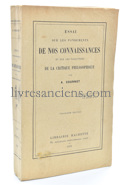
COURNOT, Antoine Augustin.
Essai sur les fondements de nos connaissances et sur les caracteres de la critique philosophique.
Paris, Hachette, 1922.
More Details >
50 €
Third edition.
The work is an exploration of the philosophy of science, addressing the theory of knowledge, causality, and the role of philosophical critique. The author, Antoine Augustin Cournot, was a mathematician, economist, and philosopher. His work influenced the development of epistemology and the philosophy of probability in the 19th century.
JAMES, William.
Le Pragmatisme.
Paris, Ernest Flammarion, 1911.
More Details >
40 €
First edition in french.
William James (1842-1910) was an influential American philosopher and psychologist, co-founder of pragmatism. A member of the Institut de France and a professor at Harvard, he is considered one of the most important thinkers of the 19th century. "Pragmatism" is one of his most famous works, synthesizing his lectures given in 1906-1907. In it, he develops the idea that the truth of an idea must be judged by its practical consequences and utility. This French edition, translated by E. Le Brun and enriched with an introduction by Henri Bergson (1859-1941), a Nobel Prize-winning French philosopher and member of the Institut, is particularly notable. Bergson's presence underscores the importance and resonance of James's pragmatism in the French philosophical context of the early 20th century.
OSTWALD, Wilhelm.
Esquisse d'une Philosophie des Sciences.
Paris, Librairie Félix Alcan, 1911.
More Details >
Sold
First edition in french.
Wilhelm Ostwald (1853-1932) was a German chemist and philosopher, winner of the Nobel Prize in Chemistry in 1909 for his work on catalysis and the study of chemical equilibria and reaction rates. He was one of the major figures in physical chemistry and a fervent defender of energism, a theory that reduced all phenomena to energy transformations. As a professor at the University of Leipzig, he exerted considerable influence. This work, "Outline of a Philosophy of Science," translated from German by M. Dorolle (Associate Professor of Philosophy), demonstrates his interest in the epistemological foundations of science. In it, he sets out his vision of science, its method, and its philosophical scope, marking an important current of thought at the beginning of the 20th century, a period of profound scientific and philosophical upheaval.
TANNERY, Jules.
Science et Philosophie.
Paris, Librairie Félix Alcan, 1912.
More Details >
35 €
Jules Tannery (1848-1910) was a French mathematician and philosopher, professor at the Sorbonne and deputy director of the École Normale Supérieure. Brother of the philosopher of science Paul Tannery, Jules was an influential educator, having trained many important mathematicians. This work, "Science and Philosophy," is a compilation of his posthumous writings, with an introductory note written by Émile Borel (1871-1956), one of his illustrious students and himself an eminent mathematician.
SECCHI, P. Angelo.
L'Unité des forces physiques. Essai de philosophie naturelle.
Paris, F. Savy, 1874.
More Details >
35 €
Father Angelo Secchi (1818-1877) was an Italian Jesuit, director of the Rome Observatory, and a renowned astronomer and physicist, corresponding member of the Institute of France. His work L'Unité des forces physiques (The Unity of Physical Forces) is an essay on natural philosophy that explores the concept of unity and interconnectedness of the various forces known in physics at his time. Secchi, a pioneer in stellar spectroscopy, sought to establish a unified vision of the physical world, a central theme in 19th-century science. This second, revised and considerably augmented edition, published based on Dr. Deleschamps' Italian translation, demonstrates the interest in his ideas in France.
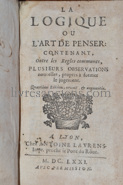
ARNAULD, Antoine || NICOLE, Pierre.
La logique ou l'art de penser, contenant, outre les règles communes, plusieurs observations nouvelles, propres à former le jugement.
Paris, Antoine Laurens, 1671.
More Details >
90 €
LOCKE, John.
Essai philosophique concernant l'entendement humain, où l'on montre quelle est l'étendue de nos connoissances certaines, et la manière dont nous y parvenons.
Paris, Bossange, An VII [1798].
More Details >
Sold
John Locke's (1632-1704) An Essay Concerning Human Understanding is a foundational work of empiricism and Enlightenment philosophy. First published in 1689, it explores the origin, certainty, and extent of human knowledge, rejecting the idea of innate ideas and asserting that all knowledge derives from sensory experience and reflection. This French edition from "An VII" (1798-1799), translated by Pierre Coste, is particularly notable as it incorporates posthumous additions by Locke and the translator's remarks, thereby enriching the original work and demonstrating its continued influence on French thought.
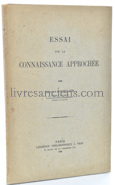
BACHELARD, Gaston.
Essai sur la connaissance approchée.
Paris, J. Vrin, 1927.
More Details >
Sold
First edition.
Gaston Bachelard (1884-1962), agrégé in philosophy and doctor of letters, was one of the greatest French philosophers of the 20th century, specializing in epistemology and the history of science. His Essai sur la connaissance approchée (Essay on Approximated Knowledge) is one of his first major works, in which he develops the notion that scientific knowledge is never absolute, but always relative and "approximated." He examines concepts from contemporary science (relativity, quantum mechanics) and defends a philosophy of the "no" that shows how new knowledge is built by breaking with previous knowledge. This book is a landmark of French epistemology.
MACH, Ernst.
La Connaissance et l'Erreur.
Paris, Ernest Flammarion, 1908.
More Details >
Sold
First french edition.
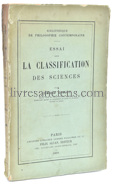
GOBLOT, Edmond.
Essai sur la Classification des Sciences.
Paris, Librairie Germer Baillière, 1898.
More Details >
30 €
First edition.
Edmond Goblot (1858-1935), ancien élève de l'École Normale Supérieure et agrégé de philosophie, était un philosophe et logicien français. Son Essai sur la Classification des Sciences est une contribution importante à l'épistémologie, le domaine qui étudie la connaissance scientifique. Goblot y propose un système de classification des sciences basé sur leurs méthodes et leur objet. L'ouvrage s'inscrit dans la lignée des travaux de l'épistémologie française de la fin du XIXe siècle et a influencé les réflexions sur la structure des connaissances et la méthodologie scientifique.
VERTOT, René Aubert de.
Histoire des révolutions de Suède.
Besançon, Charles Deis, 1846.
More Details >
30 €
René Aubert de Vertot (1655-1735) was a French historian, member of the Académie des inscriptions et belles-lettres, known for his narrative historical works. His Histoire des révolutions de Suède (History of the Revolutions of Sweden) is one of his most famous works, recounting the political and dynastic upheavals that marked Swedish history, particularly the rise of Gustav I Vasa. Although criticized today for its lack of historical rigor compared to modern standards, Vertot's work was very popular in its time for its vivid and dramatic style, helping to shape the perception of historical events for the French public in the 18th and 19th centuries.
TAINE, Hippolyte.
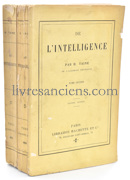
De l'Intelligence.
Paris, Hachette, 1903.
More Details >
20 €
Hippolyte Taine (1828-1893), a member of the French Academy, was a French historian, philosopher, and critic whose work had a major influence on naturalism and positivism. His work De l'Intelligence (On Intelligence) is a treatise on psychology and philosophy that explores the nature of human cognitive faculties. Taine applies a scientific and deterministic method to the study of the mind, analyzing the mechanisms of perception, memory, and ideas.
This book was a fundamental text for nascent psychology and the philosophy of science in France in the late 19th century.
CHAMPOLLION, Jean François.
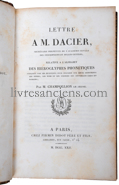
Lettre à M. Dacier,... relative à l'alphabet des hiéroglyphes phonétiques employés par les Égyptiens pour inscrire sur leurs monuments les titres, les noms et les surnoms des souverains grecs et romains
[relié à la suite]
Précis du système hiéroglyphique des anciens égyptiens, ou Recherches sur les élémens premiers de cette écriture sacrée.
Paris, Didot / Treuttel et Würtz, 1822-1824.
More Details >
25000 €
First edition of the two major work of Champiollin, bound completely in one contemporary full calf.
1. Lettre à M. Dacier. Paris. 1822. Champollion's seminal work, which first announced the deciphering of the Rosetta Stone, provides the key to reading Egyptian hieroglyphics and gave birth to modern Egyptology. This seminal work is undoubtedly the most important philological work ever written.
2. Précis du système hiéroglyphique Paris. 1824. Two years after his “Lettre à M. Dacier,” Champollion presents here for the first time in its entirety the deciphering of hieroglyphics.
The Rosetta Stone, brought back by the Napoleonic expeditions to Egypt, gave the same text in three different languages, it is the key that gave Champollion the understanding of the language of the ancient Egyptians.
After laying down the principle of phonetic writing in 1822 in his Letter to M. Dacier, he continued his work and his demonstrations until he had an intimate knowledge of this language: "It is a complex system, a writing at the same time figurative, symbolic and phonetic, in the same text, the same sentence, I would almost say in the same word"
His Precis of the hieroglyphic system gives us with many examples an unprecedented understanding of hieroglyphs, thus cutting the grass under the feet of his opponents (and competitors) such as Thomas Young.
The discovery of Champollion suddenly gave humanity access to three millennia of its history.
NUDANT, Alphonse.
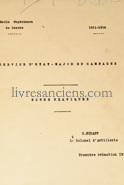
Service d'Etat Major en campagne. Notes Pratiques.
s.l., Ecole supérieure de guerre, 1911-1912.
More Details >
300 €
First edition.
Staff course given by Lieutenant Colonel Nudant at the Ecole Supérieure de Guerre for the year 1911-1912.
He was promoted to Brigadier General during the First World War and Foch said of him: "I loved this poor Nudant. put in all the sauces and all the sauces it was good!”
Very interesting document for understanding the organization of the French army on the eve of 14-18.
An exceptional document is attached: Examination copy of the student "Captain Bichot" on which he must write a fictitious "Secret Instruction" to give the maneuver signal perhaps during a wargame. Another hand corrects it in pencil and indicates: “Very clear, very clear TB”.
DUMORTOUS, Pierre.
Histoire des conquêtes de Louis XV. Tant en Flandre que sur le Rhin, en Allemagne & en Italie, depuis 1744, jusques à la paix conclue en 1748.
Paris, De Lormel, 1759.
More Details >
1300 €
First edition.
Illustrated work on the battles and military victories of the reign of Louis XV between 1744 and 1748.
With maps and views of the fortifications of Tournai, Ghent, Mons, Antwerp, Brussels, Bruges, Ostend, Bergen op Zoom, Maastricht, Ypres, Wissembourg, Freiburg im Breisgau, Villefranche, Cony, and more.
DESMAZES, Charles.
Le Bailliage du Palais Royal de Paris.
Paris, Willem et Daffis, 1875.
More Details >
1500 €
One of the three copies printed on vellum.
[DESFORGES, Pierre].
Avantages du mariage, et combien il est nécessaire & salutaire aux prêtres & aux évêques de ce tems-ci d'épouser une fille chrétienne.
Bruxelles, s.n., 1758.
More Details >
600 €
First edition.
This edition was seized for destruction upon the conviction of its author. A work with bold and polemical theories for the 18th century, on the marriage of priests, which was condemned to be destroyed by laceration and burned by a judgment of the Court of Parliament in 1758. The author, a canon of Etampes, was forced to retract in 1760 and was imprisoned.
PETAIN, Philippe.
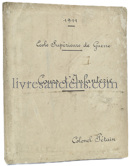
Cours d'Infanterie.
s.l., Ecole supérieure de guerre, 1911.
More Details >
1600 €
First edition.
Infantry course given by Colonel Philippe Pétain at the War School in 1911.
Major document for understanding the strategic thinking of the future hero of Verdun.
This course was only rediscovered and studied in 1960 by General Jean Delmas and published for the first time in 2010 by Editions du Cosmogone.
Pétain taught the infantry course at the War School between 1908 and 1911. His course is divided into three parts: the first two, of around a hundred pages each, are devoted to the story and study of combat. infantry that Pétain considers exemplary (Auerstedt in 1806, Saint-Privas in 1870). The third part, of only fifty pages, offers an uncompromising analysis of the infantry regulations in use in the French army between 1870 and 1902. It promotes a change in the doctrine of use of the infantry which must no longer expose itself to enemy fire as the Napoleonic vision of combat wanted.
Through its concern to spare the blood of men, this course clearly announces the Pétain of 1917-1918.
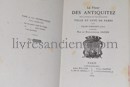
CORROZET, Gilles || Le Bibliophile JACOB.
La Fleur des antiquitez de la noble et triomphante ville et cité de Paris.
Paris, Léon Willem, 1874.
More Details >
200 €
Reprint with an erudite preface by Bibliophile Jacob (Paul Lacroix) of this 1532 booklet by Gilles Corrozet.
La Fleur des Antiquités is the first work written on the annals of Paris and its citizens. It is particularly insightful on the topography of Parisian streets at the time.
One of 22 copies on China paper, ours is number 20.
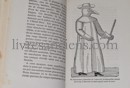
CHÉREAU, Achille.
Les Ordonnances de la ville de Paris pour éviter le danger de peste 1531.
Paris, Léon Willem, 1873.
More Details >
200 €
Scholarly reprint of Renaissance hygienic prescriptions, accompanied by a historical study.
One of 22 copies on China paper, ours number 11.
Some engravings in the text.
FRANKLIN, Alfred.
Les Rues et les cris de Paris au XIIIe siècle.
Paris, Léon Willem / Paul Daffis, 1874.
More Details >
250 €
First edition.
In this work, Franklin mainly used the book of the size of Paris from 1292 which had been published by H. Géraud in 1837. He added several poems by Rutebeuf.
One of 35 copies on China paper, ours number 15.
BARREIRA, Isidoro de.
Tratado das significaçoens das plantas, flores e frutos.
Lisbonne, Manoel Lopes Ferreyra, 1698.
More Details >
300 €
Second edition.
Rare Portuguese treatise on the symbolism of plants in sacred and secular writings.
Results (1 - 30) of
402
1
2
3
4
5
>
New
Price ↓
Price ↑
Author A-Z
Author Z-A
Title A-Z
Title Z-A
Date ↑
Date ↓
About
Sell your books
Contact
Newsletter
Blog
52 rue des Ecoles 75005 Paris
tel. +33 (0)1 43 54 22 23
contact@livresanciens.com
Terms and conditions
European VAT number: FR87515091171
© Eric Zink, Antiquarian Bookseller