
Categories

All our Scientific books

Are you passionate about the history of science?
You will certainly find a book for you among our rare books and manuscripts of Mathematics, Physics, Chemistry or Natural Sciences.
The famous names in science are present on our shelves: Euclid, Newton, Darwin, Pascal, Lavoisier and also those who have participated in scientific progress.

Results (1 - 30) of 795
TilesList
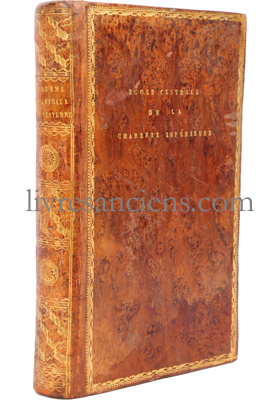
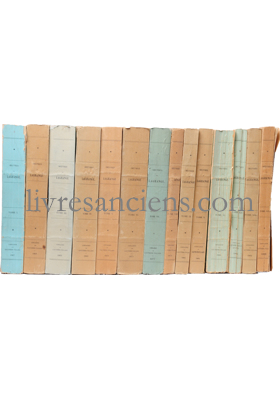
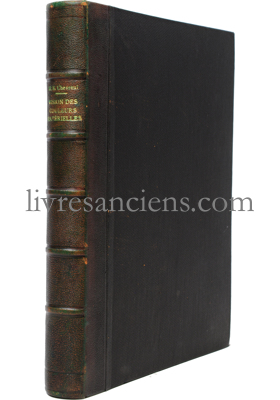
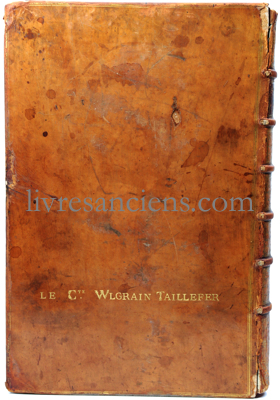
Photo CHEVREUL, Michel Eugène. 

First edition.
One of the most influential books on art in the 19th century.
Michel-Eugène Chevreul (1786–1889) is known to chemists for his research on fatty substances (1810–1823) and on immediate organic analysis (1824), but it is as a color theorist that his name achieved lasting fame.
De la loi du contraste simultané des couleurs introduced a scientific understanding of color that had a profound and lasting impact on the painters of his time.
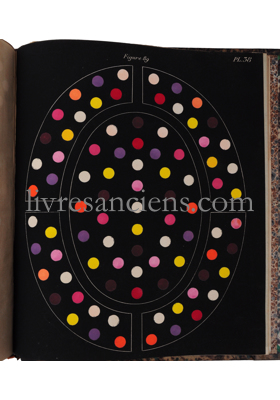
His “law” describes how the perception of a hue is altered by the surrounding colors, each color projecting its complementary onto its immediate environment (thus, a red object tends to cast a greenish glow on nearby surfaces, a yellow one a purplish tint, and so on). This principle is clearly illustrated in plate 7 of the Atlas, where colored dots on a white background seem to emit halos of their complementary hues.

Eugène Delacroix (1798–1863), a central figure of Romanticism, paid close attention to Chevreul’s research. According to the painter Paul Signac, Delacroix even sought to meet the chemist and acquired notes from his lectures in order to better grasp the law of simultaneous contrast. Several of his paintings feature harmonies built around complementary color pairs. For instance, The Entry of the Crusaders into Constantinople (1840) deliberately juxtaposes yellow/purple, blue/orange, and red/green to dramatize the scene—so effectively that art historian Lee Johnson called it an ideal “illustration” of Chevreul’s treatise.

But it was arguably within the Impressionist movement that Chevreul’s theories reached their highest artistic fulfillment. Claude Monet (1840–1926), in particular, used simultaneous contrast to heighten luminosity in his landscapes. He avoided black and earth tones, preferring instead to render shadows in color: purples and blues for shaded areas at sunset, accented with yellow-orange highlights in full light. This technique appears as early as Impression, Sunrise, the foundational work of the movement. One might also recall the poppy fields, a favorite motif of the Impressionists (Van Gogh, Monet, Pissarro…), where red flowers vibrantly stand out against green backgrounds.

A book heralding one of the greatest revolutions in painting.

Our copy is complete with all the color plates, most of them signed by Chevreul himself.

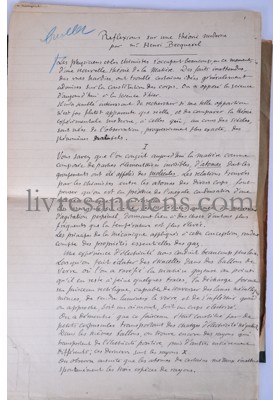
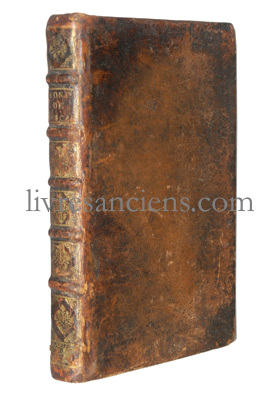
Photo [MANUSCRIT] MAHOT, Maurice. 

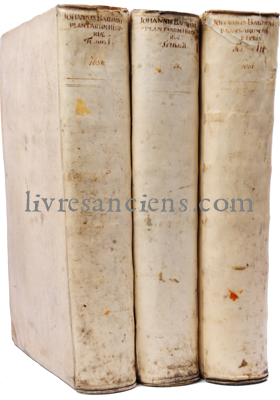
Original manuscript of an unpublished botanical treatise by a learned scholar from Nantes.
It presents botanical concepts as well as the classifications of Linnaeus and Tournefort. This manuscript, nearly 200 pages long, is written on the verso of the plates from Buc'hoz’s Flore Lorraine.
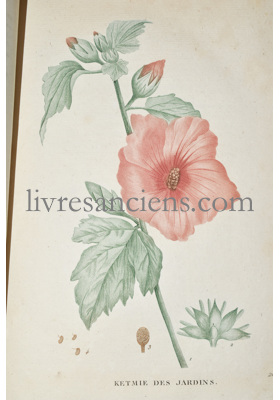
All plates are also annotated with details on plant names, their classification according to Linnaeus and Tournefort, and their medicinal uses—together forming a true pharmacopoeia.
These 187 plates were intended to illustrate Buc'hoz’s Traité historique des plantes qui croissent dans la Lorraine et les Trois-Évêchés, published in ten octavo volumes between 1762 and 1770. The plates, originally issued separately in installments and designed to be folded and bound in octavo, are gathered here in a single folio volume.
Buc'hoz, known for the beauty of his plates, had solicited financial support from fellow countrymen and botany enthusiasts for the production of these engravings. Thus, at the bottom of almost every plate, one finds the coat of arms and name of the sponsor who funded it.
Maurice Mahot, the author of this manuscript, sponsored plate 152.
While biographical information on Maurice Mahot “the elder” (1745–1810), a royal counselor, civil and criminal judge at the présidial, alderman (1777), and deputy mayor of Nantes (1779), offers little indication of an interest in natural sciences and botany, the same cannot be said of his son, Maurice Mahot “the younger” (1774–1842), a doctor of medicine and scholar who published several books on medicine and lexicography.
The annotations by the son—a physician—on the plates funded by the father—a botany enthusiast—explain the numerous pharmaceutical and medical recipes found in the work.
Another collector has left his name on the title page: Silas Boucher de la Ville Jossy, a member of a prominent Nantes family in the mid-19th century.
A fascinating manuscript, still largely unexplored, of exceptional character, both for the beauty of its annotated plates and for its content, which intertwines botanical classification and pharmacopoeia.

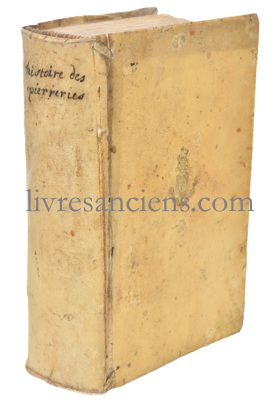
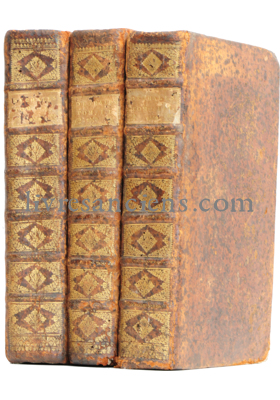
Photo GALOIS, Évariste. 

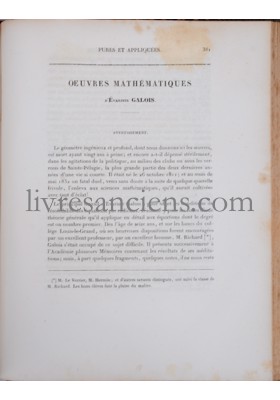
First edition of collected mathematical works of Evariste Galois given by Liouville in this volume of the Journal de Mathématiques pures et appliquées .

A brilliant mathematician, misunderstood in his day and with a tragic fate (he died at the age of 20 in a gallant duel), Galois created the notion of group, and his work has inspired generations of mathematicians.
A brilliant student, he was misunderstood by his contemporaries. Poisson rejected the work he wanted to present to the Paris Academy of Sciences.
In 1832, on the eve of his fatal duel, Galois wrote his mathematical will, which he entrusted to a friend.
It was not until 1846 that Liouville published them in this volume of the Journal des mathématiques, and not until 1870 that Jordan recognized their importance.

"When, yielding to the wish of Evariste's friends, I gave myself up, as it were under the eyes of his brother, to the attentive study of all the printed or manuscript pieces he left behind, I therefore thought I had to propose as my sole aim to seek out, to unravel, to then bring out as best I could, what was new in these productions.

My zeal was soon rewarded, and I was delighted when, after filling in a few small gaps, I recognized the complete accuracy of the method by which Galois proves, in particular, this beautiful theorem: For an irreducible equation of prime degree to be solvable by radicals, it is necessary and sufficient that all the roots be rational functions of any two of them.
This method, truly worthy of the attention of geometers, would alone suffice to secure our compatriot a place among the small number of scientists who have earned the title of inventor." (Liouville p.382).

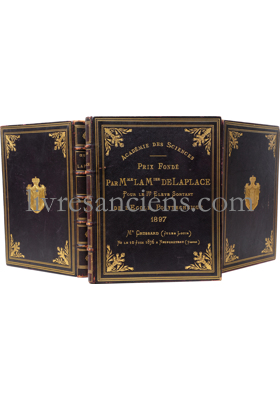
Photo CHEVREUL, Michel Eugène. 

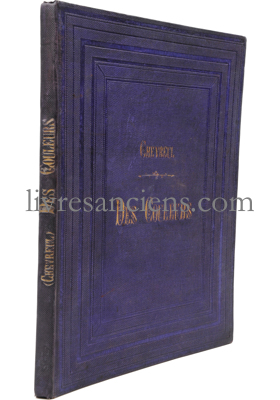
First edition of the rarest of Chevreul's publications on color.

Michel-Eugène Chevreul (1786-1889) is known to chemists for his research on fatty acids, saponification, and the discovery of stearin, but it is as a color theorist that his name will go down in history. Chevreul was appointed director of the Manufacture des Gobelins in 1824. Responsible for overseeing the production of dyes, he supported the work of dyers with his research on color perception. Thus, in 1839, he proposed a scientific approach to color complementarity and subsequently developed "color circles." A true "Pantone" color chart, a hundred years ahead of its time, Chevreul's color circles had the dual benefit of systematizing the production of hues (each with its own name) and making it easier to understand the concept of color complementarity. Thus, complementary colors are found on the same diameter of the color wheel, Red No. 2 corresponds to Green No. 2. "I believe I can affirm that it is possible to subject colors to a reasoned nomenclature, by relating them to types classified according to a simple method, accessible to the intelligence of all those who deal with colors" (extract from the preface). The standardization of color production was to interest first and foremost the industry then in full development, but it is undoubtedly in the Impressionist movement that Chevreul's theories found their finest accomplishment. Very early on, painters were inspired by Chevreul's work in their paintings, starting with Delacroix and then Monet. We will thus remember the fields of poppies dear to the Impressionists (Van Gogh, Monet, Pissaro...) where the red dots of the flowers burst out on complementary green backgrounds. The 27 spectacular plates were printed by René-Henri Digeon using chromochalcography, the process and difficulties of which are discussed in a paragraph in the book. Digeon appears to have presented a first edition of these plates at the 1855 World's Fair, for which he received a patent from the Empress. Several of the plates in our copy appear to be from this first edition and contain errors that have been corrected in other later copies that we have been able to consult.

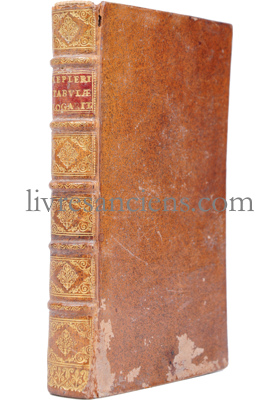
Photo KEPLER, Johannes || BARTSCH, Jakob. 
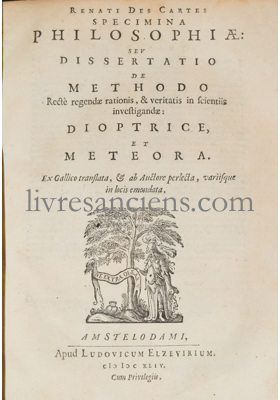
Photo DESCARTES, René. 

First edition.
Very rare copy with title page in unlisted condition in the name of Jacques Le Gras.

Descartes wrote this treatise in 1632 and 1633. He defended in particular the heliocentric system of Copernicus, but following Galileo's condemnation, he gave up publishing this work during his lifetime. It will not be finally published, according to his will, until after his death. At the end of 1663, the Le Gras and Clerselier family will dispute the privilege of publishing the posthumous works of Descartes. For the "World" it is Jacques Le Gras who will be the first to deposit the privilege. (cf. CARTESIAN BULLETIN V. (1976). Archives de Philosophie, 39 (3), 445–494) Jacques Le Gras, the holder of the privilege, then shared it with Thomas Girard (his brother-in-law) and Michel Bobin.

Our title page is unknown to Tchermerzine and Guibert as well as to Mathias Van Otegem who in his bibliography of the works of Descartes published in 2002, after consulting the copies in public libraries, describes only four states of the title page of this edition.
Our copy therefore presents a fifth state of the still unpublished title page.
Our title page has the same typographical mark as the Thomas Girad state (6 fleurons) canonically considered to adorn the true first edition. In addition, like the copy "Thomas Girad" from the Munich library (BSB: Rar. 4594) our title page is margined shorter than the rest of the book body and printed with the same characters, which suggests an impression at the same time.
The copies having a recomposed title page with a typographical mark "à l'oiseau" only coming, according to bibliographers, in a second step.

"In Le Monde, Descartes wants to ruin the concepts of scholasticism, and 'evacuate' Aristotle's physics, by giving a physical interpretation of the new heliocentric astronomy. As opposed to traditional finalism, he envisions, in the form of a "Fable", the mechanical formation of the cosmos, from an initial state of chaos (pieces of matter of various shapes and sizes agitated by all-out movements) and only by virtue of the general laws of nature: principle of inertia, laws of the communication of movement, etc ... "Robert Maggiori, Liberation, 26.

Results (1 - 30) of 795
TilesList
52 rue des Ecoles   75005 Paris
tel. +33 (0)1 43 54 22 23
European VAT number: FR87515091171
© Eric Zink, Antiquarian Bookseller