
Categories

Manuscripts

Results (1 - 30) of 70
TilesList
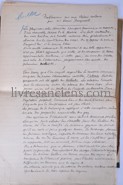
Photo [MANUSCRIT] MAHOT, Maurice. 

Original manuscript of an unpublished botanical treatise by a learned scholar from Nantes.
It presents botanical concepts as well as the classifications of Linnaeus and Tournefort. This manuscript, nearly 200 pages long, is written on the verso of the plates from Buc'hoz’s Flore Lorraine.
All plates are also annotated with details on plant names, their classification according to Linnaeus and Tournefort, and their medicinal uses—together forming a true pharmacopoeia.
These 187 plates were intended to illustrate Buc'hoz’s Traité historique des plantes qui croissent dans la Lorraine et les Trois-Évêchés, published in ten octavo volumes between 1762 and 1770. The plates, originally issued separately in installments and designed to be folded and bound in octavo, are gathered here in a single folio volume.
Buc'hoz, known for the beauty of his plates, had solicited financial support from fellow countrymen and botany enthusiasts for the production of these engravings. Thus, at the bottom of almost every plate, one finds the coat of arms and name of the sponsor who funded it.
Maurice Mahot, the author of this manuscript, sponsored plate 152.
While biographical information on Maurice Mahot “the elder” (1745–1810), a royal counselor, civil and criminal judge at the présidial, alderman (1777), and deputy mayor of Nantes (1779), offers little indication of an interest in natural sciences and botany, the same cannot be said of his son, Maurice Mahot “the younger” (1774–1842), a doctor of medicine and scholar who published several books on medicine and lexicography.
The annotations by the son—a physician—on the plates funded by the father—a botany enthusiast—explain the numerous pharmaceutical and medical recipes found in the work.
Another collector has left his name on the title page: Silas Boucher de la Ville Jossy, a member of a prominent Nantes family in the mid-19th century.
A fascinating manuscript, still largely unexplored, of exceptional character, both for the beauty of its annotated plates and for its content, which intertwines botanical classification and pharmacopoeia.

Photo [MANUSCRIT]. 

Very rare manuscript of spiritualist session reports.
The spiritualist wave arrived in France in 1854, and spread to all walks of life. We will remember, for example, the famous sessions of Victor Hugo in Guernsey...
In the following decades, all bourgeois families tried to turn the tables or dance. Methods of spiritualist contact are becoming more refined, we are seeing automatic writing methods appear in the presence or absence of a medium.

Very few of the sessions from this period have left written traces; the manuscript we present is the transcription of automatic writing sessions that took place between October 1866 and March 1867 in the Moret family. The first sessions took place in the presence of the medium Ms. Parain then in Bordeaux with the help of Ms. Benoit. Mrs. X. (unidentified) first contacted her grandfather Louis Pierre Moret. This is also why she transcribed the content of her communications in this notebook which belonged to her grandfather. The first communications are short, but little by little the mind gains confidence and the communications are longer. It was then his mother Marie Louise Moulins who “took up” the pen, then his father Moret. It is also amusing to note that the signatures of the spirits gradually become different.

The spirits advise their descendants to pray for them, to be charitable and above all to spread the ideas of spiritualism! We know that her husband tried a session but seems very skeptical...In a communication one of the spirits evokes the Other world which is organized into planets hierarchized according to the degree of wisdom, the summit seems to be the planet Juno .

70-page manuscript, quite fascinating to read!

The book is continued by another hand (probably at the beginning of the 20th century) who used it to note famous quotes and thoughts (out of 114 pages, around twenty leaves were cut from this part) then 250 blank pages remain.

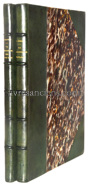
Photo BOUTMY, Emile || RIBOT, Alexandre. 
Photo [MANUSCRIT]. 

Handwritten botany course focusing on "common plants", plants that can be used in medicine.
This course lists 486 plants, each with its Latin binomial name and its therapeutic use.
The plants seem to follow an order whose logic is not explained in the short introduction: "The large number of plants that I will have the honor of discussing with you during the short time that this course will last does not allow me to stop here for a long preface where I could explain to you in general how these same plants act, whether they are considered purgatives or simply as alteratives, [...] I propose to follow the order that we will follow in the demonstrations so that at the same time as you learn to know these same plants, you enter into the knowledge of their virtues."
The Latin names refer to the catalogues of Bauhin (C.B.) and Tournefort (inst. r. h.) which suggests that this course was dictated before the penetration of Linnaeus' classification in France, i.e. before the 1760s.
The structure of this course differs from the known courses on "Usual Plants", as dictated by Chomel and Jussieu.

We find, bound below, a manuscript by the same hand:
"Observations on bone diseases explained and demonstrated by Mr Arnaud In the amphitheater of the Jardin du Roy on June 13, 1714" 42 pages.

This suggests that both courses were taken at the Jardin du Roi or Royal Garden of Medicinal Plants (the future Museum of Natural History from 1793), which at the beginning of the 18th century was a major center for teaching medicine and surgery. It is known that at that time both Antoine Jussieu and Sébastien Vaillant were teaching botany there.

Photo [SCIENCES]. 

Interesting set of working documents of a Scienfitic Society from Marseille in the 18th century.
At the beginning of the eighteenth century two projects of a foundation of a Marseille Academy clashed, the first wanted to devote himself solely to Sciences, the second on the model of the French Academy, wanted to focus on Letters. It is the second project supported by the governor of Provence which won the support of Louis XV and the Academy of Belles-Lettres de Marseille was founded in 1726. It was only in a second time, in 1766, that it will open up to Sciences and the Arts.
We imagine the dismay of Marseilles scientists during the interval, and it is probably this frustration which is at the origin of the creation of the Société des Sciences de Marseille of which we present some documents here.
Lot consisting of 6 pieces:
- 3 transcripts of speeches, one of which addresses the question of the rules of the "Academy" which excluded the religious. It offers openness to abbots and monks, those with interest libraries, but seeking a solution that avoids animosities between the different orders.
- Speech by the perpetual secretary summarizing the work of the Academy during the period 1739-1740.
- Work report: Geometry of Mr Gérard, Mechanics of Mr De Pontis.
- Bundle of 10 tickets, "Tasks of the Academicians for 1741": Each academician offers on a small autograph ticket signed the scientific work they undertake to address during the year 1741. We find the names of Ganteaume, De Pontis , Pelissery, Gérard, Saint-Jacques, Roussin.

Results (1 - 30) of 70
TilesList
52 rue des Ecoles   75005 Paris
tel. +33 (0)1 43 54 22 23
European VAT number: FR87515091171
© Eric Zink, Antiquarian Bookseller