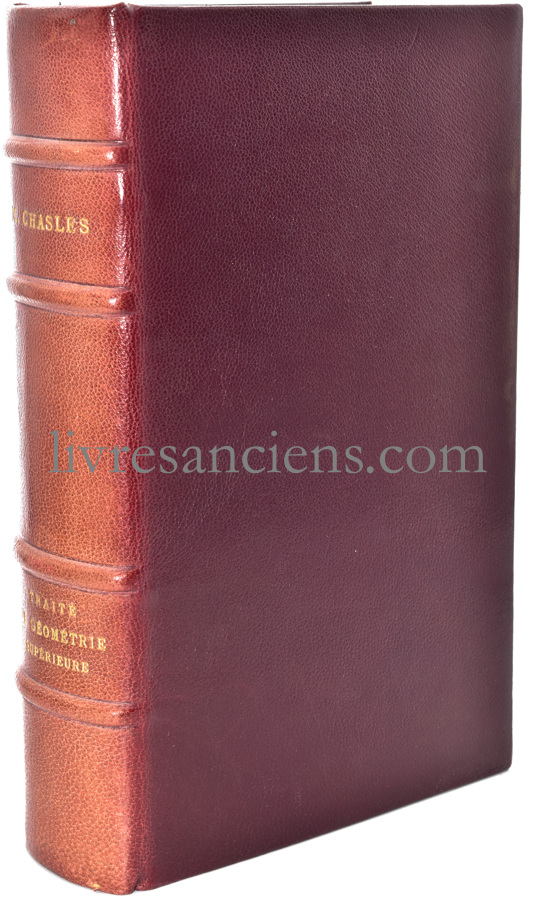



CHASLES, Traité de géométrie supérieure, 1852
CHASLES, Michel.
Traité de géométrie supérieure.
Paris, Bachelier, 1852.
8vo (225x132 mm), (4)-lxxxiii-603 pages and 12 folding plates. binding : Modern full chagreen, spine in five compartments. Original wrappers have been bound in. Spine faded.
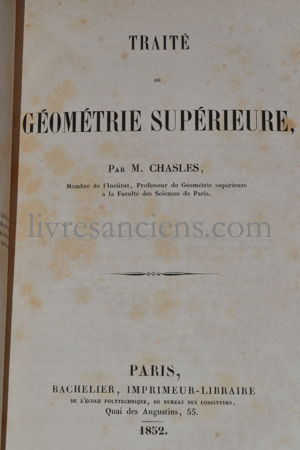
First edition.
Major book of the famous mathematician Chasles.
references: Smith [in. History, Vol. 1, p. 498 : "his treatise on higher geometry...[which] gave him a world-wide reputation"], DSB [III, pp. 212-4 : "In 1846 a chair of higher geometry was created for Chasles at the Sorbonne and he remained there until his death... He published highly original work... His work was marked by its unity of purpose and method. The purpose was to show not only that geometry, by which he meant synthetic geometry, had methods as powerful and fertile for the discovery and demonstration of mathematical truths as those of algebraic analysis, but that these methods had an important advantage, in that they showed more clearly the origin and connections of these truths. The methods were those introduced by L. Carnot, G. Monge and V. Poncelet and included a systematic use of sensed magnitudes, imaginary elements, the principle of duality and transformations of figures... Chasles wrote two textbooks for his course at the Sorbonne. The first of these, the Traité de géométrie supérieure is based on the elementary theories of the cross ratio, homographic ranges and pencils and involution... In the case of the cross ratio, which Chasles called the anharmonic ratio, he was anticipated by A. Moebius. However, it was Chasles who developed the theory and showed that the use of sensed magnitudes and imaginary elements gives to geometry the freedom and power of analysis"].
Price : 220 €