
Newsletter
About
New arrivals
Sell your books
Cart
Contact us
Blog
Categories
Categories
Science
Astronomy
Chemistry
Mathematics
Physics
Natural History
Engineering
History of science
Medicine
Medicine
Pharmacy
Occult
Astrology
Alchemy
Occult
Social Sciences
Economy
History
Philosophy
Law
Theology
Arts & Architecture
Art & Artist's Books
Architecture
Litterature
Miscellany
Manuscripts
Fine bindings
Early printings
FREE SHIPPING WORLWIDE
WE ACCEPT
Philosophy
Results (1 - 30) of
73
1
2
3
>
New
Price ↓
Price ↑
Author A-Z
Author Z-A
Title A-Z
Title Z-A
Date ↑
Date ↓
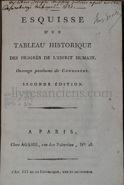
CONDORCET, Jean Antoine Nicolas de Caritat, marquis de.
Esquisse d'un tableau historique des progrès de l'esprit humain.
Paris, Agasse, An III [1795].
More Details >
375 €
Second edition.
Reprint of the original edition published the same year, with a new title page. Condorcet's work marks the birth of the idea of Progress, which would become the credo of the 19th century.
AMPÈRE, André-Marie.
Essai sur la Philosophie des Sciences, ou Exposition analytique d'une classification naturelle de toutes les connaissances humaines.
Paris, Bachelier, 1834.
More Details >
200 €
First edition.
André-Marie Ampère (1775-1836) was a French mathematician, physicist, and chemist, considered one of the founders of electromagnetism. A member of the Royal Academy of Sciences and a professor at the Collège de France and the École Polytechnique, he is famous for Ampère's law and the unit of electric current that bears his name. Beyond his scientific contributions, Ampère was also interested in the classification of sciences, as this Essay demonstrates.
THÉON DE SMYRNE.
Exposition des connaissances mathématiques utiles pour la lecture de Platon.
Paris, Impression anastaltique culture et civilisation, 1892 [1966].
More Details >
60 €
Reprint from 1892 edition.
BACHELARD, Gaston.
Le Nouvel Esprit Scientifique.
Paris, Librairie Félix Alcan, 1934.
More Details >
50 €
First edition.
BRUNSCHVICG, Léon.
Le Progrès de la conscience dans la philosophie occidentale.
Paris, Félix Alcan, 1927.
More Details >
50 €
First edition.
Léon Brunschvicg (1869-1944) was a French philosopher, a member of the Institut, and a professor at the Sorbonne. He is a major figure in French idealism and worked on the philosophy of science and psychology. This work offers a history of Western philosophy from the perspective of the development of consciousness, from antiquity to his own time.
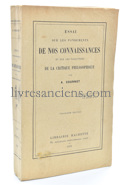
COURNOT, Antoine Augustin.
Essai sur les fondements de nos connaissances et sur les caracteres de la critique philosophique.
Paris, Hachette, 1922.
More Details >
50 €
Third edition.
The work is an exploration of the philosophy of science, addressing the theory of knowledge, causality, and the role of philosophical critique. The author, Antoine Augustin Cournot, was a mathematician, economist, and philosopher. His work influenced the development of epistemology and the philosophy of probability in the 19th century.
JAMES, William.
Le Pragmatisme.
Paris, Ernest Flammarion, 1911.
More Details >
40 €
First edition in french.
William James (1842-1910) was an influential American philosopher and psychologist, co-founder of pragmatism. A member of the Institut de France and a professor at Harvard, he is considered one of the most important thinkers of the 19th century. "Pragmatism" is one of his most famous works, synthesizing his lectures given in 1906-1907. In it, he develops the idea that the truth of an idea must be judged by its practical consequences and utility. This French edition, translated by E. Le Brun and enriched with an introduction by Henri Bergson (1859-1941), a Nobel Prize-winning French philosopher and member of the Institut, is particularly notable. Bergson's presence underscores the importance and resonance of James's pragmatism in the French philosophical context of the early 20th century.
OSTWALD, Wilhelm.
Esquisse d'une Philosophie des Sciences.
Paris, Librairie Félix Alcan, 1911.
More Details >
Sold
First edition in french.
Wilhelm Ostwald (1853-1932) was a German chemist and philosopher, winner of the Nobel Prize in Chemistry in 1909 for his work on catalysis and the study of chemical equilibria and reaction rates. He was one of the major figures in physical chemistry and a fervent defender of energism, a theory that reduced all phenomena to energy transformations. As a professor at the University of Leipzig, he exerted considerable influence. This work, "Outline of a Philosophy of Science," translated from German by M. Dorolle (Associate Professor of Philosophy), demonstrates his interest in the epistemological foundations of science. In it, he sets out his vision of science, its method, and its philosophical scope, marking an important current of thought at the beginning of the 20th century, a period of profound scientific and philosophical upheaval.
TANNERY, Jules.
Science et Philosophie.
Paris, Librairie Félix Alcan, 1912.
More Details >
35 €
Jules Tannery (1848-1910) was a French mathematician and philosopher, professor at the Sorbonne and deputy director of the École Normale Supérieure. Brother of the philosopher of science Paul Tannery, Jules was an influential educator, having trained many important mathematicians. This work, "Science and Philosophy," is a compilation of his posthumous writings, with an introductory note written by Émile Borel (1871-1956), one of his illustrious students and himself an eminent mathematician.
SECCHI, P. Angelo.
L'Unité des forces physiques. Essai de philosophie naturelle.
Paris, F. Savy, 1874.
More Details >
35 €
Father Angelo Secchi (1818-1877) was an Italian Jesuit, director of the Rome Observatory, and a renowned astronomer and physicist, corresponding member of the Institute of France. His work L'Unité des forces physiques (The Unity of Physical Forces) is an essay on natural philosophy that explores the concept of unity and interconnectedness of the various forces known in physics at his time. Secchi, a pioneer in stellar spectroscopy, sought to establish a unified vision of the physical world, a central theme in 19th-century science. This second, revised and considerably augmented edition, published based on Dr. Deleschamps' Italian translation, demonstrates the interest in his ideas in France.
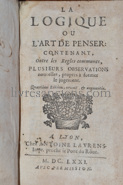
ARNAULD, Antoine || NICOLE, Pierre.
La logique ou l'art de penser, contenant, outre les règles communes, plusieurs observations nouvelles, propres à former le jugement.
Paris, Antoine Laurens, 1671.
More Details >
90 €
LOCKE, John.
Essai philosophique concernant l'entendement humain, où l'on montre quelle est l'étendue de nos connoissances certaines, et la manière dont nous y parvenons.
Paris, Bossange, An VII [1798].
More Details >
Sold
John Locke's (1632-1704) An Essay Concerning Human Understanding is a foundational work of empiricism and Enlightenment philosophy. First published in 1689, it explores the origin, certainty, and extent of human knowledge, rejecting the idea of innate ideas and asserting that all knowledge derives from sensory experience and reflection. This French edition from "An VII" (1798-1799), translated by Pierre Coste, is particularly notable as it incorporates posthumous additions by Locke and the translator's remarks, thereby enriching the original work and demonstrating its continued influence on French thought.
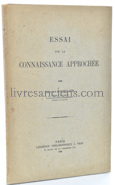
BACHELARD, Gaston.
Essai sur la connaissance approchée.
Paris, J. Vrin, 1927.
More Details >
Sold
First edition.
Gaston Bachelard (1884-1962), agrégé in philosophy and doctor of letters, was one of the greatest French philosophers of the 20th century, specializing in epistemology and the history of science. His Essai sur la connaissance approchée (Essay on Approximated Knowledge) is one of his first major works, in which he develops the notion that scientific knowledge is never absolute, but always relative and "approximated." He examines concepts from contemporary science (relativity, quantum mechanics) and defends a philosophy of the "no" that shows how new knowledge is built by breaking with previous knowledge. This book is a landmark of French epistemology.
MACH, Ernst.
La Connaissance et l'Erreur.
Paris, Ernest Flammarion, 1908.
More Details >
Sold
First french edition.
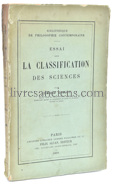
GOBLOT, Edmond.
Essai sur la Classification des Sciences.
Paris, Librairie Germer Baillière, 1898.
More Details >
30 €
First edition.
Edmond Goblot (1858-1935), ancien élève de l'École Normale Supérieure et agrégé de philosophie, était un philosophe et logicien français. Son Essai sur la Classification des Sciences est une contribution importante à l'épistémologie, le domaine qui étudie la connaissance scientifique. Goblot y propose un système de classification des sciences basé sur leurs méthodes et leur objet. L'ouvrage s'inscrit dans la lignée des travaux de l'épistémologie française de la fin du XIXe siècle et a influencé les réflexions sur la structure des connaissances et la méthodologie scientifique.
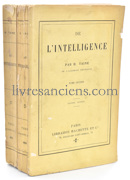
TAINE, Hippolyte.
De l'Intelligence.
Paris, Hachette, 1903.
More Details >
20 €
Hippolyte Taine (1828-1893), a member of the French Academy, was a French historian, philosopher, and critic whose work had a major influence on naturalism and positivism. His work De l'Intelligence (On Intelligence) is a treatise on psychology and philosophy that explores the nature of human cognitive faculties. Taine applies a scientific and deterministic method to the study of the mind, analyzing the mechanisms of perception, memory, and ideas.
This book was a fundamental text for nascent psychology and the philosophy of science in France in the late 19th century.
GUIBELET, Jourdain.
Examen de l'examen des esprits.
Paris, Veuve Jean de Heuqueville et Louis de Heuqueville, 1631.
More Details >
800 €
First edition.
Critical work of the Examen de ingenios para las sciencias by Juan Huarte de San Juan, which had been, in 1575, the first modern treatise to study the relationship between psychology and physiology.
Guibelet offers an in-depth analysis and a refutation of some of Huarte's theses, thus entering into the intellectual debates of the time on the nature of intelligence and human aptitudes. This text constitutes a valuable contribution to the history of ideas and to the study of the reception of psychological and medical theories at the dawn of the 17th century.
Title page in the name of the Heuquevilles with whom Soly (who appears on the privilege) shared the edition.
HUARTE, Jean.
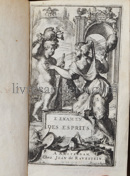
L'Examen des Esprits pour les Sciences.
Amsterdam, Jean de Ravestein / Pierre Mortier [Daniel Elzevier], 1672.
More Details >
400 €
First edition of the French translation by François Savinien d'Alquié.
Beautiful Elzevirian edition decorated with a frontispiece by Romeyn de Hooghe.
On our copy, a butterfly replaces the name of the publisher with that of Pierre Mortier with the date of 1704.
Fresh copy.
[FONTENAY, (Abbé)].
Antilogies et Fragmens Philosophiques, ou Collection méthodique des morceaux les plus curieux & les plus intéressans sur la Religion, la Philosophie, les Sciences & les Arts, extraits des écrits de la Philosophie moderne.
Paris, Vincent, 1774-1775.
More Details >
800 €
First edition.
Louis Abel de Bonafous, a Jesuit priest, became a writer when his order was banned in 1773, under the name of Abbé Fontenay.
The Antilogies are a collection of contradictory arguments, often used to demonstrate paradoxes or to question certain dogmatic assertions. This work is typical of the way in which certain authors of the 18th century, particularly during the Enlightenment, questioned established truths and rigid systems of thought.
The Antilogies had a certain influence in the philosophical circles of its time, because of its innovative approach to logic and theology.
[BOYER D'ARGENS, Jean-Baptiste (de)].
Lettres chinoises, ou Correspondance philosophique, historique et critique, entre un Chinois voyageur à Paris & ses correspondans à la Chine, en Moscovie, en Perse et au Japon.
La Haye, Pierre Paupie, 1755.
More Details >
550 €
New edition.
Epistolary fiction told in the form of letters exchanged between a Chinese, Hoang, and a European. It is a social and philosophical critique that highlights the absurdities of European society through the eyes of a foreign character, a process often used by the Enlightenment to offer an external perspective on the customs and beliefs of the time. The last volume contains the author's philosophical dreams in which he develops several political utopias.
[MANUSCRIT].
Metaphysica.
s.l., s.n., 1775.
More Details >
200 €
Original manuscript.
Course in metaphysics and ontology with a long section on theodicy.
D'AQUIN, Thomas.
Summa de veritate celeberrimi doctoris sancte Thome Aquinatis.
Cologne, Quentell, 1508.
More Details >
2500 €
Post-incunable edition.
The most famous work of St Thomas Aquinas, which brings together 29 questions on the truth, and 253 articles of answers.
These disputed issues correspond to the first disputes led by Thomas Aquinas as master of theology at the University of Paris during the academic year 1256–1257, when Thomas Aquinas was a young professor.
In the first question, Thomas Aquinas defined truth as "the adequacy of the thing and the intellect.".
GAMA MACHADO, José Joaquim da.
Théorie des ressemblances ou essai philosophique sur les moyens de déterminer les dispositions physiques et morales des animaux.
Paris, H. Fournier et Cie, 1844.
More Details >
600 €
First edition.
Third part alone of the four parts that appeared over a period of almost thirty years. The first part appeared in 1831, the last in 1858. The subject, on the border between natural history and philosophy, consists in applying a rigorous analogy between animal forms and human psychology. In the tradition of Lavater, Gall and the physiognomists, the physical configuration of the organ is revealing of personal dispositions. Da Gama Machado was a commander and gentleman of the Royal House of the King of Portugal; he lived surrounded by his birds, which he cherished.
Presentation copy to Achille Comte (1802-1866).
MALEBRANCHE, Nicolas.
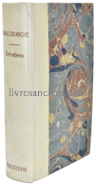
Entretiens sur la Metaphysique & sur la Religion.
Rotterdam, Reiner Leers, 1688.
More Details >
300 €
First edition.
The Entretiens sur la métaphysique et sur la religion are the most accomplished of all Malebranche's works. A true literary work, demonstrating a magnificent mastery of the art of dialogue, these fourteen conversations are a model of pedagogy.
BOUILLIER, Francisque.
Histoire et critique de la révolution cartésienne.
Lyon, Boitel, 1842.
More Details >
150 €
First edition.
Francisque Bouillier (1813-1899) was a French philosopher known above all for his studies on Cartesianism.
[BLANCHET, Jean].
L'Homme éclairé par ses besoins.
Paris, Durand, 1764.
More Details >
150 €
First edition.
The work of a philosopher who was won over to the ideas of the Lumières, Blanchet is resolutely modern: the 18th century is marked by the reign of science and the arts, and the passions of modern man are the subject of vibrant praise, including self-esteem, because it is they which allow the realization of the great projects of humanity, which a Diderot would not deny.
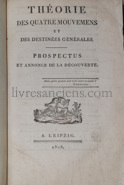
FOURIER, Charles.
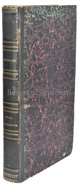
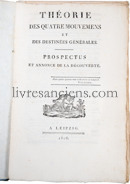
Théorie des Quatre Mouvemens et des Destinées Générales. Prospectus et Annonce de la Découverte.
Leipzig [Lyon], [Pelzin], 1808.
More Details >
3500 €
First edition.
Founding work of Fourierism.
It is in this book that Charles Fourier sets out for the first time his theories on the organization of human societies. Discoveries, which, according to him, is on a par with Newton's theory of gravitation. Fourier defines four phases of universal history (ascending chaos, ascending plenitude, descending plenitude, descending chaos), each phase subdivided into a multitude of times. Humanity is currently going through the fifth time of the first phase: Civilization. The revelation to humanity of "passionate attraction" will bring about Harmony, a phase of bliss in which Fourier's Utopia is realized.
When it was published, no one understood anything about this work, riddled with neologisms, divisions and subdivisions, extravagant considerations... the press passed over the book in silence and Fourier, annoyed that he was not recognized as a Genius, would not publish again for fourteen years.
Rare untouched copy.
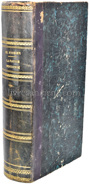
FOURIER, Charles.
La Fausse industrie morcelée, répugnante, mensongère, et l'antidote, l'industrie naturelle, combinée, attrayante, véridique, donnant quadruple produit.
Paris, Bossange, 1835-1836.
More Details >
1500 €
First edition.
The last and most enigmatic of Charles Fourier's books.
Fourierist exegetes see the beginnings of a planetary ecology, Fourier inventing a practical ecosophy source of wealth and abundance.
Like pagination, the speech is often disjointed, linking demonstrations and free discussions moving from one subject to another.
Copy which was bound for François Barrier, central personality of the Fourierist movement, he adhered to the Fourierist doctrine in 1843. He was, in 1845, one of the founders of the Phalansterian project of the African Agricultural Union and became the main leader and financial support from the Lyon School of Society in the 1850s. He created a “Fourierist” bank which notably financed the Texas phalanstery. In 1864, he left Lyon and his career as a surgeon to go to Paris to reorganize the School of Society and devote himself to writing Fourierist treatises.
VIGOUREUX, Clarisse.
Parole de Providence.
Paris, Bossange, Novembre 1834.
More Details >
3500 €
Scarce first edition of the only work by the first female disciple of Charles Fourier.
Clarisse Vigoureux (1789-1865), born Charlotte-Dorothée-Claire Gauthier, was a fervent follower of Fourier's theories: it was she who introduced Victor Considerant to Fourierism (the latter married his daughter Julie).
She put her personal fortune at the service of the Fourierist cause by financing Phalanges (the journal of Charles Fourier) and later the exile of Considerant and then their attempt to found the Réunion phalanstery in Texas. Ruined, she will end her life alone in San Antonio.
François Barrier, central personality of the Fourierist movement, he adhered to the Fourierist doctrine in 1843. He was, in 1845, one of the founders of the African Agricultural Union and became the main leader and financial supporter from the Lyon Corporate School in the 1860s.
His work responded to the Words of a Believer, published in April 1834 by Lamennais, in which he promoted violence in the service of the class struggle. Clarisse Vigoureux, deeply pacifist and feminist, will answer him:
"What is this war cry and this reverberation which has been heard on all sides? [...] I ask the stronger sex who knows how to dethrone their kings, and who, calling himself a king, does not know how to hold the reins of the world" (excerpt from the preface)
This book will be condemned by the Roman Church and put in the Index catalog on September 22, 1836.
On the false title we see. finds the following mention written in pencil : "Given by Miss Beuque to Mr Barrier. (April 1845). Aimée Beuque (1788-1871) met Charles Fourier at Clarisse Vigoureux in 1828 and immediately adhered to his ideas, she will lead the Fourierist circles of Lyon. François Barrier, professor of medicine at the Faculty of Lyon, adhered to the Fourierist doctrine in 1844.
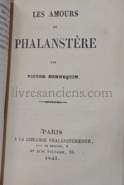
HENNEQUIN, Victor.
Les Amours au phalanstère.
Paris, A la librairie phalanstérienne, 1847.
More Details >
800 €
First edition.
Exposition of Fourier's ideas and theories dealing with love and the regulation and organization of relations between the sexes in the Phalanstery. Each being in one of the roles defined by Fourier: the chaste Vestals, the Damsels, the Angels and the Fairies (experts in love), ... Hennequin with Fourier considers that adultery and prostitution are invariants of human societies and must therefore be organized.
Hennequin's work is bound in the penultimate position with four other Fourierist brochures:
GUEPIN. Traité d'économie sociale. Paris, sn, 1835. 108 pages.
- [Anonymous]. Catéchisme de Fourier ou Fourier réfuté par lui-même. Paris, Maison, 1841. (8)-98-(2) pages.
- Le Sept Avril. Banquets commémoratifs de la naissance de Charles Fourier - Années 1843 et 1844. Paris, À la librairie sociétaire, 1844. 36 pages.
- PELISSIER. Choix de Poésies d'un Sourd-Muet. Paris, Rue St-Jacques, sd. 72 pages.
Results (1 - 30) of
73
1
2
3
>
New
Price ↓
Price ↑
Author A-Z
Author Z-A
Title A-Z
Title Z-A
Date ↑
Date ↓
About
Sell your books
Contact
Newsletter
Blog
52 rue des Ecoles 75005 Paris
tel. +33 (0)1 43 54 22 23
contact@livresanciens.com
Terms and conditions
European VAT number: FR87515091171
© Eric Zink, Antiquarian Bookseller